Bio-Rad Laboratories (BIO): Supplier relationships that shape instrument reach and recurring economics
Bio-Rad is a manufacturer of life‑science research and clinical diagnostics instruments that monetizes through hardware sales, consumables and service contracts, supplemented by licenses and royalty obligations tied to third‑party intellectual property. With roughly $2.58B revenue (TTM) and a market capitalization near $7.05B, Bio‑Rad’s commercial strategy hinges on embedding its instruments into partner workflows—creating ongoing consumable demand and recurring revenue streams for installed bases. For investors evaluating counterparty exposure, the structure and depth of those supplier/partner links determine both distribution upside and operational risk. Learn more about how these relationships are tracked and analyzed at Null Exposure.
Why partner and supplier linkages matter to valuation
Bio‑Rad’s go‑to‑market is not a simple one‑time hardware sale: value is captured across instrument, reagent and software lifecycles, and partnerships amplify that capture when third‑party platforms funnel customers into Bio‑Rad workflows. Multiple structural characteristics follow from that model:
- Contracting posture: The company reports holding licenses and paying royalties to third parties, which is a recurring contractual expense line that influences gross margins and product pricing flexibility. Company filings state, “We also hold licenses under U.S. and foreign patents owned by third parties and pay royalties on the sales of certain products under these licenses.”
- Concentration: OEM or workflow tie‑ins with platform leaders concentrate commercial exposure—winning integration with a market leader can substantially increase addressable spend, while losing that linkage is disruptive.
- Criticality: When Bio‑Rad instruments are embedded inside third‑party genomics or cytometry workflows (software, cloud services, or analytic suites), the supplier relationship becomes a de facto standardizer for downstream consumables and service revenues.
- Maturity: Many of these partnerships are long‑dated go‑to‑market deals, reflecting an industry where adoption curves are measured in years and installed‑base economics dominate near‑term growth.
These are company‑level signals: the licensing and royalty language in filings is an explicit corporate operating characteristic rather than a relationship‑specific footnote.
The specific relationships we see in public reporting
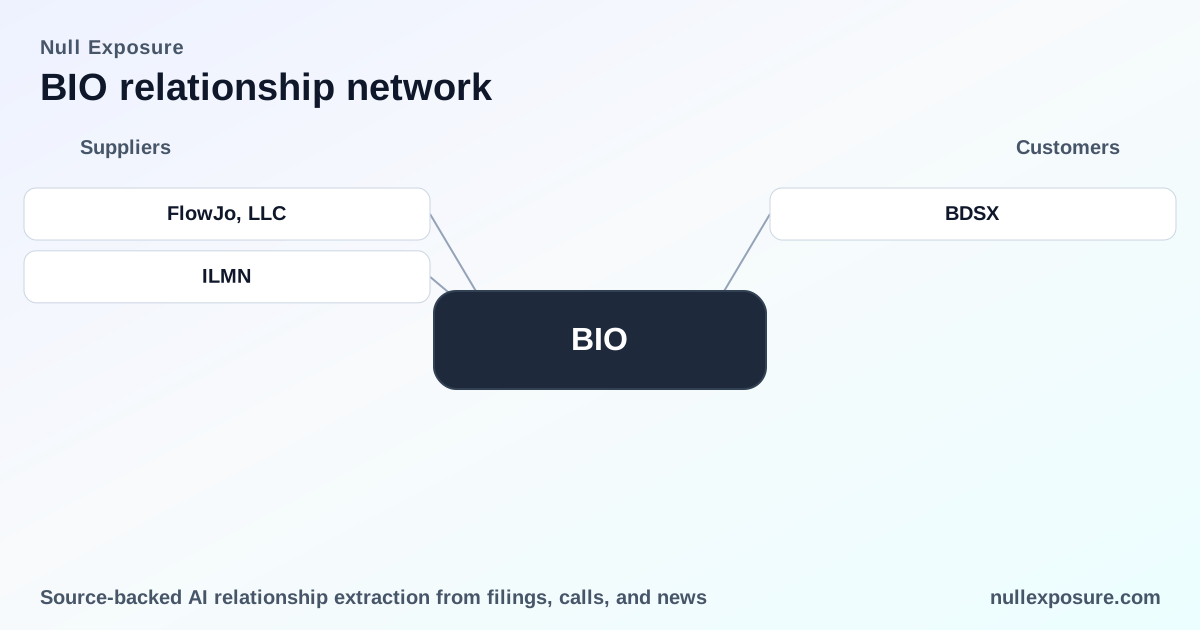
Below I cover every relationship returned in the supplier results and summarize what each link means for investors and operators.
Illumina, Inc. — integration into a dominant genomics platform
According to a News‑Medical report from January 2017, Illumina and Bio‑Rad announced a single‑cell genomics workflow linking Bio‑Rad hardware to Illumina’s BaseSpace® informatics suite; the partnership positions Bio‑Rad’s instruments to feed sequencing inputs and downstream analytics into Illumina’s cloud environment. (News‑Medical, Jan 12, 2017)
Source: News‑Medical article on the Illumina–Bio‑Rad single‑cell genomics launch, FY2017.
FlowJo, LLC — visualization and tertiary analysis tie‑in
The same January 2017 News‑Medical article notes that tertiary data analysis and visualization for the workflow was provided via SeqGeq™ from FlowJo, the market leader in flow cytometry analysis, effectively pairing Bio‑Rad instrumentation output with established analytical software to simplify customer adoption. (News‑Medical, Jan 12, 2017)
Source: News‑Medical article on the single‑cell genomics workflow and SeqGeq integration, FY2017.
What these relationships imply for commercial strategy and risk
The Illumina and FlowJo ties illustrate a deliberate approach: Bio‑Rad prioritizes embedment inside high‑value genomics and cytometry workflows, which both accelerates instrument adoption and locks in consumable sales. Operational implications for investors and operators:
- Revenue pull‑through: Integration with Illumina’s BaseSpace can increase consumable turnover and aftermarket service revenue because customers prefer vertically validated workflows. This is a durable commercial advantage when documentation, validations, and interoperability are completed.
- Dependency on partner platforms: That advantage is two‑edged—reliance on another firm's platform strategy concentrates commercial risk. If Illumina alters its preferred supplier list or internalizes components, Bio‑Rad faces an accelerated replacement cost to re‑establish access.
- Licensing cost pressure: Company filings confirm Bio‑Rad is a licensee under multiple patents and pays royalties on some product sales; that contractual reality constrains margin elasticity and can influence which product lines are profitable to pursue.
- Sales cadence and maturity: These are long‑cycle enterprise buys in research and clinical markets; wins take time but produce long tails of consumable demand once the installed base is established.
If you want a structured, transaction‑level view of how these partner links map to revenue concentration and margin sensitivity, start with a targeted supplier exposure assessment at Null Exposure.
How investors should quantify impact
For valuation and operational stress‑testing, translate partnership exposure into two measurable vectors:
- Percentage of instrument revenue attributable to integrated workflows (impact on gross margin and aftermarket revenue).
- Royalty and licensing expense as a percent of product gross profit (to model downside if royalty rates rise or if licensing shifts).
Be conservative in scenarios where a single platform partner drives incremental instrument placements; reward scenarios where embedment yields sticky consumable annuity streams. The company’s public filings and the 2017 Illumina/FlowJo announcement are primary evidence points for constructing those vectors.
Final read and action plan
Bio‑Rad’s commercial model is built on instrument placement plus recurring consumables, with partnerships like Illumina and FlowJo functioning as accelerants to adoption. Licensing obligations are an explicit corporate constraint that investors must fold into margin and scenario analyses. For investment or operational diligence, focus on installed‑base health, partner exclusivity terms, and the detailed royalty footprint in the filings.
For a deeper supplier‑level risk map and to convert these relationship signals into actionable exposure metrics, visit Null Exposure and run a focused supplier risk scan. If you are evaluating supplier counterparty concentration for due diligence or portfolio risk, begin your analysis at Null Exposure — it’s the fastest way to translate partner announcements into balance‑sheet impacts.