BioAge Labs (BIOA): The underwriting relationships that shape capital access and supply posture
BioAge Labs operates as a clinical-stage biopharma that funds development and operations by monetizing equity and public-market offerings while outsourcing most development and manufacturing functions to third parties. The company generates cash through capital markets activity rather than product sales today, and that financing posture drives the need for underwriters and broad institutional distribution. For investors evaluating supplier relationships, the financing syndicate and the company’s outsourced manufacturing model together define execution risk, counterparty concentration, and where operational continuity is most dependent on external partners. Learn more at https://nullexposure.com/.
Quick thesis for capital allocators
BioAge is a research-focused company that sells equity to fund R&D and scale-up while relying on CDMOs and CROs for manufacturing and trials; underwriting relationships are therefore a primary operational partner because they determine access to dilutive capital and market timing. The January 2026 public offering and its book-runners are the immediate supplier relationships of interest for investors assessing financing execution and downstream operational resilience.
Who the company engaged for its January 2026 offering
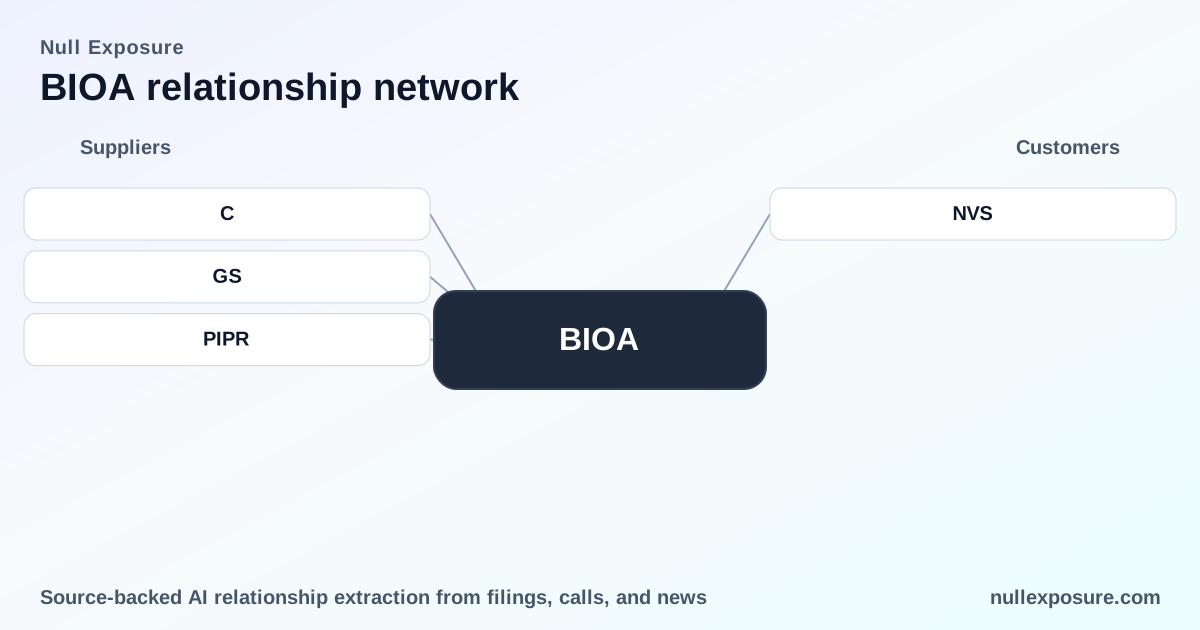
The public record shows BioAge selected a three‑firm syndicate to manage its January 2026 offering: Goldman Sachs, Piper Sandler, and Citigroup acted as joint book‑running managers for the proposed and subsequently priced upsized offering. These firms function as critical distribution and execution partners for equity raises that fund BioAge’s pipeline and outsourced manufacturing commitments. Source coverage is available in BioAge press releases in January 2026. For more supplier mapping and counterparty visibility go to https://nullexposure.com/.
Relationship breakdown (concise, source-backed)
Goldman Sachs & Co. LLC
Goldman Sachs served as a joint book‑running manager on BioAge’s proposed and upsized January 2026 public offering, providing capital markets execution and distribution to institutional clients. Goldman’s role directly affects BioAge’s ability to place shares and secure proceeds for operations. Source: BioAge press releases via GlobeNewswire (Jan 20 and Jan 22, 2026) — https://www.globenewswire.com/news-release/2026/01/20/3222237/0/en/BioAge-Announces-Proposed-Public-Offering.html and https://www.globenewswire.com/news-release/2026/01/22/3223360/0/en/BioAge-Announces-Pricing-of-Upsized-115-0-Million-Public-Offering.html.
Piper Sandler (Piper Sandler & Co.)
Piper Sandler acted as a joint book‑running manager alongside Goldman Sachs and Citigroup for the January 2026 offering, bringing mid‑market syndicate support and sell-side coverage that broadened the deal’s investor reach. Piper’s presence helps diversify distribution channels beyond the largest bulge‑bracket desks. Source: BioAge press releases via GlobeNewswire (Jan 20 and Jan 22, 2026) — https://www.globenewswire.com/news-release/2026/01/20/3222237/0/en/BioAge-Announces-Proposed-Public-Offering.html and https://www.globenewswire.com/news-release/2026/01/22/3223360/0/en/BioAge-Announces-Pricing-of-Upsized-115-0-Million-Public-Offering.html.
Citigroup / Citigroup Global Markets Inc.
Citigroup was named as a joint book‑running manager for the proposed and priced offering, contributing global distribution capacity that supports large block placements and cross‑border investor access. Citigroup’s participation expands liquidity pathways and institutional reach for BioAge’s equity issuance. Source: BioAge press releases via GlobeNewswire and secondary coverage (Jan 20 and Jan 22, 2026) — https://www.globenewswire.com/news-release/2026/01/20/3222237/0/en/BioAge-Announces-Proposed-Public-Offering.html and https://www.globenewswire.com/news-release/2026/01/22/3223360/0/en/BioAge-Announces-Pricing-of-Upsized-115-0-Million-Public-Offering.html.
What the supplier and constraint signals reveal about BioAge’s operating model
The relationship data and corporate disclosures produce several clear operating-model signals for investors:
-
Contracting posture — outsourced and managerial: BioAge does not operate its own manufacturing facilities and explicitly contracts with third‑party manufacturers and CDMOs, while overseeing those partners. That posture implies high reliance on external manufacturers for product supply and scale, and the company’s value depends on successful coordination with service providers rather than captive manufacturing capacity. (Company disclosures, 2025–2026.)
-
Geographic concentration — APAC manufacturing exposure: BioAge’s disclosures state it contracts third‑party manufacturers located in China, signaling supply chain exposure to APAC geopolitical and operational risks that can affect timelines and costs. This is a company-level signal; these China-based suppliers are not named in the press releases that covered the equity offering, but the geographic exposure is material for execution risk.
-
Relationship roles — manufacturer and service provider mix: The company uses CDMOs and CROs for development and manufacture and additional third‑party service providers for labs, enterprise platforms, and supply chain resources. Operational continuity depends on a network of specialist suppliers rather than integrated operations, which raises vendor management and quality oversight as critical capabilities.
-
Maturity and criticality: The supplier set is typical of a clinical-stage biotech: critical service providers are mature contract firms (CDMOs/CROs) but BioAge’s reliance on capital markets for funding elevates the importance of stable underwriting relationships. The underwriting syndicate thus functions as a non‑manufacturing supplier whose performance is critical to funding runway.
Implications for investors and operators
-
Liquidity and dilution are the proximate risks. Underwriters control timing and pricing of equity placements that fund third‑party manufacturing and trials; the January 2026 syndicate performance directly governed BioAge’s cash runway and ability to execute outsourced programs. Institutional investors should monitor subsequent underwriter-led follow‑on activity as an indicator of continued market access.
-
Operational risk is concentrated in external vendors located in China. That geographic exposure requires active mitigation: dual‑sourcing, contractual SLAs, and inventory buffers are the practical levers operators should prioritize. For allocators, a company with outsourced manufacturing and APAC concentration demands a premium for execution risk.
-
Counterparty diversification beyond the three book‑runners matters less for supply than for funding. The underwriting trio broadens investor reach; manufacturing resilience depends on the CDMO and CRO network. Governance that demonstrates strong vendor oversight is a positive signal.
If you want a deeper counterparty map and supplier-risk scorecard for BioAge, start here: https://nullexposure.com/.
Bottom line and next actions
BioAge monetizes via equity markets and runs a largely outsourced operational model; the January 2026 underwriters (Goldman Sachs, Piper Sandler, Citigroup) are essential capital-supply partners, while CDMOs and CROs—including contract manufacturers in China—carry execution risk. Investors should track follow‑on financing activity, underwriter allocations, and any disclosures about CDMO counterparties or changes in supplier geography.
For a tailored report on BioAge’s supplier exposure and underwriting counterparties, visit https://nullexposure.com/ and request a supplier risk brief.