Bioceres Crop Solutions (BIOX): Supplier relationships and what they signal for investors
Bioceres Crop Solutions monetizes agricultural innovation through seed and input commercialization, breeding asset management, and capital-market access as a public company. The firm generates top-line revenue from crop inputs and related services while selectively monetizing intellectual property and breeding assets; its public listing provides liquidity and access to capital to fund R&D and international expansion. For investors and counterparty managers, the combination of modest market capitalization, negative EPS, and active asset-level transactions defines BIOX as a commercially active but financially transitional supplier—one that can deliver operating income while still grappling with profitability and capital structure constraints. If you want a quick view of counterparties and corporate signals, start here: https://nullexposure.com/.
How Bioceres operates and how that influences supplier risk
Bioceres is a publicly traded agribusiness focused on seeds and crop inputs with roots in Argentina and a U.S. listing. The company reports TTM revenue of $318.2 million and gross profit of $125.4 million, but it posts a negative EPS of -$0.89 and a profit margin of -17.7%, indicating operating scale that has yet to translate into net profitability. Balance between commercial sales and strategic asset transactions is central to the operating model:
- Commercial revenue driver: seed sales and agricultural inputs deliver recurring revenue and gross margin.
- Asset-transaction driver: the company selectively transfers or sells breeding assets and IP to align capital needs and strategic geography.
- Capital-market driver: Nasdaq listing and public float underpin financing options and valuation discovery.
These elements create a contracting posture that is hybrid: commercial supplier relationships with embedded strategic asset transfers, moderate institutional ownership (~31.7%) and notable insider control (~25.5%) that influence negotiation dynamics and deal cadence.
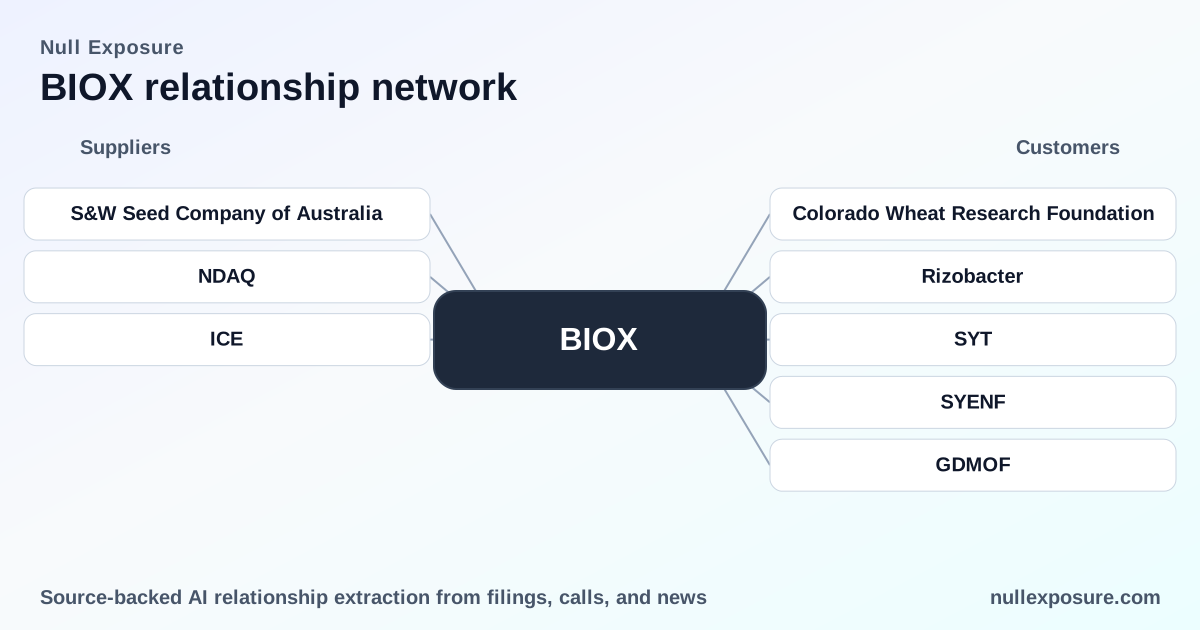
Relationship map — the counterparties flagged in public reporting
Below I cover each supplier relationship surfaced in the public record. Each entry is concise, investor-focused, and tied to the original reporting.
S&W Seed Company of Australia — breeding assets transfer reported (FY2022)
Bioceres was reported to be involved in discussions under which Trigall Australia would acquire the breeding assets of S&W Seed Company of Australia, reflecting BIOX activity in cross-border asset transfers and consolidation of breeding operations. This is consistent with the company’s practice of monetizing or reorganizing breeding IP to optimize geographic footprints and capital allocation. According to a Yahoo Finance report in March 2026, the discussions referenced Trigall Australia acquiring those assets. (Source: Yahoo Finance, March 9, 2026).
Nasdaq Global Select Market — listing transition (FY2021)
Bioceres transferred its U.S. listing voluntarily from NYSE American to the Nasdaq Global Select Market as part of its capital market strategy, which materially affects investor access and liquidity for counterparties and suppliers monitoring credit and payment risk. An Argentine business report documents the voluntary transfer to Nasdaq in FY2021. (Source: on24.com.ar business coverage, FY2021).
NYSE American — previous U.S. listing (FY2021)
Prior to the Nasdaq move, Bioceres was listed on NYSE American; the transfer away from NYSE American reflects an intentional repositioning of where the company attracts institutional investors and liquidity. The transition from NYSE American was noted in the same FY2021 on24.com.ar coverage that recounted the shift to Nasdaq Global Select Market. (Source: on24.com.ar business coverage, FY2021).
What the relationship profile tells investors about operating constraints and business characteristics
There are no explicit supplier constraints disclosed in the record for BIOX, so the following are company-level operating signals drawn from public financials and the relationship activity above.
- Contracting posture: The company operates with a mixed posture—commercial supplier agreements for inputs paired with strategic asset transfers (breeding IP), creating episodic counterparty events that affect cash flow and bargaining power.
- Concentration: Revenue is concentrated in agricultural inputs and related services; geographic roots in Argentina create regional exposure while the Nasdaq listing increases global investor scrutiny.
- Criticality: Bioceres’ breeding assets and seed technologies are material to downstream growers and seed distributors, giving the company leverage in licensing and asset deals but also making those assets targets for consolidation.
- Maturity: Publicly listed but small cap (market capitalization roughly $27.6 million), BIOX is in a growth-to-stabilize phase—operating profit-generation exists (positive operating margin on a TTM basis at ~8.9%) but net profitability and returns on equity are negative (ROE -19%), signaling capital structure and margin pressures.
Taken together, these signals indicate a supplier that is commercially active and strategically flexible but financially constrained, which influences payment terms, contract length, and counterparty diligence requirements.
Investment and operational implications for counterparties
For investors evaluating BIOX as a supplier or strategic partner, prioritize these takeaways:
- Counterparty diligence should weigh asset-transfer events (breeding/IP sales) as both sources of cash and potential discontinuities in supply or licensing terms.
- Liquidity and capital access are enhanced by Nasdaq listing, but the company’s small market cap and negative EPS require scrutiny of covenant and working-capital provisions.
- Contract design should hedge episodic restructurings—shorter terms or clear transition clauses reduce supply risk when breeding assets are sold or reorganized.
If you want structured intelligence on counterparties like BIOX to support contracting and portfolio decisions, review our coverage at https://nullexposure.com/.
Final read — positioning BIOX for suppliers and investors
Bioceres is a strategically active agribusiness: operationally capable, with recurring revenue and positive operating margins, yet financially transitional due to negative EPS and modest market capitalization. Public moves—such as the Nasdaq relisting—and asset-level transactions like the S&W Seed-of-Australia breeding-assets discussion, demonstrate a firm that finances growth through both market access and targeted asset monetization. Those dynamics make BIOX a supplier deserving of careful contracting and monitoring rather than a simple credit or procurement engagement.
For deeper workflow-ready counterparty intelligence and updated relationship monitoring, visit our homepage and explore coverage tailored to investor and operator needs: https://nullexposure.com/.
Bold takeaway: BIOX delivers commercial scale and strategic asset optionality, but suppliers and investors must underwrite episodic asset transfers and constrained net profitability when structuring deals.