Brookfield Infrastructure Corporation (BIPC): Who the company leans on to raise capital and manage market access
Brookfield Infrastructure Corporation operates regulated natural gas transmission systems in Brazil and monetizes through long-term utility-style cash flows supplemented by active capital-marketing: it collects regulated revenues from energy assets while tapping global capital markets for equity issuance and share repurchases to optimize its capital structure and return cash to holders. For investors and operators evaluating supplier and service-provider risk, the key relationships are with capital markets agents, exchanges that handle liquidity, and transfer agents that execute corporate actions. Learn more on the research platform: https://nullexposure.com/
What the relationship map tells you in one sentence
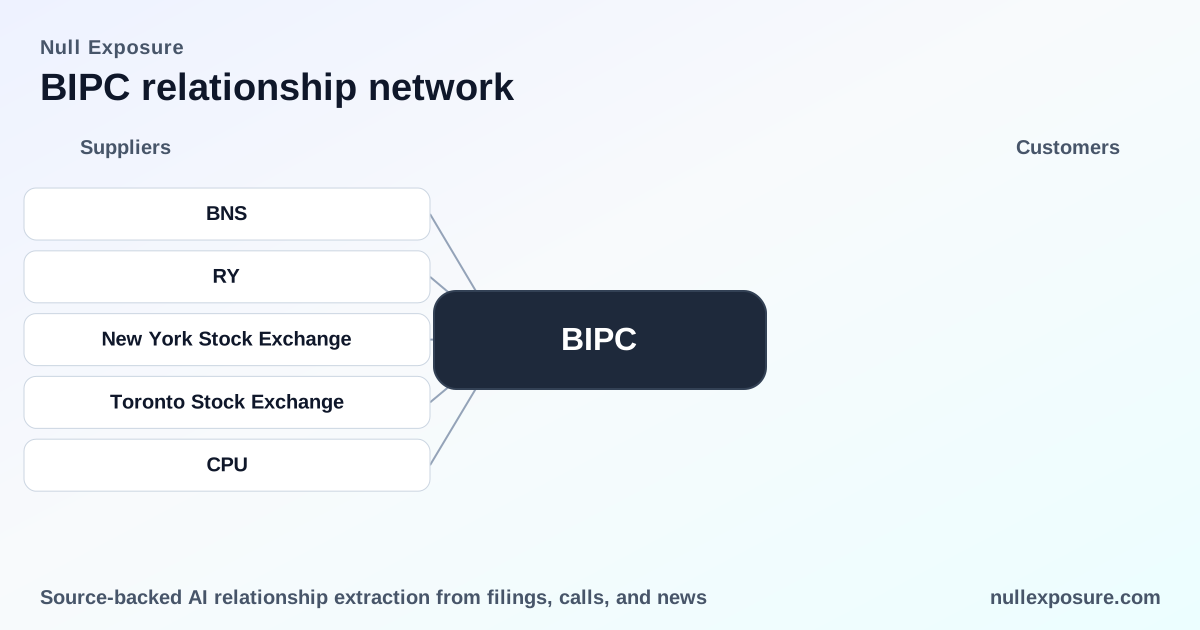
BIPC uses a small group of large, established financial intermediaries and market infrastructures as its primary external partners for equity distributions, issuer bids, and transfer-agent services—these are mature, high-criticality relationships that support capital flexibility rather than day-to-day operational delivery.
How BIPC monetizes and why these partners matter
Brookfield Infrastructure’s business model centers on long-duration regulated cash flows from Brazilian gas transmission assets; monetization is twofold: operational cash collection from regulated tariffs and capital-market transactions (equity issuances and repurchases) to manage balance sheet and per-share dynamics. Capital markets partners are therefore strategic suppliers: they enable incremental financing, liquidity for shareholders, and execution of corporate programs that directly affect shareholder value.
- Contracting posture: BIPC executes standard equity distribution and issuer-bid agreements with tier-one banks and exchanges; these relationships are contractual and transactional rather than embedded operational outsourcing.
- Concentration and diversification: Multiple agents (RBC, Scotia) and multiple trading venues (NYSE, TSX, alternative trading systems) indicate intentional diversification of capital-market counterparties, reducing single-counterparty risk.
- Criticality: These suppliers are mission-critical for capital transactions—without them, BIPC’s ability to raise equity or effect repurchases would be constrained.
- Maturity: Counterparties are large, regulated institutions with long track records; the relationships are high-maturity and standard for an issuer of BIPC’s size.
If you want the platform that aggregates these supplier relationships and source details, visit https://nullexposure.com/ to subscribe.
The relationships you need to know (each covered from the public record)
RBC Capital Markets, LLC — A U.S. agent under the equity distribution agreement executed November 19, 2025, positioned to sell BIPC Shares in the U.S. market as part of an at-the-money issuance program. According to a press release published on The Globe and Mail and mirrored in market wires (Nov 20, 2025), RBC Capital Markets is named among the U.S. agents responsible for distribution.
RBC Dominion Securities Inc. — Named alongside Scotia as a Canadian agent on the same November 19, 2025 equity distribution agreement, responsible for Canadian market placements of BIPC Shares. This placement was disclosed in the company’s press release syndicated to The Globe and Mail (Nov 20, 2025).
Scotia Capital Inc. — Identified as one of the Canadian agents to the November 19, 2025 distribution agreement and included in press distribution describing the at-the-money equity issuance program. The Globe and Mail press release (Nov 20, 2025) lists Scotia Capital among the Canadian agents.
Scotia Capital (USA) Inc. — Named as a U.S. agent alongside RBC Capital Markets in the November 19, 2025 Distribution Agreement, providing U.S. placement capability for the equity issuance program. This role is documented in the Markets.FinancialContent press notice (Nov 20, 2025).
New York Stock Exchange — The NYSE is cited as one of the facilities through which Brookfield Infrastructure effects repurchases of LP Units and Exchangeable Shares under its renewed normal course issuer bid, indicating the company uses U.S. exchange liquidity and execution channels for buybacks. This usage is described in an announcement captured by QuiverQuant (FY2024 issuer-bid filing).
Toronto Stock Exchange — The TSX is cited as a trading venue through which repurchases of LP Units and Exchangeable Shares will be effected under the renewed normal course issuer bid, signifying use of Canadian market liquidity for repurchases. The QuiverQuant notice (FY2024) referencing the issuer bid lists the TSX explicitly.
Computershare Investor Services Inc. — Served as the depositary for the Inter Pipeline transaction, handling letters of transmittal and elections for registered shareholders in the strategic acquisition closed in October 2021; this identifies Computershare as the transfer-agent and transaction services provider used for tender and settlement activity. The role is documented in a Boereport write-up covering the Inter Pipeline acquisition (Oct 28, 2021).
What these relationships mean for investors and operators
- Execution capability is robust and diversified. BIPC’s choice of multiple Canadian and U.S. agents (RBC, Scotia) and use of both NYSE and TSX supports cross-border execution and lowers the execution risk of equity programs. The presence of a recognized depositary (Computershare) for M&A activity underscores standard governance and settlement capability.
- These suppliers are strategic but not operationally embedded. Banks and exchanges facilitate capital flows and liquidity; they do not run the regulated gas infrastructure. The loss of a specific agent would be disruptive to an issuance or repurchase program but not to the regulated utility operations themselves.
- Counterparty risk is concentrated to market access and execution timing. Because these are public, regulated institutions, credit or regulatory stress among agents would materially affect capital actions but is unlikely to affect day-to-day cash generation from assets.
For portfolio teams assessing exposure, prioritize monitoring: (1) announcements of new distribution agreements or terminations; (2) issuer-bid filings and their execution windows on NYSE/TSX; and (3) transfer agent notices tied to corporate actions. For ongoing monitoring services and supplier intelligence for this issuer, see https://nullexposure.com/.
Risks and watch-items to track
- Dilution versus repurchase trade-off. Frequent use of at-the-market issuances alongside normal course issuer bids requires active scrutiny of net share issuance over time; these programs can offset each other but change equity count and per-share metrics.
- Market-access dependency. While diversified, the company’s capital strategy depends on orderly functioning of major exchanges and dealer distribution networks—market dislocations could limit execution.
- Governance and disclosure cadence. The most actionable signals for investors will come through press releases and securities filings that name agents, define programs, and disclose volumes; maintain a steady watch of those channels.
Bottom line and next steps
BIPC has constructed a conventional, resilient capital-markets supplier footprint: large dealer groups, dual-exchange execution and a professional transfer agent. That footprint supports the company’s dual monetization strategy—regulated cash flows plus active balance-sheet management—while keeping supplier concentration moderate and counterparty maturity high.
If your team wants a single place to track these counterparties and source documents for due diligence or monitoring, start here: https://nullexposure.com/
For bespoke alerts and ongoing supplier intelligence on BIPC and peer issuers, visit https://nullexposure.com/ and request a demo.