Biophan (BIPH) — Supplier Relationships, Commercial Signals, and what investors should watch
Biophan Technologies (trading as BIPH) develops and markets technologies for the medical-device sector and monetizes primarily through product sales and service agreements to device makers and laboratories. The company is a micro‑cap commercial operator with very limited revenues, negative operating cash flow, and no visible institutional sponsorship, which shapes both its contracting posture with suppliers and the practical importance of any third‑party mentions in public media.
If you want a consolidated view of BIPH exposures and third‑party mentions, start here: https://nullexposure.com/
Quick financial and operating thesis for investors
Biophan’s stated business is straightforward: hardware and related services sold into medical-device workflows. The public profile shows TTM revenue of roughly $678k and an EBITDA loss exceeding $2.8M, confirming that the company is in a sub‑scale commercial phase rather than a mature supplier standing. Market capitalization is effectively negligible relative to peers, and there is no analyst coverage listed, which increases execution and liquidity risk for counterparties. Given this profile, commercial contracts are likely to be short, price‑sensitive and non‑exclusive, and supplier negotiation leverage will tend toward the counterparty rather than Biophan.
Visit the NullExposure homepage for further supplier‑level intelligence: https://nullexposure.com/
What the relationship data actually shows — executive summary
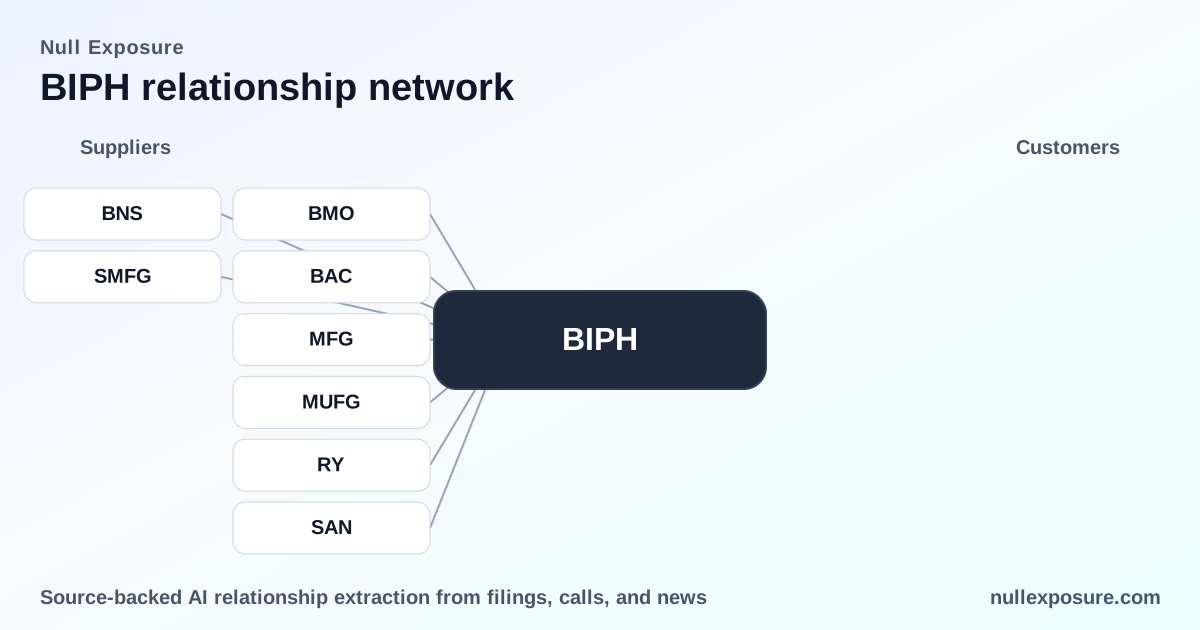
The relationship records returned for BIPH are exclusively media co‑mentions of major investment banks serving as joint book‑running managers on a Brookfield Infrastructure securities deal. All nine relationship entries cite the same QuiverQuant news item (March 9, 2026) about a $300 million subordinated notes offering, and none of the excerpts describe procurement, manufacturing, licensing, or supplier contracts with Biophan itself. This is an important distinction: these entries represent shared media coverage, not documented supplier contracts or procurement dependencies.
The listed counterparts — plain English descriptions and sources
BMO Capital Markets Corp.
BMO is cited as one of the joint book‑running managers on Brookfield Infrastructure’s $300 million subordinated notes offering, and that news item is the source of the BMO mention tied to BIPH’s relationship feed. A QuiverQuant item (March 9, 2026) carries the reference.
BofA Securities, Inc.
BofA Securities appears in the same QuiverQuant news piece as a joint book‑running manager for the Brookfield offering; the mention is a co‑mention in market coverage rather than evidence of a supply contract with Biophan. QuiverQuant, March 9, 2026.
Mizuho Securities USA LLC
Mizuho is listed alongside other banks in the QuiverQuant story as a joint book‑runner for the Brookfield notes; the relationship entry reflects that underwriting role in market reporting. QuiverQuant, March 9, 2026.
MUFG Securities Americas Inc.
MUFG Securities Americas is identified in the same public notice as a joint manager on Brookfield’s transaction; the record in Biophan’s relationship feed derives from that underwriting mention. QuiverQuant, March 9, 2026.
RBC Capital Markets, LLC
RBC Capital Markets is recorded as another joint book‑running manager in the March 2026 QuiverQuant article about Brookfield Infrastructure’s offering and is present in the relationship list for that reason.
Santander US Capital Markets LLC
Santander US Capital Markets is named in the QuiverQuant coverage as a joint underwriter on the Brookfield deal; its appearance in Biophan’s relationship results is a co‑mention pulled from that news item.
Scotia Capital (USA) Inc.
Scotia Capital (USA) is included in the roster of joint book‑running managers reported in the March 9, 2026 QuiverQuant article and is therefore present in the relationship feed.
SMBC Nikko Securities America, Inc.
SMBC Nikko Securities America is likewise listed with the other banks as a joint book‑running manager in the QuiverQuant news story that generated the relationship entry.
(Each of the above relationship entries originates from the same QuiverQuant news release covering Brookfield Infrastructure Partners’ public offering of fixed‑to‑fixed reset rate subordinated notes on March 9, 2026.)
Interpreting these co‑mentions for supplier risk and commercial due diligence
- Co‑mention is not the same as supplier linkage. The banks above were acting as underwriters on a third‑party capital markets transaction; the public mentions do not document procurement, manufacturing, licensing, distribution, or financing relationships with Biophan. Treat these as media‑driven signals rather than contractual exposures.
- Company‑level signals matter more. Biophan’s small scale, negative EBITDA, and lack of institutional ownership are the primary determinants of supplier posture: short, non‑exclusive contracts; limited bargaining leverage; and heightened sensitivity to payment terms and cash‑flow timing. These are company‑level constraints that will shape any real supplier relationship.
- Operational maturity is low. Revenue and margin metrics point to early commercialization; counterparties that require scale, lengthy payment horizons, or extensive warranty/maintenance commitments should price those risks accordingly.
Constraints and contracting posture (company-level signals)
There are no explicit contractual constraints surfaced in the supplier‑scope relationships returned. As a company‑level signal, the financial profile forces a conservative contracting posture for Biophan: high supplier negotiation pressure, limited commitment capacity, and the likelihood of short‑term, transactional vendor arrangements rather than strategic, long‑duration partnerships. Concentration risk is present in the sense that Biophan’s revenue base is small, so losing a single customer would have outsized impact. The company’s maturity level is early commercial; vendors and investors should demand clear milestones, escrowed payments where appropriate, and strict warranty caps.
For ongoing monitoring and supplier analytics, consider the full NullExposure offering here: https://nullexposure.com/
Practical guidance for investors and operators
- Validate every “relationship” flagged by co‑mentions before treating it as a counterparty exposure; start with primary documents (contracts, 10‑Q/10‑K exhibits) rather than media feeds.
- Prioritize cash‑flow metrics and counterparty payment history when assessing supplier risk to BIPH, because financial fragility is the dominant business risk.
- Require transparency around any material supply or OEM agreements; absence of filings and zero institutional ownership increase the need for documentary due diligence.
Final takeaway: Biophan is a micro‑scale medical‑device supplier with early commercial revenues and clear financial constraints; the bank co‑mentions in the relationship feed are underwriting co‑mentions in a Brookfield capital markets story and do not constitute documented supplier contracts. For a deeper, continuously updated supplier exposure view, visit https://nullexposure.com/ and request full supplier intelligence.