Brookfield Infrastructure Finance ULC (BIPJ): underwriting partners and what the capital markets activity signals
Brookfield Infrastructure Finance ULC operates as a financing vehicle within the Brookfield infrastructure franchise, monetizing through long-duration debt issuance and structured financing tied to high-quality infrastructure assets in utilities, transportation and renewable energy. The company raises long-term capital, often via subordinated notes and structured issuances underpinned by Brookfield’s operating platform, to fund asset acquisition and to optimize the group’s capital stack. For investors assessing supplier and counterparty exposure, the identity and breadth of the underwriting syndicate is an important proxy for market access, pricing power and funding resilience. Visit the NullExposure homepage for deeper supplier intelligence: https://nullexposure.com/
How BIPJ funds itself and why underwriters matter
Brookfield’s financing vehicle performs a classic infrastructure finance role: secure stable long-term funding for capital-intensive assets that produce reliable cash flows. Funding is core to the business model — if access to long-duration capital narrows, asset returns and refinancing plans are affected directly.
At a company level, available public records in this data pull show no explicit contractual constraints extracted, which itself is a signal: the sources examined did not flag special covenants or third‑party limitations. Because no constraints are documented here, treat that as a neutral company-level observation rather than evidence of absence of risk. Operationally, Brookfield’s contracting posture is consistent with large institutional issuers: market-standard underwriting and syndicated distribution using global banks to distribute long-tenor instruments to fixed-income investors. The maturity profile implied by a 60-year subordinated note issuance underscores a strategic preference for very long-duration financing and an investor base that accepts extended duration exposure.
Recent capital markets transaction — why a 60‑year subordinated note matters
Brookfield Infrastructure completed a 60‑year subordinated note offering, distributing the issuance through a syndicate of global banks. A single transaction like this reveals several durable features of BIPJ’s operating model:
- Access to top-tier capital markets channels. Using major banks as joint bookrunners indicates institutional placement capability and broad investor distribution.
- Long-duration financing preference. A 60‑year tenor signals willingness to match infrastructure asset lives with equally long-term liabilities, reducing frequent refinancing but increasing sensitivity to structural rate shifts and subordinated capital treatment.
- Reliance on underwriting partners for market execution. The underwriter group performs an outsized role at issuance moments; ongoing counterparty risk is concentrated around funding windows, not everyday operations.
A mid‑stream resource for more supplier intelligence is available here: https://nullexposure.com/
Who underwrote the deal — relationship breakdown
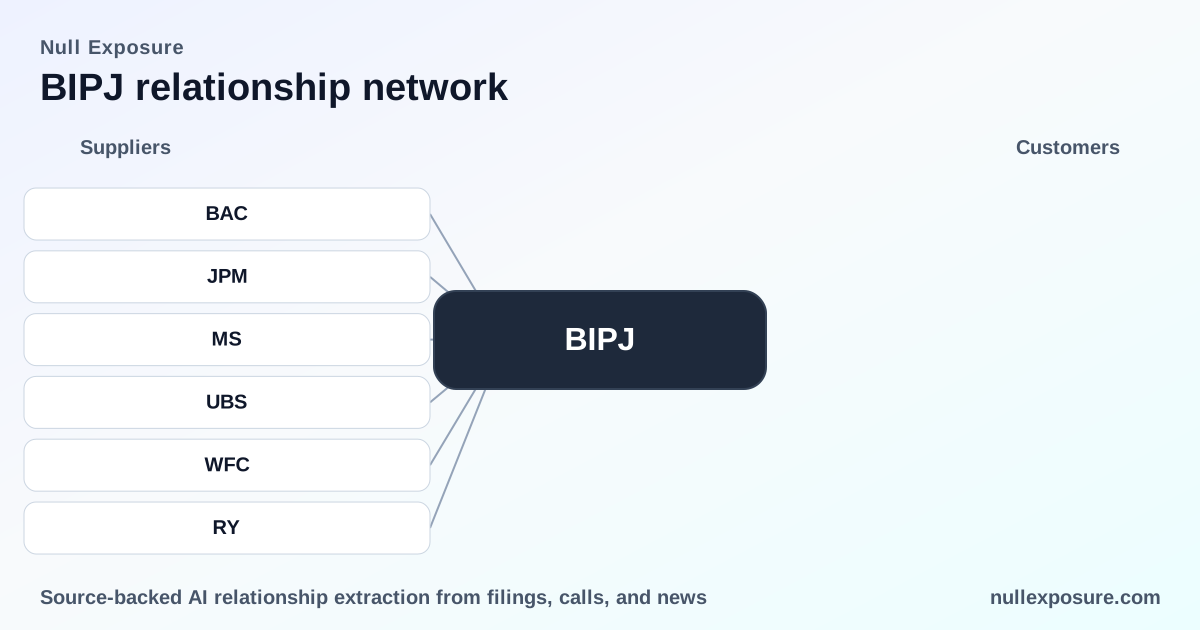
Each of the following firms served as a joint book‑running manager on the 60‑year subordinated note offering, according to reporting on the offering. The language below summarizes their role in plain English and cites the source.
- BofA Securities, Inc. acted as a joint book‑running manager on the transaction, helping to structure distribution and place the notes with institutional investors. According to a FinancialContent report published May 31, 2024, BofA was listed among the joint book‑running managers for the offering.
- J.P. Morgan Securities LLC served as a joint book‑running manager, contributing to syndicate formation and investor outreach for the issuance. FinancialContent’s May 31, 2024 coverage lists J.P. Morgan among the underwriters.
- Morgan Stanley & Co. LLC took part as a joint book‑running manager, participating in pricing discussions and distribution to its fixed‑income client base. FinancialContent’s May 31, 2024 report includes Morgan Stanley in the underwriting group.
- UBS Securities LLC participated as a joint book‑running manager, bringing its institutional fixed‑income distribution network to the offering. The same FinancialContent article from May 31, 2024 cites UBS among the joint book‑runners.
- Wells Fargo Securities, LLC was engaged as a joint book‑running manager, supporting syndication and placement activities for the subordinated notes. FinancialContent’s May 31, 2024 coverage names Wells Fargo as a participant.
- RBC Capital Markets, LLC acted as a joint book‑running manager, providing underwriting and distribution services during the issuance. The FinancialContent report dated May 31, 2024 lists RBC Capital Markets in the syndicate.
What the syndicate composition signals for investors and operators
High-quality underwriter mix reduces single‑counterparty concentration risk. Brookfield used a diverse group of global banks rather than a single lead manager, which spreads distribution, leverages multiple investor channels and limits execution dependency on any one dealer.
Underwriting partners are critical at issuance but not permanent operating suppliers. The banks provide market access and execution; they are essential during funding events but do not run day‑to‑day operations of the financed assets. For counterparties evaluating BIPJ, the underwriting relationship is therefore important primarily as a liquidity and market‑access indicator.
Maturity and subordinated structure change counterparty calculus. Sixty‑year subordinated paper reduces refinancing frequency and signals a long‑duration investor base, but it increases structural sensitivity to credit ranking and regulatory treatment. Underwriters’ willingness to place such long paper is a strong market endorsement of distribution capability and investor appetite.
Risk factors and monitoring priorities
- Funding and market risk: Long-dated subordinated notes reduce refinancing cadence but increase exposure to long‑term interest rate regimes and structural credit re-rankings. Monitor secondary market liquidity and investor concentration in future issuances.
- Capital structure sensitivity: Subordinated debt sits behind senior creditors; in stressed scenarios this junior position amplifies recovery uncertainty for holders and affects BIPJ’s ability to support other group obligations.
- Counterparty execution risk at issuance windows: While the syndicate spreads execution risk, market dislocation during a placement could widen pricing dramatically; maintain attention on syndicate breadth and investor demand signals at issuance.
- Reputational and operational continuity: The presence of top-tier banks is a positive signal of market confidence; however, any dispute between Brookfield entities and global banks would have outsized visibility and could affect access.
Actions for investors and operators
- For institutional investors, validate the role of underwriters in the distribution chain and monitor secondary liquidity rather than relying solely on initial placement for mark assessments.
- For operators and counterparties, treat underwriting partners as strategic market-access suppliers and include issuance windows in counterparty concentration planning.
- For credit analysts, focus ongoing surveillance on covenant language, subordination mechanics and future issuance cadence—these elements have material impact on recovery and funding flexibility.
For continued supplier and counterparty intelligence on Brookfield entities and their market counterparties, visit https://nullexposure.com/
Conclusion — concise investment-grade takeaway
Brookfield Infrastructure Finance ULC leverages top-tier global banks to access long-duration capital; the syndicate composition on the reported 60‑year subordinated note offering is a positive signal of distribution capability and investor appetite. The structure reduces refinancing frequency and demonstrates market trust, but it imposes long-horizon rate and credit risks that investors must actively monitor. For deeper supplier-level analysis and ongoing tracking of these relationships, refer to NullExposure: https://nullexposure.com/