BIVIW (BioVie Inc. Warrant): supplier relationships and what they imply for investors
BioVie Inc. is a clinical-stage biopharmaceutical company that funds operations and development through capital markets activity and licensing arrangements while relying on third-party service providers for clinical development and manufacturing. The company’s short-term liquidity is supported by public offerings and tradable warrants (BIVIW), while long-term monetization depends on successful drug approvals and royalty-bearing commercialization agreements for assets such as BIV201. For investors evaluating counterparty risk and operational continuity, the network of underwriters, market venues, service vendors, and communications firms is a concentrated but conventional mix for a small biopharma. For more supplier intelligence and counterparty visibility, visit https://nullexposure.com/.
How BioVie runs its operations — the contracting posture you should price in
BioVie operates with a mixed contracting posture: a combination of low-cost, short-term headquarters arrangements and a longer-term, higher-cost commercial office lease. The company documents a 60-month San Diego lease with an annual escalation and a renewed annual HQ lease in Carson City at nominal cost — evidence of deliberate cost-minimization at the corporate level while maintaining a more committed presence in a commercial market. These arrangements indicate moderate fixed-cost leverage: corporate overhead is controllable, but mid-term obligations (the five-year San Diego lease) create a fixed cash outflow that investors must model into burn scenarios.
Beyond real estate, BioVie relies on external partners for the most value-critical activities: clinical operations, manufacturing, and cognitive outcome measurement. The filing language explicitly recognizes dependence on CROs, clinical sites, contract labs, manufacturers, and other third parties, which is standard for a company at this stage but also concentrates execution risk off balance sheet. Separately, BioVie is contractually committed to pay royalties on net sales of BIV201, reflecting legacy licensor obligations that will affect gross margins if commercialization occurs.
- Short-term contracting: modest HQ rent (~$2,200 annually) that is renewed annually, capped in the sub-$100k spend band.
- Long-term contracting: San Diego lease at roughly $10,024/month with a 60-month term (falls in the $100k–$1M spend band over the lease term).
- Operational reliance: third-party clinical and manufacturing partners are essential; suppliers are service providers and manufacturers in critical roles.
- Legacy royalties: a 5% royalty obligation on net sales of BIV201 shared among predecessor licensors, which will persist post-separation and reduce net commercialization economics.
Collectively these constraints define a company that is operationally asset-light but contractually leveraged in discrete areas, and that generates value for investors primarily through successful clinical readouts and capital markets transactions rather than internal manufacturing scale.
Who BioVie is working with (each relationship in the public record)
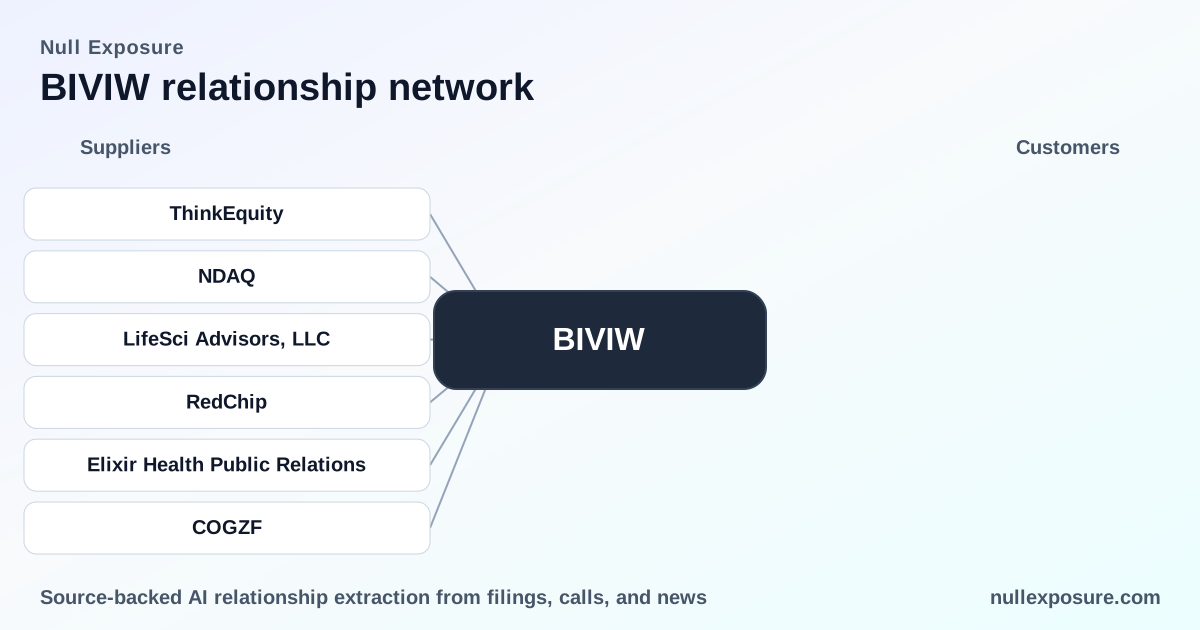
Below are every counterparty mentioned in the available results, with a short plain-English takeaway and a source note.
ThinkEquity
ThinkEquity served as the sole book-running manager on BioVie’s $12 million public offering and was granted a 45-day over-allotment option for additional securities, a conventional underwriter role that positions ThinkEquity as the lead capital markets intermediary on the transaction. According to a GlobeNewswire press release dated August 8, 2025, ThinkEquity acted as sole book-running manager for the offering (https://www.globenewswire.com/news-release/2025/08/08/3129900/0/en/BioVie-Inc-Announces-Pricing-of-12-Million-Public-Offering.html).
Nasdaq / Nasdaq Capital Market
The company’s warrants were approved for listing and began trading on the Nasdaq Capital Market under the ticker BIVIW on August 8, 2025, with a $2.50 exercise price and a five-year term, providing a visible and liquid financing instrument for investors and a formal public market for warrant holders. This listing detail is reported in Nasdaq-related notices and media summaries from August 2025 (see Nasdaq/Stocktitan coverage: https://www.stocktitan.net/news/BIVI/bio-vie-inc-announces-closing-of-12-million-public-isxdzhs10ap2.html).
LifeSci Advisors, LLC
LifeSci Advisors is identified as the investor relations contact, with Bruce Mackle listed as Managing Director; this positions LifeSci as the external IR advisor responsible for investor communications and outreach. Source: press materials uploaded in August 2025 listing LifeSci contact details (https://www.stocktitan.net/news/BIVI/bio-vie-inc-announces-closing-of-12-million-public-isxdzhs10ap2.html).
RedChip
RedChip appears as the platform for investor presentations and registration, with free registration and a facility to submit questions to BIVI@redchip.com, indicating a partnership for retail/SMID investor engagement. Source: investor event notices circulated alongside the offering materials (https://www.stocktitan.net/news/BIVI/).
Elixir Health Public Relations
Elixir Health is listed as the media relations firm, with Melyssa Weible named as Managing Partner and contact for press inquiries, reflecting an appointed external communications agency. Source: offering/closing press release contact section (https://www.stocktitan.net/news/BIVI/bio-vie-inc-announces-closing-of-12-million-public-isxdzhs10ap2.html).
Cogstate
Cogstate is used as a cognitive assessment vendor for clinical studies, providing a branded cognitive battery to stratify participants by symptom duration and age and to quantify neurocognitive outcomes — an operational vendor with direct influence on clinical endpoint measurement. This vendor relationship is referenced in clinical study descriptions in the August 2025 public notices (https://www.stocktitan.net/news/BIVI/).
(Full press and disclosure materials that reference these relationships were publicized in August 2025 and compiled in subsequent market write-ups, including Yahoo Finance and Stocktitan summaries.)
For supplier diligence and transaction history, see more at https://nullexposure.com/.
What these counterparties imply for risk, execution, and valuation
- Execution risk is outsourced and concentrated. BioVie’s reliance on CROs, contract manufacturers and specialized vendors like Cogstate means clinical timelines and data quality are contingent on third-party performance. Investors should price a meaningful probability of vendor-related delays into models.
- Capital markets are an active funding channel. The ThinkEquity-led offering and Nasdaq listing of warrants show the company uses public markets to raise cash and derisk near-term funding; however, warrants dilute common equity if exercised, and the $2.50 strike establishes a clear threshold for dilution economics.
- Fixed-cost structure is mixed but material. Small annual HQ rent keeps burn flexible, while the five-year San Diego lease creates medium-term fixed obligations that reduce downside flexibility if trial timelines extend.
- Royalties constrain upside on commercialization. A 5% royalty on net sales of BIV201 is an explicit off-take on future revenue and should be included in any long-term NPV of the asset.
Midway through diligence, investors should reassess counterparties for redundancy (multiple CRO options), contract term ceilings, and explicit service-level agreement (SLA) language where available. For a targeted rundown of counterparties and to map supplier concentration against your exposure tolerance, explore our platform: https://nullexposure.com/.
Investment conclusion and recommended next steps
BioVie presents the classic small-cap biopharma profile: externally executed development, market-funded operations, and legacy royalty obligations that will reduce gross commercialization economics. The active use of ThinkEquity and Nasdaq for financing and a clear vendor list (Cogstate for cognition, LifeSci/RedChip/Elixir for outreach) reduce informational friction for investors but do not eliminate operational execution risk. Key investment levers are the timing and quality of clinical data, the company’s ability to manage third-party performance, and the capital markets’ appetite for further dilution.
Actionable next steps for investors and operators:
- Confirm SLA and milestone terms with primary CRO/manufacturer partners and model vendor-driven timeline variance.
- Stress-test cash runway including the San Diego lease obligations and potential warrant exercises.
- Monitor clinical endpoint data sourcing (e.g., Cogstate outputs) for data integrity signals.
For a deeper supplier-risk assessment and counterparty visibility tailored to your portfolio, visit https://nullexposure.com/ and request a briefing.