BJ's Restaurants (BJRI) — supplier relationships and operational posture investors need to know
BJ's Restaurants operates a scaled casual-dining chain that monetizes through restaurant-level sales, proprietary branded menu items and beverages, and a steady roll-out of new concepts that drive traffic and margin. The company captures revenue through in-restaurant sales, craft-beer distribution where licensed, and controlled menu innovation (limited-time offers and partnerships) that increase check size and repeat visitation. For investors and operators, the critical signal is that BJ's combines long-duration real estate commitments with short-cycle commodity sourcing and third-party service dependencies — a mixed contracting posture that creates predictable fixed costs and tactical variable inputs. Explore supplier relationships and contract constraints below, or visit the NullExposure homepage for deeper supplier intelligence: https://nullexposure.com/
Quick investment thesis
BJRI delivers stable cash flow from a well-known brand and a conservative capital footprint per unit, with long-term lease commitments anchoring fixed cost structure and menu partnerships and distributor relationships driving top-line variability and innovation. The stock trades at mid-teens P/E with modest growth expectations and elevated exposure to input-cost cycles and execution of new-unit economics.
What the recent relationship signals mean for revenue and execution
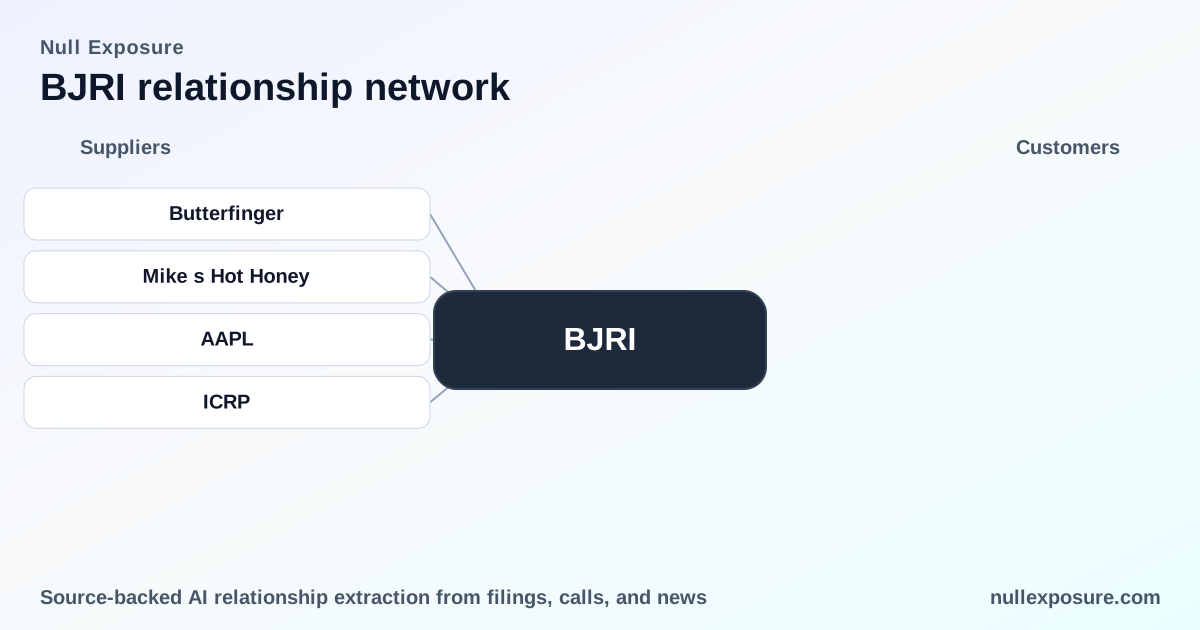
BJ's supplier and partner disclosures in FY2026 highlight three themes that matter for investors: brand-driven co-promotions to drive traffic (Butterfinger, Mike's Hot Honey), payments and operations digitization (Apple Pay), and standard investor-relations support (ICR). These are incremental to the core distributor and brewer relationships that underpin day-to-day operations. Read on for the specific partners and source references.
Butterfinger — branded dessert collaboration
BJ's launched a seasonal Butterfinger Pizookie — a branded limited-time dessert combining Butterfinger pieces with BJ's signature pizookie offering, designed to increase dessert attach rates and ticket averages. According to PR Newswire (March 9, 2026), the rollout was positioned as a marquee co-brand LTO to capture incremental dessert sales during the quarter.
Mike's Hot Honey — first LTO pizza partnership
BJ's used Mike's Hot Honey for its first limited-time offer (LTO) pizza, which quickly became the chain's third-most-popular flavor out of nine, a direct indication of effective product-market fit for spicy-sweet flavor profiles driving pizza category penetration. This outcome was discussed during the Q4 2025 earnings call transcript published by InsiderMonkey (Q4 2025 earnings call transcript, March 2026).
Apple Pay — payments integration to simplify service
BJ's is integrating Apple Pay for pay-at-the-table experiences and simplifying split-check workflows to reduce point-of-sale friction and improve throughput. The integration was mentioned in the Q4 2025 earnings call transcript (InsiderMonkey, March 2026) as part of the company's operational simplification program to speed ordering and reduce labor complexity.
ICR — investor relations and communications partner
BJ's lists ICR as its investor-relations contact for earnings and corporate communications, underlining a formalized external communications posture. The earnings release and conference call notice published on GlobeNewswire (February 11, 2026) and republished on Sahm Capital (February 12, 2026) direct investors to ICR for inquiries.
How these supplier signals fit into BJ's operating model
BJ's operating model is defined by a hybrid of long-duration fixed commitments and short-term procurement agility:
- Contracting posture: The company uses long-term operating leases (10–20 years) for its locations, which locks in real estate occupancy and creates durable fixed rent exposure. At the same time, BJ's offsets commodity risk with short-term fixed-price purchase commitments (typically up to one year) for selected ingredients.
- Cost structure mix: Rent agreements often include minimum plus percentage (contingent) rent tied to sales, introducing usage-based variability that aligns landlord incentives with BJ's sales performance.
- Counterparty concentration: BJ's relies on leading national foodservice distributors and a major fresh-produce distributor for the majority of food deliveries, and it contracts independent third-party brewers to produce proprietary beers — signaling reliance on large enterprise suppliers for scale and coverage.
- Relationship maturity and criticality: Distributor and brewer relationships are active and critical to operations; expansion requires additional distribution agreements, indicating moderate operational complexity as the chain grows.
- Capital intensity per unit: The company's prototype construction cost (~$6.0 million per restaurant, fiscal 2024 prototype) positions new restaurants in the $1m–$10m spend band, creating meaningful but manageable per-unit capex.
These company-level constraints create a profile of predictable fixed obligations with variable profit drivers tied to consumer-facing promotions and supply cost execution.
If you want a supplier-level map to quantify exposure across rent, distribution, and third-party services, start here: https://nullexposure.com/
Risk and opportunity takeaways for investors
- Risk — fixed-cost leverage: Long-term leases (10–20 years) translate into high operating leverage; sales volatility materially affects profitability given percentage rent structures and fixed lease amortization.
- Opportunity — branded LTOs drive traffic: Successful co-brands such as Butterfinger and Mike's Hot Honey increase check sizes and guest frequency without material capital outlay, offering a high-margin lever to boost same-store sales.
- Operational efficiency upside: Payments integration and POS simplification (Apple Pay, split-check improvements) reduce labor friction and can materially improve table turns and guest satisfaction when widely adopted.
- Supplier concentration: Dependence on a leading national distributor and third-party brewers creates vendor concentration risk but also delivers scale benefits and negotiating leverage.
Explore how these dynamics compare across restaurant peers and supplier networks on the NullExposure homepage: https://nullexposure.com/
Final position — what investors should do next
BJ's combines stable, lease-backed real estate exposure with agile merchandising and payments improvements, presenting a balanced risk-reward for investors focused on operational execution and margin expansion. Monitor same-store sales versus percentage-rent exposure, LTO performance metrics, and the rollout pace of payments/operational simplifications as the primary catalysts. For tailored supplier risk analysis and tracking of co-brand rollouts, visit NullExposure to subscribe to ongoing supplier intelligence: https://nullexposure.com/
Key sources referenced in this note include PR Newswire (Butterfinger announcement, March 9, 2026), the Q4 2025 earnings call transcript published on InsiderMonkey (March 2026), and earnings release notices on GlobeNewswire and Sahm Capital (February 2026) for investor-relations details.