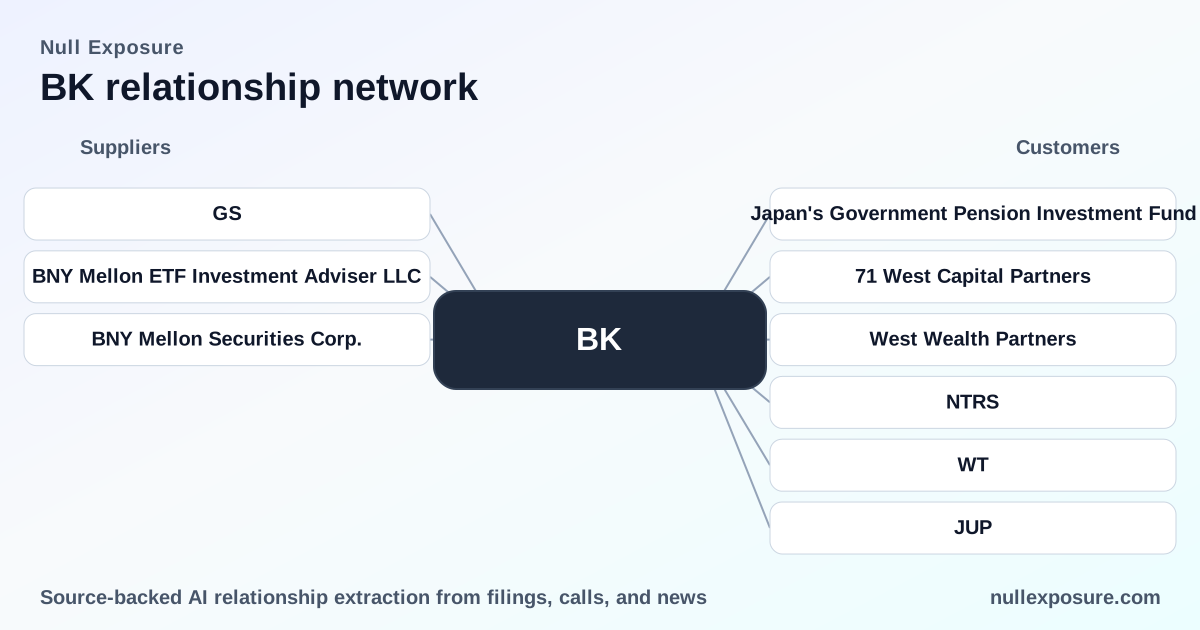
BNY Mellon (BK) supplier map: what investors need to know
Thesis — The Bank of New York Mellon monetizes a global custody and asset-servicing franchise by charging fees on custody, clearing, investment management and securities servicing while also capturing spread and fee income from treasury and deposit-like activities; incremental growth is coming from fee-rich products such as ETFs and digital-asset custody delivered through a mix of internal affiliates and selective third‑party partnerships. For investors, the crucial signal is a predominantly integrated operating model with selective external dependencies that are strategically concentrated around new technology stacks. For deeper vendor and counterparty visibility, visit https://nullexposure.com/.
How BNY Mellon runs and gets paid
BNY Mellon is a diversified financial services holding company with a broad service set: custody and asset servicing, investment management, treasury services and retail/wholesale securities operations. The company generated roughly $20.0 billion in trailing revenue and trades at a price/book of about 2.0 with ROE around 12.9%, indicating a mature, profitable franchise that extracts recurring fee revenue from institutional clients. The firm’s dividend yield (~1.7%) and low revenue growth cadence reflect the steady‑state nature of custody and asset servicing businesses rather than fast consumer growth.
Operationally, BNY Mellon demonstrates a clear preference for internalizing critical functions where scale produces margin and control: ETF advisory and distribution are staffed inside the corporate family, while selective technology partnerships are used to accelerate entry into adjacent markets such as digital assets. This results in a contracting posture that is integrated for core custody and go‑to‑market functions, and selectively outsourced for specialized tech capabilities. The supplier footprint is therefore a mix of captive affiliates and targeted third‑party vendors.
Supplier relationships uncovered — read every entry
Below are all supplier mentions discovered for BK in our review. Each entry is a plain-English summary with the primary source.
Goldman Sachs — LiquidityDirect uses GS DAP (news item)
BNY Mellon’s LiquidityDirect platform uses the Goldman Sachs Digital Asset Platform (GS DAP) to deliver an initial digital‑assets offering to clients, signaling a technology partnership that brings external digital‑asset capability onto BNY Mellon’s client-facing liquidity product. Source: StockTitan news report (first seen 2026‑03‑09) — https://www.stocktitan.net/news/BK/northern-trust-asset-management-enters-digital-assets-market-with-3rukqceyyu1j.html.
Goldman Sachs — same partnership referenced in another bulletin
An additional press mention repeats that LiquidityDirect will utilize GS DAP, confirming multiple market notices picked up the same collaboration between BNY Mellon and Goldman Sachs in early March 2026. Source: ADVFN news item (first seen 2026‑03‑09) — https://mx.advfn.com/bolsa-de-valores/NASDAQ/NTRS/noticias/97951934/northern-trust-asset-management-enters-digital-assets-market-with-launch-of-toke.
BNY Mellon ETF Investment Adviser LLC — primary advisor for BKLC
BNY Mellon ETF Investment Adviser LLC is listed as the primary advisor for the fund issued under the BNY Mellon brand (BKLC), reflecting internalized portfolio management and advisor functions for BNY Mellon‑branded ETFs. Source: TradingView fund page (first seen 2026‑03‑09) — https://www.tradingview.com/symbols/AMEX-BKLC/.
BNY Mellon Securities Corp. — distributor for BKLC
BNY Mellon Securities Corp. is reported as the distributor for BNY Mellon’s BKLC fund, demonstrating that distribution and placement for certain retail/institutional ETFs are handled within the BNY Mellon corporate family. Source: TradingView fund page (first seen 2026‑03‑09) — https://www.tradingview.com/symbols/AMEX-BKLC/.
BNY Mellon ETF Investment Adviser LLC — primary advisor for BKUI
BNY Mellon ETF Investment Adviser LLC is also identified as the primary advisor on the BKUI fund listing, reinforcing that ETF advisory services are standardized in-house across multiple funds. Source: TradingView fund page (first seen 2026‑03‑09) — https://www.tradingview.com/symbols/AMEX-BKUI/.
BNY Mellon Securities Corp. — distributor for BKUI
BNY Mellon Securities Corp. is likewise recorded as the distributor on the BKUI listing, confirming consistent internal distribution mechanics for the firm’s ETF suite. Source: TradingView fund page (first seen 2026‑03‑09) — https://www.tradingview.com/symbols/AMEX-BKUI/.
What the relationship map implies for investors
- Vertical integration is a structural strength. Multiple entries show that advisory and distribution for BNY Mellon ETFs are handled by BNY Mellon affiliates. This reduces vendor fragmentation and preserves fee capture inside the corporate family while limiting third‑party distribution costs.
- Selective external dependence for technology. The partnership with Goldman Sachs on GS DAP for LiquidityDirect demonstrates BNY Mellon’s strategy to acquire specialized tech capability through partnerships rather than building every stack internally. This is efficient for speed to market but creates a concentrated external dependency around digital‑asset technology.
- Contracting posture and criticality. BNY Mellon’s contracting posture is insourcing for revenue-critical, customer-facing functions (ETF advice/distribution) and outsourcing for specialized infrastructure (digital asset platforms). For investors, this signals stability in fee capture but introduces targeted vendor risk where the company relies on external vendors for new product lines.
- Maturity and concentration. The business is mature, profitable and institutionally concentrated: high institutional ownership (≈88%) and stable margins indicate professional investor base and slow‑burn growth. Concentration risk is operational rather than client‑base driven: dependency on a small set of third‑party tech partners to enter new markets elevates transition risk if partnerships change.
For a more granular supplier view and scoring, see the supplier intelligence hub at https://nullexposure.com/.
Investment implications and risk checklist
- Upside: Fee-line expansion from ETFs and digital assets is scalable without proportional increases in fixed cost because advisory/distribution are captive. Internalization protects margins.
- Downside: The Goldman Sachs relationship creates a concentrated single‑vendor exposure for a strategic new capability—digital assets. A change in terms or technology access would be disruptive to LiquidityDirect’s roadmap.
- Operational resilience: Large scale, profitable margins, and diversified services create a high baseline resilience, but product innovation is dependent on external partners for capability acceleration.
If you are evaluating counterparty risk or procurement exposure for BK, the tradeoff is clear: internal control for core revenue streams; selective externalization to accelerate new capabilities.
Recommended next steps for investors and operators
- For investors: track filings and announcements around digital asset custody/product rollouts and any further GS‑related disclosures, as changes will materially affect capability and competitive positioning.
- For operators and procurement teams: document fallback plans for externally supplied digital‑asset stacks and quantify the revenue concentration attached to those partnerships.
- For detailed supplier dashboards and continuous monitoring, visit Null Exposure’s coverage at https://nullexposure.com/.
Final takeaway — BNY Mellon runs a tightly integrated revenue engine supported by internal adviser/distributor arms while using targeted third‑party tech partnerships to enter adjacent growth markets; that strategy preserves margin but concentrates risk in a small number of external suppliers for strategic initiatives. For continuous supplier monitoring and deeper relationship analytics, explore https://nullexposure.com/.