BKFI supplier relationships: what investors need to know
BKFI is listed as the BNY Mellon Active Core Bond ETF, an exchange-traded fund that issues shares to investors and generates revenue through management fees, securities lending and the operational spread between fund assets and running costs. For holders and counterparties, the product’s commercial profile is driven by its asset mix, fee schedule and the distribution/servicing relationship with the product sponsor and custodian. Understanding BKFI is therefore about understanding its sponsor and service relationships, not a standalone operating company.
If you want a quick navigator to supplier intelligence for ETF products and financial sponsors, visit the NullExposure homepage: https://nullexposure.com/
One clear supplier relationship and what it means for risk
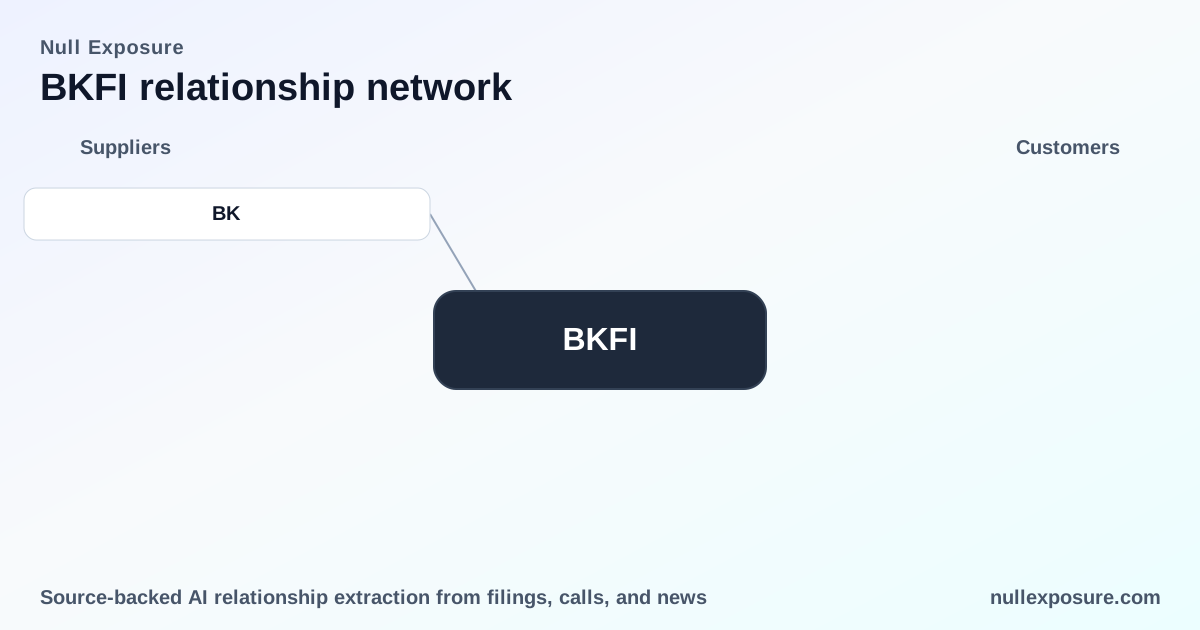
The results returned for BKFI show a single, explicit supplier relationship: BNY Mellon (inferred symbol BK), referenced as the BNY Mellon Active Core Bond ETF BKFI. According to Quiver Quant’s institutional listing for BKFI (first seen March 9, 2026), the fund is recorded under that BNY Mellon product name. This entry confirms the sponsor/custodian association that underpins distribution, custody and operational servicing for the ETF.
- BNY Mellon (BK): The feed lists the fund explicitly as “BNY Mellon Active Core Bond ETF BKFI,” tying BKFI to BNY Mellon’s ETF platform and operational stack. (Source: Quiver Quant institutional page for BKFI, first seen March 9, 2026.)
Why a single supplier record matters to investors and operators
The presence of a single, prominent sponsor/service provider is typical for ETFs and has clear implications:
- Concentration and dependency: ETFs operate through a small number of critical service relationships (sponsor, custodian, transfer agent, authorized participants). A single visible supplier here reflects that model: the sponsor/custodian relationship is central and critical to fund distribution and operations.
- Contracting posture: ETF sponsors and custodians operate under long-term, standardized service agreements with well-established SLAs; the contracting posture is hands-on and institutional, not ad hoc vendor-supplier bargaining.
- Maturity: Association with a large, established sponsor like BNY Mellon indicates operational maturity—scaling, reporting and compliance processes are centralized and repeatable.
- Disclosure gap: The results return no constraints or additional supplier contract details, which signals a company-level limitation in supplier constraint disclosure rather than the absence of such arrangements.
These are company-level signals: the dataset returned no explicit contractual constraints, so these operating-model inferences describe BKFI as a product and its supplier posture rather than a contract-level fact tied to a named supplier.
Practical implications for portfolio managers and counterparties
For investors and operations teams that interact with BKFI, the commercial and operational priorities are straightforward:
- Liquidity and NAV mechanics: ETF performance and liquidity depend on authorized participant activity, primary market creation/redemption mechanics, and the sponsor’s ability to manage inflows and outflows confidently.
- Operational risk rests with the sponsor and custodian: BNY Mellon’s role is material—custody, settlement, fund accounting and distribution are concentrated through the sponsor ecosystem.
- Fee and revenue drivers: Income to the sponsor comes from management fees and ancillary revenue (securities lending, cross-product services). Investors should stress-test expense ratios and compare them against peer funds.
If you need a structured assessment of sponsor concentration and service relationships across your ETF exposures, start at the NullExposure homepage: https://nullexposure.com/
Relationship-by-relationship breakdown
BNY Mellon — The listing identifies BKFI explicitly as a BNY Mellon product: “BNY Mellon Active Core Bond ETF BKFI.” This establishes BNY Mellon as the fund sponsor/custodian responsible for issuance, custody and operational servicing for the ETF. (Source: Quiver Quant institutional page for BKFI, entry first seen March 9, 2026.)
Key takeaways for risk management and investment committees
- Sponsorship matters: The fund’s operational resilience and investor protections are directly tied to BNY Mellon’s operational capacity and compliance programs. This is a primary counterparty relationship for fund operations.
- Disclosure is limited in this feed: No supplier-side contractual constraints or additional supplier names were returned; this is a company-level signal that more granular contract diligence is required if you need counterparty-specific SLA or recourse details.
- Concentration of roles is normal but material: For ETFs, a small number of suppliers execute critical functions—custody, fund administration and AP activity—so governance should treat these as high-priority counterparties.
What to do next if BKFI is in your book
- Request the fund prospectus and the statement of additional information to verify fee structure, securities-lending policy and custodian details; these documents trace operational responsibilities back to the sponsor.
- For operational counterparties, validate settlement cutoffs, redemption mechanics and the authorized participant list to confirm how liquidity risk will be managed during market stress.
- For credit and counterparty panels, obtain the sponsor’s operational risk and continuity plans—BNY Mellon’s controls are the effective controls for BKFI.
Final thought: BKFI is an ETF product with an identifiable sponsor relationship; governance and risk assessment should center on sponsor capabilities, custody arrangements and the limited public disclosure of supplier constraints. For deeper supplier mapping across a broader fund universe, explore our platform: https://nullexposure.com/
Bold move for portfolio clarity: treat the sponsor/custodian relationship as the first-line supplier risk for any ETF exposure and prioritize contractual review accordingly.