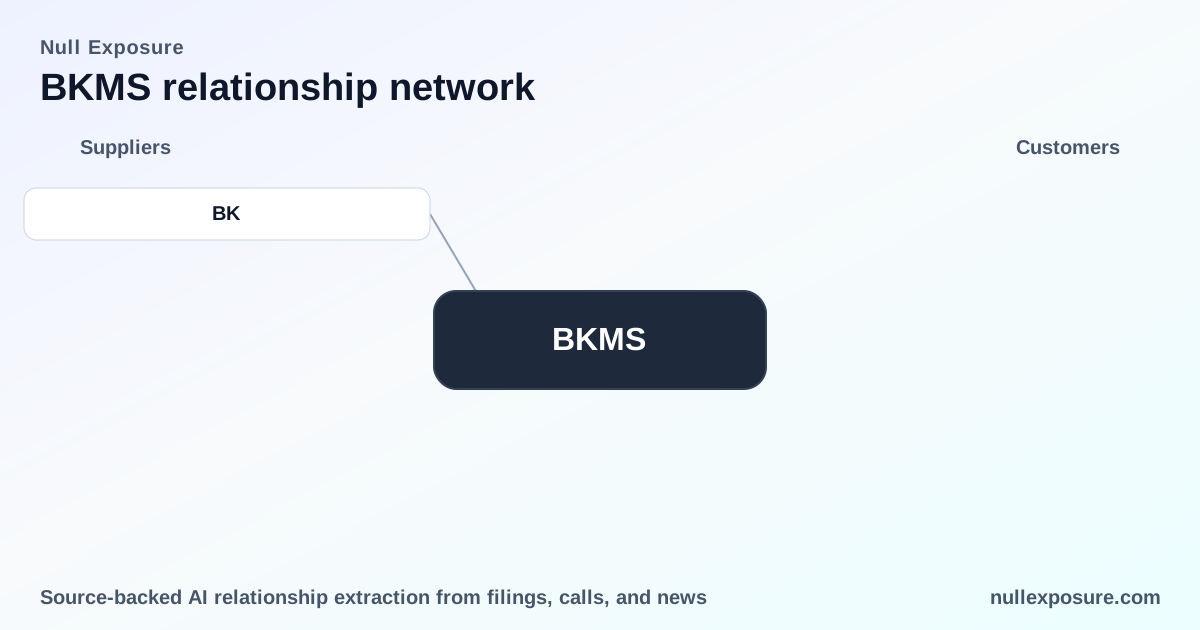
BKMS supplier briefing: what investors need to know about the BNY Mellon relationship
Thesis: BKMS is the ticker for the BNY Mellon Municipal Short Duration ETF, a product-style supplier relationship in which value is created and monetized through fund distribution, asset management, and fee collection tied to assets under management. For investors and operators evaluating BKMS as a supplier relationship, the core dynamics are issuer control, product-level operational criticality, and exposure to market liquidity and distribution channels — the relationship is commercial and product-driven rather than an open-ended technology or raw-material supply contract.
Explore deeper supplier intelligence at https://nullexposure.com/.
How the relationship surfaces in public signals
The available relationship signals in our feed point directly to BNY Mellon as the issuer and steward of BKMS. These entries are concise public mentions that tie the ticker to the parent institution rather than to discrete third-party vendors.
- BNY Mellon is referenced in a QuiverQuant insiders page that lists “BNY Mellon Municipal Short Duration ETF BKMS.” This entry was captured on 2026-03-09 and frames BKMS as a BNY Mellon product. (QuiverQuant, insiders page, 2026-03-09: https://www.quiverquant.com/insiders/BKMS)
- A separate QuiverQuant institutions page records real-time price and institutional information for the same ETF symbol, again linking BKMS to BNY Mellon in market-facing data captured on 2026-03-09. (QuiverQuant, institutions page, 2026-03-09: https://www.quiverquant.com/stock/BKMS/institutions/)
Key takeaway: public references in market data and insider/institutional pages identify BKMS as an ETF under the BNY Mellon umbrella; the signal set is product-centric rather than vendor-centric.
What that means for operating and contracting posture
With the supplied payload showing product-level references and no vendor constraints, treat BKMS as a managed financial product whose relationship characteristics follow asset-manager norms rather than bespoke supplier contracts.
- Contracting posture: Fund products operate under standardized industry contracts (custody, transfer agency, authorized participant agreements), so counterparty terms are generally templated and consistent across similar funds. Expect market-standard custody and distribution agreements rather than bespoke, high-friction procurement.
- Concentration: The dataset contains no constraints or named third-party bottlenecks, which is itself a signal: public traces emphasize the issuer, not a narrow supplier network. For an ETF, concentration risk usually lives at the authorized participant/custodian level, not in the brand-level listing shown here.
- Criticality: The product is operationally critical — fund accounting, NAV calculations, trading links and custody must function continuously. An ETF’s business interruption risk focuses on settlement and pricing infrastructure.
- Maturity: BKMS is a standard ETF product format under an established custodian/asset manager (BNY Mellon), which implies operational maturity and reliance on institutional processes and market infrastructure rather than early-stage vendor relationships.
Relationship-level summaries (every item returned)
Each returned result in the feed references the same issuer-product pairing; we document each entry separately as required.
- QuiverQuant insiders page (captured 2026-03-09) lists “BNY Mellon Municipal Short Duration ETF BKMS,” identifying BKMS as a BNY Mellon-issued municipal short-duration product and associating it with insider/institutional tracking. (QuiverQuant insiders, 2026-03-09: https://www.quiverquant.com/insiders/BKMS)
- QuiverQuant institutions page (captured 2026-03-09) publishes real-time price and institutional metadata for BKMS, reinforcing the link between the ETF ticker and BNY Mellon as issuer and market participant. (QuiverQuant institutions, 2026-03-09: https://www.quiverquant.com/stock/BKMS/institutions/)
Key takeaway: both entries confirm the same issuer-product relationship; the public trail is concentrated in market-data and institutional tracking sources.
Risk profile and monitoring priorities for operators and investors
Given the profile above, focus monitoring and mitigation on the following operational and commercial vectors.
- Issuer concentration and governance: Track BNY Mellon’s fund governance, fee schedule, and any changes to share class terms that affect revenue capture and contractual obligations. Governance changes directly alter the supplier economics for distribution partners.
- Market liquidity and NAV accuracy: Short-duration municipal products rely on accurate pricing and liquid secondary markets; prioritize surveillance on NAV calculation processes, pricing vendors (if disclosed elsewhere), and authorized participant activity.
- Custody and settlement continuity: While not named in this feed, standard fund operations rely on custody contracts; validate custody redundancy, failover procedures, and settlement SLAs through diligence.
- Regulatory and tax changes: Municipal products are sensitive to tax and regulatory shifts; active legal and compliance monitoring is essential to preserve investor utility and distribution economics.
Practical diligence checklist
Use a targeted set of verification steps to convert the signal into actionable supplier intelligence:
- Confirm the issuer and prospectus details on BNY Mellon’s fund documents and prospectus filings.
- Validate counterparties (custodian, transfer agent, distribution partners) in primary filings or contract exhibits.
- Monitor liquidity metrics and daily AUM flows for BKMS on market-data platforms.
- Establish an event feed for governance updates and prospectus amendments.
If you need a structured supplier intelligence brief tied to these actions, NullExposure can deliver a tailored extraction and monitoring plan — start here: https://nullexposure.com/.
Bottom line and recommended next steps
The public relationship trace for BKMS positions it squarely as a BNY Mellon-managed ETF product with the typical operating characteristics of institutional fund operations: standardized contracting, operational criticality around custody and NAV, and issuer-driven economics. The supplied payload contains no third-party constraints, which itself is a signal pointing to issuer-level control in public records rather than disclosed vendor concentration.
For investors and operators, the immediate priority is to move from product-level signals to counterparty validation: confirm custody, distribution, and authorized participant arrangements in primary filings and prospectus documents, and set up routine monitoring for NAV, liquidity, and governance changes. For help converting these signals into continuous supplier surveillance and operational risk reports, visit https://nullexposure.com/ and request a tailored briefing.