Booking Holdings (BKNG): Supplier relationships and what they tell investors
Booking Holdings operates a global portfolio of travel marketplaces — Booking.com, Priceline, Agoda, Kayak and OpenTable — that monetize by taking commissions on bookings, selling merchant inventory, and capturing high-margin advertising and ancillary fees. With trailing revenue near $26.9 billion and EBITDA around $10.1 billion, Booking is a platform business that turns traffic and inventory access into predictable take-rates and ad revenue. For suppliers and investors evaluating BKNG as a counterparty, the most relevant facts are its marketplace economics, procurement scale, and the way it structures financial distribution for capital markets and AI partnerships. For a deeper look at supplier implications, visit https://nullexposure.com/.
Why suppliers should care: a concise operating thesis
Booking runs scale-driven marketplaces that extract value through fee-based monetization and targeted marketing. The company’s capital markets actions (bond listings and settlement through major custodians) and technology partnerships influence payment rails, settlement timing, and demand generation for suppliers. Suppliers that integrate with Booking capture distribution but also accept concentrated commercial terms and earned-fee economics. Learn more about supplier risk and opportunity at https://nullexposure.com/.
What the relationships in public filings and press coverage mean for operators
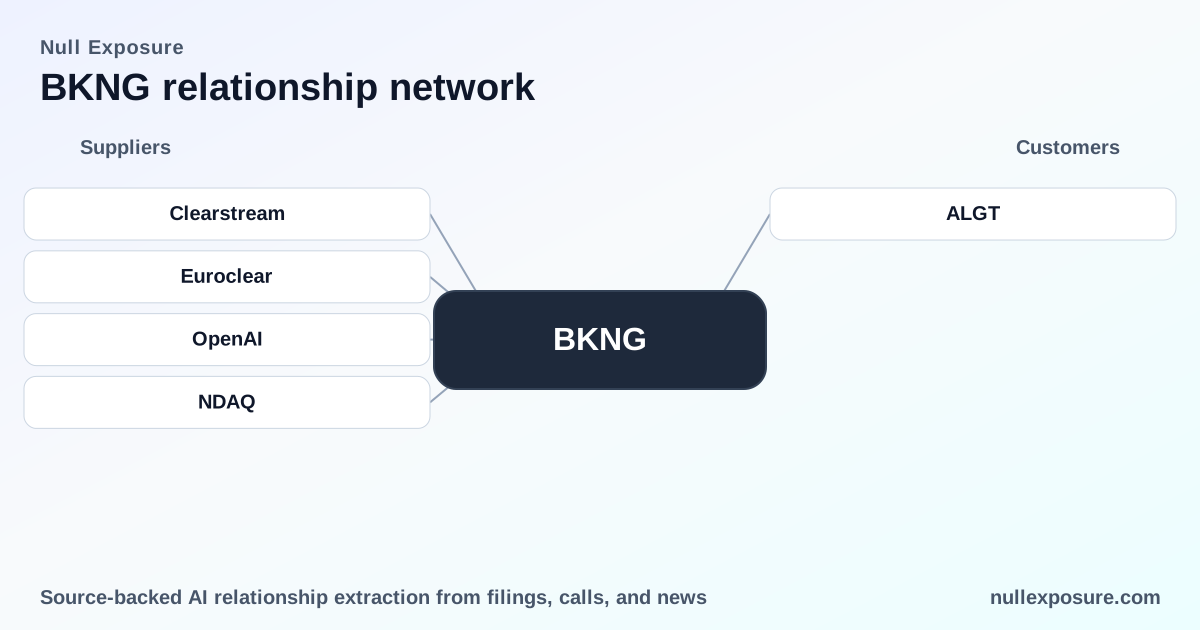
This section covers every relationship identified in the latest signals: Clearstream, Euroclear, Nasdaq Bond Exchange and OpenAI. Each entry gives a plain-English snapshot and the public source.
-
Clearstream — Booking intends to deliver newly issued notes in book‑entry form through Clearstream, which positions Clearstream as a settlement and custody route for the company’s debt instruments. This establishes a global euro-denominated custody pathway for institutional holders. The detail comes from the company’s FY2026 filing disclosed on StockTitan in March 2026.
-
Euroclear — Booking plans to use Euroclear alongside Clearstream for book‑entry delivery of the same notes, giving investors access to continental settlement infrastructure and improving cross-border liquidity for the issuance. This is disclosed in Booking’s FY2026 filing posted on StockTitan (March 2026).
-
Nasdaq Bond Exchange — Booking intends to list the notes on the Nasdaq Bond Exchange, which puts the exchange into the capital markets distribution strategy and increases secondary market visibility for the issuance. The intention to list the notes on Nasdaq Bond Exchange is described in the FY2026 filing referenced on StockTitan (March 2026).
-
OpenAI — Booking has a collaboration to enhance travel planning via ChatGPT, signaling a strategic technology partnership to embed generative AI features in customer workflows and demand generation. Coverage of this collaboration ran in March 2026 reporting from TradingKey, noting industry commentary that online travel agencies will leverage AI as a growth enabler.
Each of these relationships is drawn from public disclosures or press reports in March 2026; the company filing language about book‑entry delivery was included in a StockTitan-hosted SEC filing extract, while the AI collaboration was covered in a TradingKey market movers note.
How these ties translate into business constraints and contracting posture
Public excerpts and filing language produce clear company-level signals about Booking’s supplier posture:
-
Buyer behavior and marketing scale. The company lists marketing expenses that include search keyword purchases, affiliate programs and performance marketing, implying Booking is a high-volume buyer in digital marketing markets. That positions marketing suppliers for substantial spend but under performance-based and scalable commercial terms, not long-term fixed-price contracts.
-
Service-provider profile. Booking retains certain financial risks related to third‑party offerings (for example, insurance products underwritten by third parties). That language signals Booking often acts as a service provider/principal for specific merchandising or add-on services, which creates counterparty exposure for the third-party underwriters while Booking controls pricing and distribution.
-
Procurement scale and concentration. The firm disclosed almost $1.0 billion in non‑cancelable purchase obligations above $10 million (with $208 million payable within 12 months), a clear sign Booking operates at large, committed spend bands and will run predictable procurement cycles for high-value suppliers.
Together these company-level signals describe a supplier relationship profile where Booking is a large, sophisticated buyer that combines performance-based marketing contracts, principal-led ancillary offerings, and material purchase commitments. Suppliers should expect negotiated terms that prioritize scale, measurement, and indemnities aligned with platform risk allocation.
Risk and criticality implications for counterparties
-
Financial settlement and custody: Using Euroclear and Clearstream for bond delivery and Nasdaq Bond Exchange for listing signals robust capital market mechanics and institutional investor access; suppliers in banking, custody and brokerage services should treat Booking as a counterparty that will operate within standard institutional settlement rails and compliance frameworks.
-
Technology and distribution risk: The OpenAI collaboration elevates Booking’s product capability and search/intent capture; distribution partners in advertising and metasearch will face intensified AI-driven consumer routing, increasing competition for high-intent inventory while offering higher conversion opportunities.
-
Contracting expectations: The mix of performance-marketing buying behavior and principal-led services means suppliers will be evaluated on measurable ROI, integration depth, and capacity to scale. Booking’s disclosed purchase obligations demonstrate they execute large, contracted spends where timely delivery and SLAs matter.
Investment-angle takeaway for buyers and operators
- Booking is a high-quality platform counterparty with institutional capital-market behaviors and aggressive marketing buying. For marketing networks and fintech custody providers, that means steady flow but exacting contractual terms.
- AI partnerships accelerate product differentiation and raise the bar for suppliers to integrate on data and UX metrics. Advertising and channel partners who bring measurable lift will gain priority.
- Large committed spend creates negotiating leverage but also supplier stability: $986 million of long-dated purchase obligations signals substantial volume opportunities for qualified vendors.
For suppliers focused on growth through distribution or financial institutions considering settlement exposure, Booking’s structure favors scalable, measurable, and operationally disciplined partners.
If you would like a tailored supplier-risk briefing or counterparty scorecard for Booking Holdings, visit https://nullexposure.com/ to request a supplier analysis.
Final recommendation
Booking Holdings combines strong platform economics with institution-grade capital markets activity and selective technology collaborations. Suppliers and investors should treat Booking as a strategic, high-volume counterparty: align offers to performance metrics, prepare for institutional settlement requirements, and accelerate integrations that demonstrate measurable customer conversion. For more supplier intelligence and to commission a focused contractor-risk report, go to https://nullexposure.com/.