Baker Hughes (BKR): What the March 2026 syndicate tells investors about financing, partners and operational posture
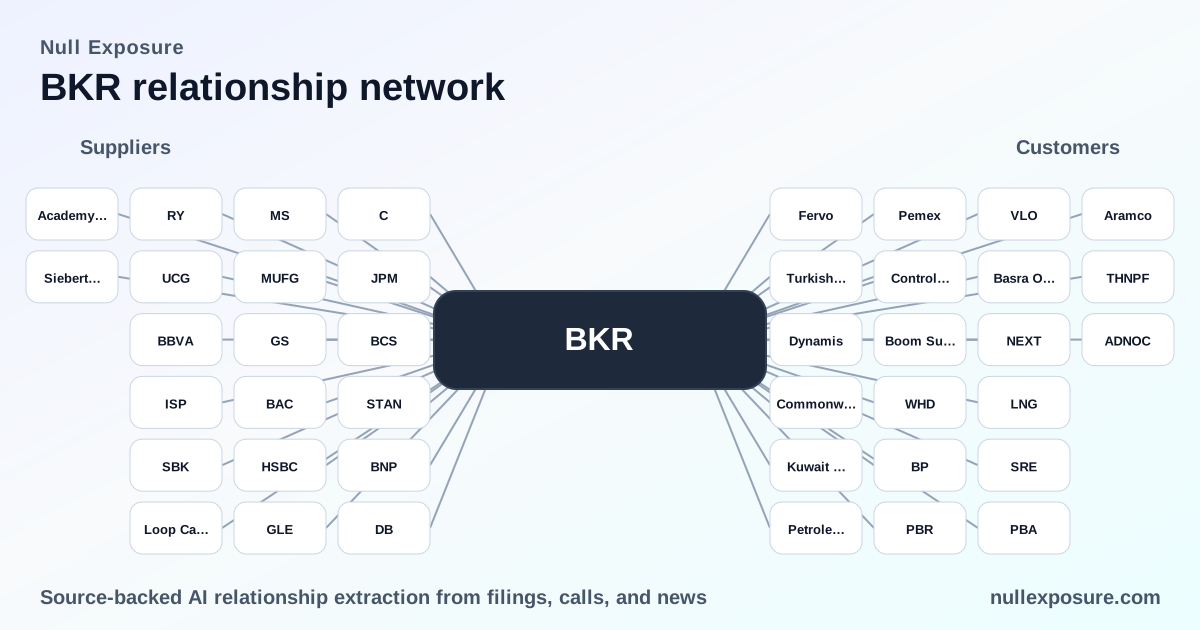
Baker Hughes is a global oilfield services and industrial technology company that monetizes through equipment sales, field services, and engineered solutions across drilling, completion and production; it finances strategic M&A with large debt issuances and broad bank syndicates. The company's March 2026 debt transactions to fund the Chart acquisition reveal a deliberate capital-markets strategy: tap deep, diversified syndicates to preserve operational liquidity while consolidating scale through M&A. For investors and operators assessing supplier and bank relationships, this syndicate is a practical indicator of Baker Hughes’ contracting posture, counterparty access and reliance on global capital markets.
Explore more supplier intelligence at https://nullexposure.com/.
Quick read: the financing in one line
Baker Hughes priced roughly $6.5 billion (USD) and €3 billion (EUR) offerings in March 2026, supported by a broad group of global investment banks that took structured roles as global coordinators, joint book-runners, senior co-managers, passive book-runners and co-managers. According to a QuiverQuant news release on March 9, 2026, the bank list is extensive and functionally distributed across those roles.
Who was on the syndicate — every named relationship and what they did
Below are each named firm from the announcement with a concise plain‑English description of their role. All observations derive from the March 9, 2026 QuiverQuant report on Baker Hughes’ debt offerings.
- Goldman Sachs & Co. LLC — Named as a joint global coordinator and joint book-running manager for the USD offering and a joint global coordinator/book‑running manager for the EUR offering. (QuiverQuant, March 9, 2026)
- Morgan Stanley & Co. LLC — Served as a joint global coordinator and joint book-running manager for the USD offering and coordinated on the euro deal via its international arm. (QuiverQuant, March 9, 2026)
- Citigroup Global Markets Inc. — Acted as a joint book-running manager for the USD offering; its global markets affiliate handled the euro side. (QuiverQuant, March 9, 2026)
- Citigroup Global Markets Limited — Participated as a joint book-running manager on the euro offering. (QuiverQuant, March 9, 2026)
- Deutsche Bank Securities Inc. — Listed as a joint book-running manager for the USD offering and involved through the London branch on the euro side. (QuiverQuant, March 9, 2026)
- Deutsche Bank AG, London Branch — Served as a joint book-running manager for the euro offering. (QuiverQuant, March 9, 2026)
- J.P. Morgan Securities LLC — Acted as a joint book-running manager on the USD deal. (QuiverQuant, March 9, 2026)
- J.P. Morgan Securities plc — Participated as a joint book-running manager for the euro offering. (QuiverQuant, March 9, 2026)
- Goldman Sachs & Co. International plc — Identified as joint global coordinator/book-runner on the euro issuance. (QuiverQuant, March 9, 2026)
- Morgan Stanley & Co. International plc — Named as a joint book-running manager for the euro offering. (QuiverQuant, March 9, 2026)
- BofA Securities, Inc. / Merrill Lynch International — Listed among passive book‑running managers for the USD offering and passive book‑runners on the euro issuance through Merrill Lynch. (QuiverQuant, March 9, 2026)
- Barclays Capital Inc. / Barclays Bank PLC — Functioned as a passive book‑running manager on the USD deal and as a passive euro book‑runner. (QuiverQuant, March 9, 2026)
- HSBC Securities (USA) Inc. / HSBC Bank plc — Participated as passive book‑runners on the USD and euro offerings respectively. (QuiverQuant, March 9, 2026)
- MUFG Securities Americas Inc. / MUFG Securities EMEA plc — Named as passive book‑running managers on the USD and euro offerings. (QuiverQuant, March 9, 2026)
- UniCredit Capital Markets LLC / UniCredit Bank GmbH — Served as passive book‑running managers for the USD and euro deals. (QuiverQuant, March 9, 2026)
- BNP Paribas / BNP Paribas Securities Corp. — Acted as senior co-manager on the euro and U.S. dollar offerings (BNP securities named among senior co-managers). (QuiverQuant, March 9, 2026)
- Société Générale / SG Americas Securities, LLC — Named as senior co-managers for the euro (Société Générale) and U.S. dollar offerings (SG Americas). (QuiverQuant, March 9, 2026)
- Standard Chartered Bank — Included as a senior co-manager for the USD offering and as senior co-manager on the euro side. (QuiverQuant, March 9, 2026)
- RBC Capital Markets, LLC / RBC Europe Limited — Listed among the co-managers for USD and euro tranches respectively. (QuiverQuant, March 9, 2026)
- Intesa Sanpaolo IMI Securities Corp. — Named as a co-manager for the USD offering. (QuiverQuant, March 9, 2026)
- BBVA Securities Inc. / Banco Bilbao Vizcaya Argentaria, S.A. — Served as co-managers on the USD and euro offerings respectively. (QuiverQuant, March 9, 2026)
- Academy Securities, Inc. — Listed as a co-manager on the USD offering. (QuiverQuant, March 9, 2026)
- Siebert Williams Shank & Co., LLC — Participated as a co-manager for the USD offering. (QuiverQuant, March 9, 2026)
- The Standard Bank of South Africa Limited — Acted as a co-manager on the USD offering, extending regional distribution reach. (QuiverQuant, March 9, 2026)
- Loop Capital Markets LLC — Named as a co-manager on the USD offering. (QuiverQuant, March 9, 2026)
- BBVA Securities Inc. (repeat listing) — Appears in the announcement as part of the USD co‑manager list. (QuiverQuant, March 9, 2026)
Note: several firms appear in paired U.S./European roles via their local legal entities—this is consistent with cross-border syndication and local placement requirements documented in the March 9, 2026 news release. (QuiverQuant, March 9, 2026)
What the syndicate composition tells operators and investors
The syndicate demonstrates broad global distribution and bank depth: top-tier global banks acted as coordinators, while a second tier of regional banks and specialty underwriters filled co‑manager roles. That structure is consistent with a high‑value acquisition financing strategy that balances execution certainty against pricing. For operators, the practical takeaway is that Baker Hughes relies on diversified capital partners rather than a small concentrated bank group, reducing single-counterparty funding risk. Learn how we map supplier and capital relationships at https://nullexposure.com/.
Constraints and what they mean for company-level risk and contracting posture
- Materiality: company filings indicate the pro forma effects of the Chart acquisition were described as not material to consolidated financial statements in post‑close commentary, which is a company-level signal that Baker Hughes structured disclosures to avoid material restatement requirements.
- Relationship role: public disclosures confirm Baker Hughes acted as the buyer in the Chart transaction, reflecting an acquisitive posture in 2025 and early 2026 that is funded by wholesale capital markets activity.
- Segment signal: separate corporate language identifies Altus Intervention as a leader in well intervention services, highlighting that services remain a core operational segment.
Together these constraints imply a company that contracts for scale through acquisitions, finances with syndicated debt, and treats some bolt‑on deals as operationally immaterial in disclosure terms.
Investor implications and risk checklist
- Strength: diversified bank access reduces refinancing and execution risk for large financing packages.
- Risk: leverage and integration. Financing $9.5 billion of combined USD/EUR issuance to fund a multibillion-dollar acquisition increases execution and integration risk for new assets and services lines.
- Counterparty exposure: broad but measurable — counterparties are global banks with market‑making capacity, which lowers counterparty credit concentration but increases reputational systemic linkage.
If you want a tailored counterparty map for your diligence or portfolio monitoring, visit https://nullexposure.com/ for more.
Bottom line
The March 2026 syndicate for Baker Hughes’ debt offerings signals a confident, market‑facing capital strategy: execute large acquisitions funded by diversified global banks, maintain service-led operational segments, and preserve disclosure lines that treat certain acquisitions as immaterial. For investors and operations managers, the primary focus should be on integration execution, leverage mechanics and monitoring bank distribution channels that underpin future access to capital.
Explore supplier relationship intelligence and tailored reports at https://nullexposure.com/ to turn these syndicate signals into actionable diligence.