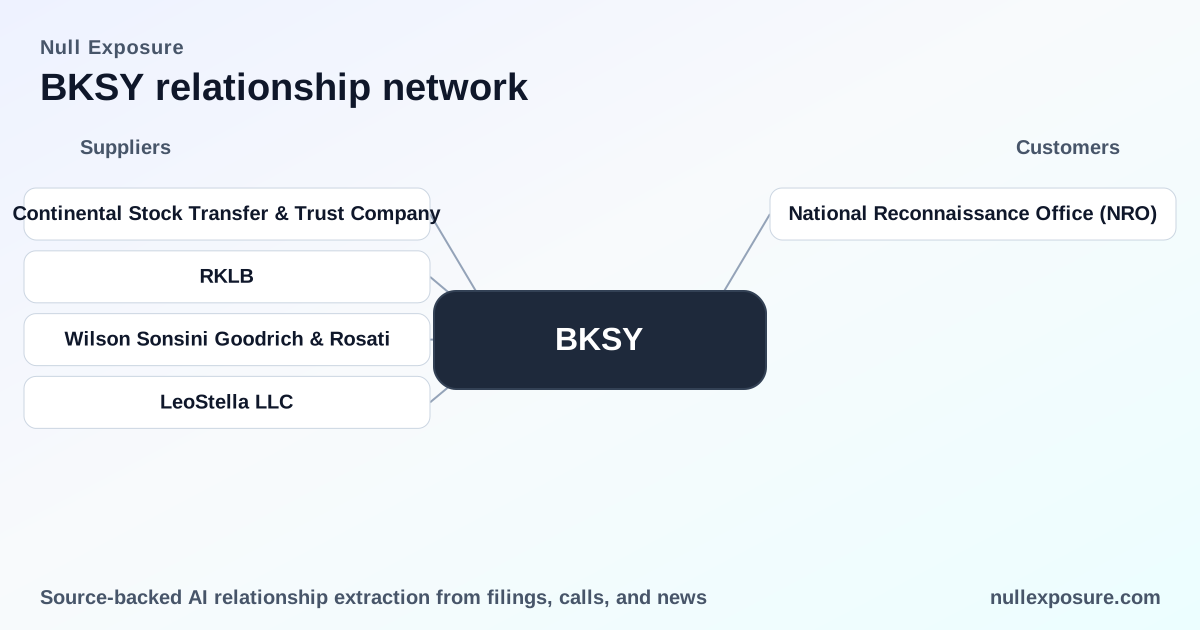
BlackSky Technology (BKSY): Supplier relationships and what they tell investors
BlackSky operates a vertically integrated geospatial intelligence business that monetizes imagery and analytics through recurring data services, government contracts, and satellite-enabled tasking. The company builds, launches, and operates a fleet of small satellites while selling subscription and mission-oriented analytics to defense, commercial, and infrastructure customers. For investors and operators evaluating supplier risk, the combination of launch partners, manufacturing ownership, legal and transfer agents, and outsourced ground station services defines both the cost structure and the execution footprint that drive revenue delivery and margin expansion. For a broader look at supplier risk analytics and how these relationships fit into a procurement map, visit https://nullexposure.com/.
How BlackSky makes money and what that implies for suppliers
BlackSky’s revenue mix is service-first: imagery tasking, analytics subscriptions, and government program contracts. That model requires three types of suppliers to work reliably together: manufacturers and integration partners for satellites, launch services, and ground and data operations providers. BlackSky’s acquisition of LeoStella gave the company direct control of a portion of its production line, reducing outsourcing for spacecraft integration; conversely, multi-launch contracts with Rocket Lab and third-party ground station agreements keep the company dependent on a handful of external execution partners.
Financially, BlackSky is in growth mode with Revenue TTM ~$106.6M and negative EPS (-2.09) while maintaining solid gross profit ($71.3M) but negative net margins, indicating ongoing investment in fleet expansion and operations. Institutional ownership is ~64%, signaling professional investor interest in the growth narrative. These facts translate into a contracting posture that blends in-house manufacturing with strategic supplier commitments and recurring third-party services. Learn more about supply-side intelligence at https://nullexposure.com/.
Supplier and partner map: the relationships you need on your scorecard
Below are the supplier and partner mentions present in public sources. Each relationship is summarized in plain English with a concise source reference.
Continental Stock Transfer & Trust Company
Continental Stock Transfer acted as the transfer and exchange agent for BlackSky’s 1-for-8 reverse stock split announced in FY2024, a transactional support role tied to corporate actions rather than operations. This is a routine corporate-services relationship used to execute capital-structure changes. (Source: StockTitan coverage of the reverse split, March 2026.)
Rocket Lab USA, Inc. (RKLB)
Rocket Lab is BlackSky’s primary launch partner for deploying Gen‑3 satellites under a multi-launch contract; Rocket Lab’s Electron vehicle has been tasked with at least four dedicated missions for BlackSky and completed encapsulation of a Gen‑3 satellite at Launch Complex 1. Rocket Lab’s role is operationally critical: launch cadence and reliability directly affect BlackSky’s ability to scale imagery capacity. (Sources: SahmCapital space-stocks weekly and Defence-Industry reporting on launch windows; MarketScreener notice regarding multi-launch contract, FY2025–early 2026.)
Wilson Sonsini Goodrich & Rosati
Wilson Sonsini served as legal advisor to BlackSky on a $46 million follow-on offering in FY2024, providing capital markets and securities counsel that enabled near-term financing and balance-sheet flexibility. Legal counsel in such offerings is an essential supplier for accessing public capital efficiently. (Source: Wilson Sonsini advisory note, referenced in March 2026 coverage.)
LeoStella LLC
BlackSky completed the acquisition of the remaining 50% of LeoStella, making it a wholly owned subsidiary in November 2024; this move increased BlackSky’s in-house satellite production and integration capabilities, improving control over the supply chain for spacecraft manufacturing and reducing reliance on external integrators. (Source: Quartz earnings coverage and company disclosure cited in March 2026.)
What the supplier mix reveals about BlackSky’s operating constraints
BlackSky’s relationship architecture shows a deliberate mix of internalization and outsourcing that shapes contracting posture, concentration, criticality, and maturity:
- Contracting posture: The company is moving from a heavily outsourced production model toward partial vertical integration (LeoStella acquisition) while still signing multi-launch commitments and outsourcing ground-station services. This hybrid posture reduces some supplier risk for spacecraft build but retains external execution dependency for launches and ground operations.
- Concentration: Launch services are concentrated—Rocket Lab is the obvious single large provider in the public record—which creates a single-provider concentration risk for deployment cadence and schedule-driven revenue. Ground station services are explicitly outsourced to third parties, representing another concentration point across operations.
- Criticality: All named suppliers are operationally critical in different ways: LeoStella affects build capacity, Rocket Lab affects launch delivery, and ground station/service providers affect data flow and tasking latency. Legal and transfer agents (Wilson Sonsini, Continental Stock Transfer) are critical for capital and corporate operations.
- Maturity: The company sits at a growth phase: recurring revenue and gross-profitable operations contrast with negative EPS and ongoing capital raises, indicating execution risk tied to scale rather than product-market fit.
A corporate-level constraint in public filings notes that BlackSky “has service agreements for ground station services to be performed by third-parties subsequent to December 31, 2024,” which is a company-level signal of outsourced ground operations and therefore a recurring operational dependency. This constraint is not tied to a specific vendor in the public excerpt, but it signals a material external reliance for data downlink, tasking, and latency-sensitive service delivery.
Mid-read takeaways and what to watch next
BlackSky’s supplier posture combines in-house production control with concentrated launch and outsourced ground operations, a configuration that accelerates scale but places a premium on supplier execution. Key watchpoints: scheduled Rocket Lab launches and manifest timing; integration ramp at LeoStella; follow-on financing and capital structure moves; and the operational performance of third-party ground stations.
- Watch launch cadence: Any delay or underperformance by Rocket Lab will directly delay revenue-bearing satellites.
- Monitor integration throughput: LeoStella’s ability to meet build schedules reduces launch queue delays.
- Track ground-station SLAs: Outsourced ground services control data flow and tasking responsiveness.
For investors and supply-chain operators who need structured supplier insight and ongoing monitoring, see how we map operational risk at https://nullexposure.com/.
Risk versus strategic upside — a final investor frame
BlackSky’s strategic upside comes from scaling a global imaging network and converting launches into recurring subscription revenue while capturing higher margin analytics. The primary risks are supplier concentration (notably launch dependency), third-party ground operations, and the funding requirement to support fleet growth. The acquisition of LeoStella materially improves manufacturing control and reduces one axis of supplier risk, while legal and transfer-agent relationships support capital transactions that enable growth.
Near-term indicators that will change the risk/reward profile include Rocket Lab launch performance and schedule adherence, LeoStella integration velocity, and ground-station service reliability under third-party contracts. Each of those factors is visible in the supplier map presented above and will determine whether BlackSky converts gross profit into sustained positive operating margins.
If you evaluate supplier risk or run procurement for a defense or commercial imagery program, BlackSky’s mix of vertical integration and strategic contracting deserves close monitoring. For a deeper supplier-risk brief and tailored monitoring, visit https://nullexposure.com/ to see how this supplier footprint maps onto counterparty risk and continuity planning.
Closing line: BlackSky has stitched together a supplier network that balances control and scale; execution on launches, integration, and ground operations will determine whether that architecture becomes a durable competitive advantage or a bottleneck to growth.