BankUnited (BKU) — supplier relationships and what they mean for investors
BankUnited operates as a regional U.S. banking franchise that earns through lending, deposit margins, and fee income across commercial and consumer portfolios. The company monetizes balance-sheet intermediation — originating loans and funding them with customer deposits and secured advances — while outsourcing specialized functions such as cybersecurity and incident response to external vendors to preserve operational scale and regulatory readiness. For investors, the supplier footprint is a direct window into where BankUnited outsources expertise that is critical to franchise continuity and regulatory compliance. Learn more at https://nullexposure.com/.
One supplier on the public record — what it is and why it matters
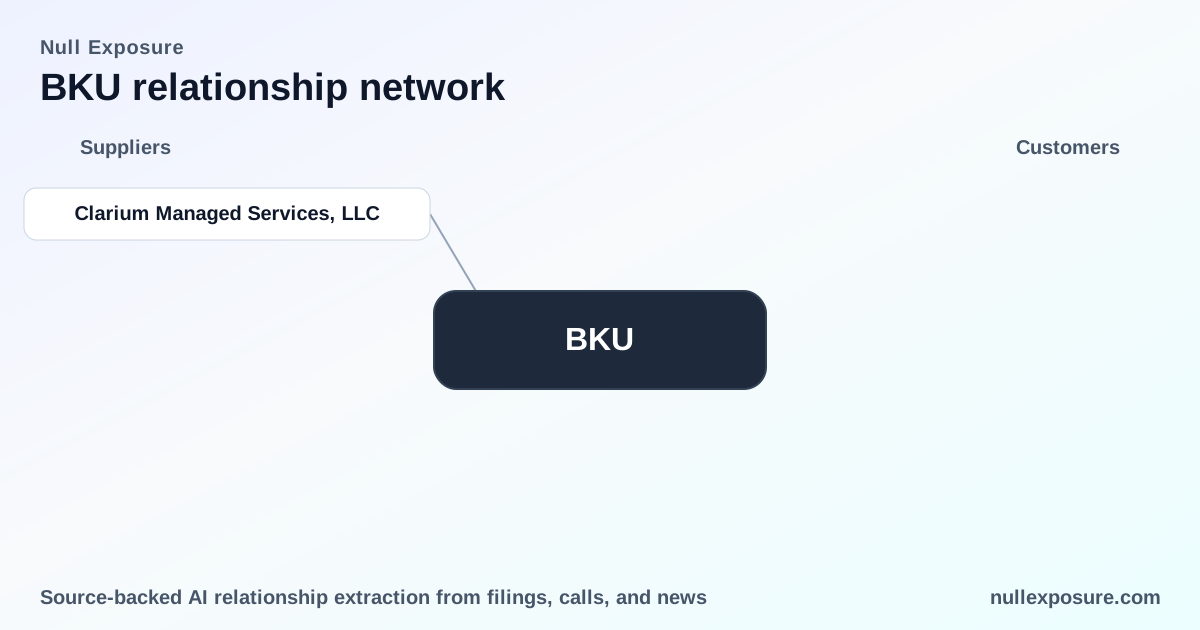
In the vendor disclosures available in BankUnited’s public filings, one named external provider appears: Clarium Managed Services, LLC. According to BankUnited’s Form 10‑K for the year ended December 31, 2024, Clarium conducted a cybersecurity assessment for the bank in 2022, a discrete engagement recorded in the company’s risk and controls narrative. The filing notes the assessment in the context of broader cybersecurity governance and vendor relationships, signaling that BankUnited uses outside specialists to validate controls and inform remediation priorities (10‑K, FY2024).
Takeaway: BankUnited engages external cybersecurity specialists for independent assessments, indicating an intentional outsourcing posture for high-expertise security functions.
What the named relationship implies about BankUnited’s operating model
Clarium’s engagement is short and focused in description, but the company-level language around cybersecurity reveals several operating model characteristics investors should register:
- Contracting posture: BankUnited purchases specialist services and retains incident response capabilities through external providers rather than building all capabilities in-house. The 10‑K describes cybersecurity service provider engagements and an “industry‑leading incident response retainer,” demonstrating a preference for retaining external expertise to supplement internal teams (10‑K, FY2024).
- Criticality: Cybersecurity and incident response are treated as mission-critical vendor interactions. The explicit disclosure of assessments and retainers places these suppliers high on the bank’s vendor priority list.
- Maturity: The presence of retained incident response arrangements and periodic third‑party assessments signals a mature vendor management approach that aligns with regulatory expectations for banks of this scale.
- Concentration signals (company-level): Separately, BankUnited discloses reliance on government‑related counterparty infrastructure for liquidity: as of December 31, 2024, the bank had $14.9 billion of pledged securities and real estate loans as collateral for advances and letters of credit from the Federal Home Loan Bank (FHLB). That disclosure functions as a company-level signal about funding counterparties rather than a supplier for professional services (10‑K, FY2024).
Bold investor read: BankUnited combines internal controls with external specialist retainers for high‑stakes functions; the firm runs a vendor model geared toward rapid response and regulatory alignment rather than vendor consolidation for cost savings alone.
Each disclosed relationship, in plain English
- Clarium Managed Services, LLC conducted a cybersecurity assessment for BankUnited in 2022, as disclosed in the company’s Form 10‑K covering fiscal 2024. This engagement is cited in the bank’s cybersecurity and incident response narrative (BankUnited 10‑K, FY2024).
How these supplier characteristics affect investor risk and value
The supplier posture and the adjacent funding disclosures create a clear set of investor implications:
- Operational resilience is outsourced but robust. By retaining incident response and commissioning assessments, BankUnited externalizes specialized functions while preserving rapid remediation capabilities; this reduces single‑point internal skill risk but increases dependency on third parties.
- Vendor risk is material to enterprise risk. Cybersecurity service providers are effectively part of the bank’s control environment; failures in vendor performance or disruptions to those contracts carry direct operational and regulatory consequences.
- Funding counterparty concentration is a separate but related risk. The $14.9 billion pledged as collateral to the FHLB shows material interaction with a government-sponsored counterparty, which affects liquidity availability and constraints on asset encumbrance in stressed scenarios (10‑K, FY2024).
- Governance and maturity lower headline risk but increase contract diligence requirements for investors. The presence of retainers and independent assessments signals that BankUnited invests in vendor governance; investors should review frequency, scope, and remediation follow-through when assessing operational risk exposure.
Midstream action: for managers or analysts who want ongoing monitoring of supplier traces and filings, visit https://nullexposure.com/ for related coverage and tracking tools.
Practical monitoring checklist for investors
Track these items in quarterly filings and vendor disclosures to translate supplier signals into portfolio action:
- Frequency and scope of external cybersecurity assessments and whether the bank discloses remediation timelines.
- Nature and duration of incident response retainers, including escalation protocols and testing frequency.
- Any expansion of the vendor list that moves from advisory assessments to outsourced operational control.
- Changes to pledged collateral and FHLB exposures that shift liquidity or counterparty concentration.
Key risk callout: vendor performance and funding counterparties are twin vectors for operational stress; both should be incorporated into downside scenario analysis for regional bank equities.
Conclusion — investor action and final recommendations
BankUnited runs a deliberate vendor model for cybersecurity and demonstrates funding ties to government‑sponsored liquidity providers. These are not incidental disclosures; they are core to how the franchise protects deposits, operates its IT estate, and manages liquidity. Investors should treat cybersecurity service relationships as an element of enterprise risk comparable to credit and market exposures, and they should monitor the scope and continuity of those supplier arrangements in each filing cycle.
For deeper supplier and filing-level analysis on BankUnited and comparable regional banks, see the research hub at https://nullexposure.com/. If you need ongoing tracking for vendor disclosures and counterparty exposures across the banking sector, sign up at https://nullexposure.com/ for tailored alerts and briefings.