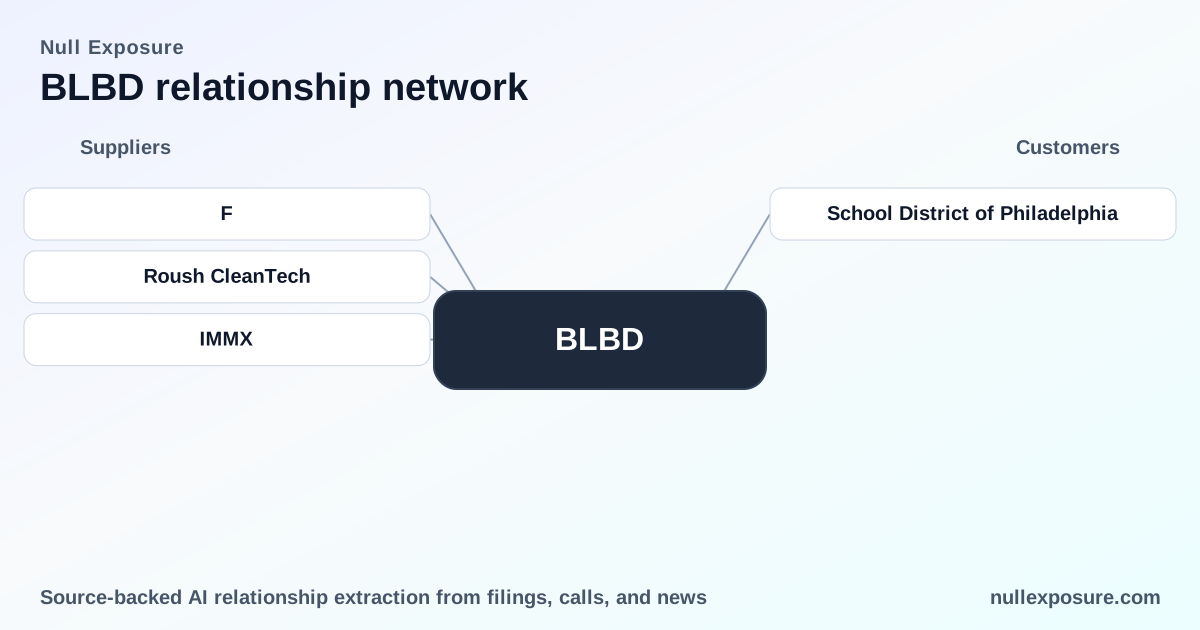
Blue Bird (BLBD) — Supplier Map and Investment Implications
Blue Bird manufactures school buses and monetizes through vehicle sales, aftermarket parts, and warranty/ service contracts; its economics depend heavily on vendor-supplied powertrains and safety systems that are integrated into finished vehicles and sold to school districts and fleet operators. The company's supplier posture is characterized by concentrated, long-term sourcing of core components (engines, transmissions, safety systems) that convert supply relationships directly into product differentiation and delivery capacity. For a quick supplier-focused due diligence briefing, visit https://nullexposure.com/.
Why suppliers matter to investors: a short investor thesis
Blue Bird’s revenue and gross-margin trajectory is closely tied to the stability and terms of its supplier agreements. When engines and critical subsystems are single-sourced and governed by long-term contracts, Blue Bird secures continuity of production but accepts concentrated counterparty risk and spend commitment. Investors should view supplier dynamics as a primary operational lever for margin compression or expansion and for capital planning.
What the supplier list looks like and what each relationship actually delivers
Ford — long-horizon powertrain partner
Blue Bird extended its collaboration with Ford through 2030 to deliver cleaner-powered school buses, and it has budgeted development funding to commercialize a rear-engine Type D bus powered by a Ford engine tied to propane fueling systems. Ford supplies core engines that anchor Blue Bird’s powertrain roadmap and product launches. Source: TradingView summary of Blue Bird SEC 10‑K and an LPGasMagazine item describing a $2.4 million project commitment (FY2025) (https://www.tradingview.com/news/tradingview:ebf63008dbdfe:0-blue-bird-corp-sec-10-k-report/; https://www.lpgasmagazine.com/nexio-blue-bird-among-approved-perc-projects/).
Roush CleanTech — propane engine and fueling system supplier
Roush CleanTech is the provider of propane-fueled engines and fueling systems used on Blue Bird buses, including vehicles deployed in school districts where the switching from diesel reduces emissions; Blue Bird’s joint projects with Ford and Roush are resourced and extended into the next decade. Roush supplies the alternative-fuel engine technologies that enable Blue Bird to offer lower-emission options and to access fleet procurement programs prioritizing non-diesel solutions. Sources: LPGasMagazine project coverage (FY2025) and a school-district deployment report noting Roush-powered buses (FY2024) (https://www.lpgasmagazine.com/nexio-blue-bird-among-approved-perc-projects/; https://www.lpgasmagazine.com/school-district-of-philadelphia-adds-propane-buses/).
IMMI — onboard safety systems provider
IMMI’s 4Front airbag safety system is now standard equipment on Blue Bird’s Vision-model school buses, reflecting a supplier-driven upgrade to occupant safety across that product line. IMMI supplies a standardized active/passive safety module that both improves product differentiation and reduces Blue Bird’s exposure to third-party safety retrofits. Source: regional industry release covering IMMI and Blue Bird plant activity (FY2025) (https://stnonline.com/industry-releases/immi-blue-bird-celebrate-opening-of-new-manufacturing-plant-in-macon-georgia/).
How the supplier relationships translate into company-level operating constraints
Blue Bird discloses long-term sourcing behavior and material purchase commitments that shape its capital and procurement posture. As of September 27, 2025, long-term supply contracts covered approximately 65% of the value of purchases, reflecting an intentional lock-in of price and supply for major components and single-source arrangements for engines and transmissions. The company recorded total purchase commitments of $107.0 million, with $106.5 million expected to be paid in fiscal 2026, signaling near-term cash flow and working-capital implications for suppliers and Blue Bird alike. These are company-level constraints that inform negotiating leverage, concentration risk, and forecastable spend. Source: Blue Bird filing language summarized in company disclosures (as of 9/27/2025).
- Contracting posture: Predominantly long-term coverage for the majority of purchase value reduces spot-price volatility but raises switch costs.
- Concentration and criticality: Engines and transmissions are single-sourced from major OEMs, making supplier continuity critical to production cadence.
- Maturity and spend scale: Commitment-levels north of $100M indicate meaningful, predictable procurement obligations that institutionalize supplier relationships.
For supplier-risk modeling or vendor exposure monitoring, the practical implication is that Blue Bird’s operations are not fungible across many small vendors—major suppliers are deeply embedded.
Investment risks and operational levers tied to suppliers
- Counterparty concentration risk. A supply disruption or price shock from an OEM engine provider would have outsized effects on production and order fulfilment given the single-source posture.
- Contracted spend is a liquidity lever. The $107M purchase commitment front-loads cash outflows and creates contingent financing pressure during demand troughs.
- Product differentiation depends on supplier roadmaps. Partnerships with Ford and Roush enable low-emission product variants; losing access to those powertrains would blunt Blue Bird’s competitive edge in eco-conscious procurement programs.
- Regulatory and fleet procurement tailwinds. Supplier-enabled propane and safety systems position Blue Bird to capture municipal and school-district replacement cycles that specify emissions and safety standards.
Practical takeaways for investors and operator-level counterparties
- Evaluate counterparty backup plans. Given the single-source nature of engines and transmissions, investors should prioritize disclosure on second-source development or dual-sourcing timelines.
- Stress-test working-capital under different demand scenarios. The near-term purchase-pay schedule implies limited flexibility if order volumes drop.
- Monitor supplier contract extensions and development funding. The Ford/Roush extension to 2030 and specific development grants are positive signals for product continuity and roadmap alignment.
If you want a concise exposure map and provider-level risk scoring for Blue Bird’s supplier set, start here: https://nullexposure.com/.
Closing guidance and next steps
Blue Bird’s supplier relationships are strategically deliberate and commercially binding: long-term contracts and single-source OEM suppliers produce both stability in production and concentrated counterparty risk. For investors, the correct prism is not whether suppliers exist—it's how contractual terms, spend commitments, and technological dependencies convert into throughput risk, margin pressure, or competitive advantage. For operators and procurement teams, these supplier arrangements define negotiation bandwidth and contingency playbooks.
For a deeper supplier-risk profile and to connect this supplier analysis to credit and revenue models, review the full supplier exposure tools at https://nullexposure.com/.