Bausch + Lomb (BLCO) supplier map: what investors need to know about concentration, contracts and near-term dependencies
Bausch + Lomb monetizes its ophthalmic portfolio by combining direct sales with strategic licensing, private‑label manufacturing and distribution partnerships. The company generates revenue through branded and acquired consumer products, prescription therapeutics it commercializes under license, and third‑party manufactured finished goods sold under its name — a model that leverages outside partners for scale while keeping commercialization and customer relationships in house. For investors, the key economic drivers are product ownership (branded vs. licensed), the degree of third‑party manufacturing, and the company’s contracting posture around exclusivity and milestone payments.
For a structured supplier-risk view and relationship playbook, visit https://nullexposure.com/ to explore the full supplier intelligence offering.
Quick read: where the supply risk lives and why it matters
BLCO relies materially on third‑party manufacturing: approximately 37% of product sales in 2024 are produced wholly or partly by external manufacturers, which creates measurable concentration and operational leverage to supplier performance. The company also acknowledges single‑source exposure for certain components and APIs, which elevates the operational and pricing risks for critical product lines. Contract terms reflect a mixed posture: BLCO pursues contractual obligations with manufacturers but accepts private‑label arrangements in which suppliers retain IP and exclusive manufacturing rights. These are not academic points — they shape how quickly BLCO can respond to supply shocks, price pressure or competitor product entries.
What the relationship roster looks like (each relationship covered)
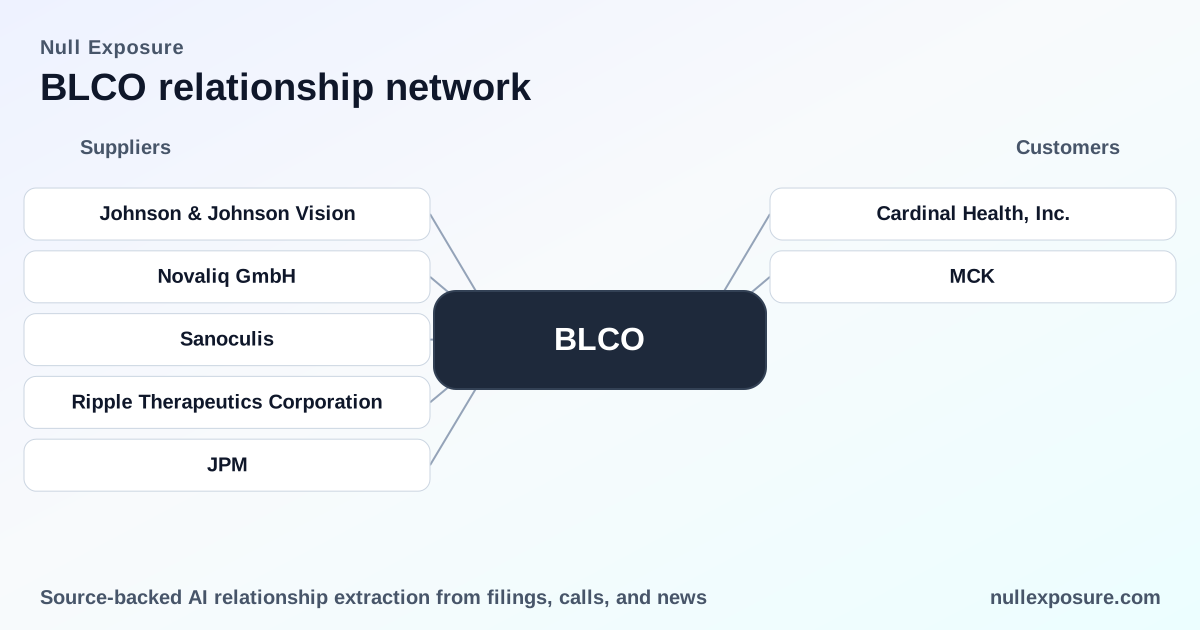
Below are the supplier and partner relationships disclosed in public filings and trade reporting, with plain‑English summaries and source notes.
-
Johnson & Johnson Vision — BLCO acquired the Blink OTC product line of eye and contact lens drops from Johnson & Johnson Vision in July 2023, folding those consumer products into its commercial franchise. This acquisition signals a strategy of buying established consumer brands to grow OTC revenues. According to BLCO’s FY2024 10‑K, the Blink OTC line was acquired in July 2023 (FY2024 10‑K filing).
-
Novaliq GmbH — BLCO holds an exclusive U.S. and Canada license to commercialize MIEBO (perfluorohexyloctane), previously called NOV03, for treating dry eye disease, with sales‑based milestone payment obligations under a December 2019 agreement. This positions BLCO as the North American commercialization partner for a licensed therapeutic with contingent payout structure. The FY2024 10‑K outlines the December 2019 license and potential sales‑based milestone payments (FY2024 10‑K filing).
-
Sanoculis — BLCO agreed to purchase the MIMS product from Sanoculis for distribution in various European countries, indicating a regional distribution arrangement that supplements BLCO’s European product portfolio. The agreement frames Sanoculis as a supplier of finished product for BLCO’s European distribution channels (FY2024 10‑K filing).
-
Ripple Therapeutics Corporation — An affiliate of BLCO is collaborating with Ripple Therapeutics on an evaluation program and licensing option to develop sustained‑release ophthalmic implants, a development‑stage R&D and licensing collaboration that could expand BLCO’s pipeline in specialty ophthalmics if the program advances. This collaboration was reported in a December 2025 EyesOnEyecare news item describing the evaluation program and licensing option (EyesOnEyecare, December 3, 2025).
-
JPMorgan Chase (and participating lenders) — JPMorgan Chase is counterparty to BLCO’s credit facility amendments and lender syndicate activity; this relationship is financial rather than a supply relationship but is material to liquidity and covenant posture. TradingView coverage in March 2026 documented BLCO signing a fourth amendment to its credit agreement with JPMorgan Chase and participating lenders (TradingView, March 2026).
How these relationships translate into business constraints and operating posture
BLCO’s supplier profile shows a hybrid operating model: significant outsourced manufacturing, targeted licensing for therapeutics, and selective M&A to bolster OTC and finished‑goods portfolios. From the company‑level signals in filings:
- Concentration risk is material. With roughly 37% of sales produced by third parties, BLCO carries meaningful dependency on external manufacturers for both volume and timing (company FY2024 disclosure).
- Some inputs are single‑sourced and therefore critical. The company explicitly flags components and APIs only available from limited suppliers, a structural vulnerability that can drive price spikes or production interruptions.
- Contracting posture mixes protection and limitation. BLCO attempts to impose contractual obligations on third‑party manufacturers but accepts that compliance cannot be guaranteed; private‑label agreements give suppliers IP and exclusive manufacturing control in some cases, constraining BLCO’s ability to reshore or redirect production quickly.
- Supplier roles are diverse. Third parties act as manufacturers, distributors, and general service providers, which increases operational complexity but also spreads execution risk across vendors.
These characteristics together create a moderate to high supplier risk profile: predictable under steady demand, but exposed to outsized impact from supply disruptions, IP constraints in private‑label arrangements, or unexpected capacity shifts.
Investment implications and what to watch next
- Near‑term execution hinge: integration and commercialization of acquired consumer lines (e.g., Blink OTC) and successful launch milestones for licensed therapeutics (MIEBO) will drive revenue mix and future margin expansion; monitor sales milestones and timing of milestone payments tied to Novaliq.
- Supplier concentration metrics: watch any issuer updates that quantify reliance on single suppliers for APIs or finished products beyond the existing 37% third‑party manufacturing disclosure. A move toward greater vertical integration or alternative suppliers would reduce near‑term operational risk.
- Liquidity and covenant flexibility: credit agreement amendments with JPMorgan and lenders are relevant to capital allocation for M&A and licensing payouts; changes in covenant terms will affect BLCO’s ability to fund commercialization and milestone obligations (TradingView, March 2026).
For a deeper, transaction‑level view of these supplier relationships and historical contract language, visit https://nullexposure.com/ and see the detailed supplier intelligence hub.
Practical risk management for operators and sourcing teams
Operators should treat these supplier relationships as strategic assets: enforceable quality provisions, clear contingency sourcing clauses for single‑sourced APIs, and milestone‑aligned payment schedules for licensed therapeutics reduce execution risk. Prioritize audits of private‑label manufacturers who retain IP and negotiate step‑in or transfer rights where possible to preserve supply continuity.
For investors, the path to de‑risking value is clear: successful commercialization of licensed therapeutics, stable integration of acquired OTC lines, and demonstrable diversification of single‑source suppliers will all materially improve BLCO’s earnings stability and downside protection. To track changes in supplier concentration and contract terms over time, consult the BLCO supplier database and analysis tools at https://nullexposure.com/.
Bottom line
Bausch + Lomb’s supplier mix is intentionally hybrid: acquisitions and licenses expand commercial reach while third‑party manufacturers supply scale. That model offers strong upside through brand and pipeline leverage, but it carries concentrated operational risk—about 37% externally produced sales and explicitly single‑sourced inputs—that investors must price into valuations. Monitor milestone schedules, supplier diversification moves, and credit facility flexibility to assess the company's ability to convert strategic assets into predictable cash flow.