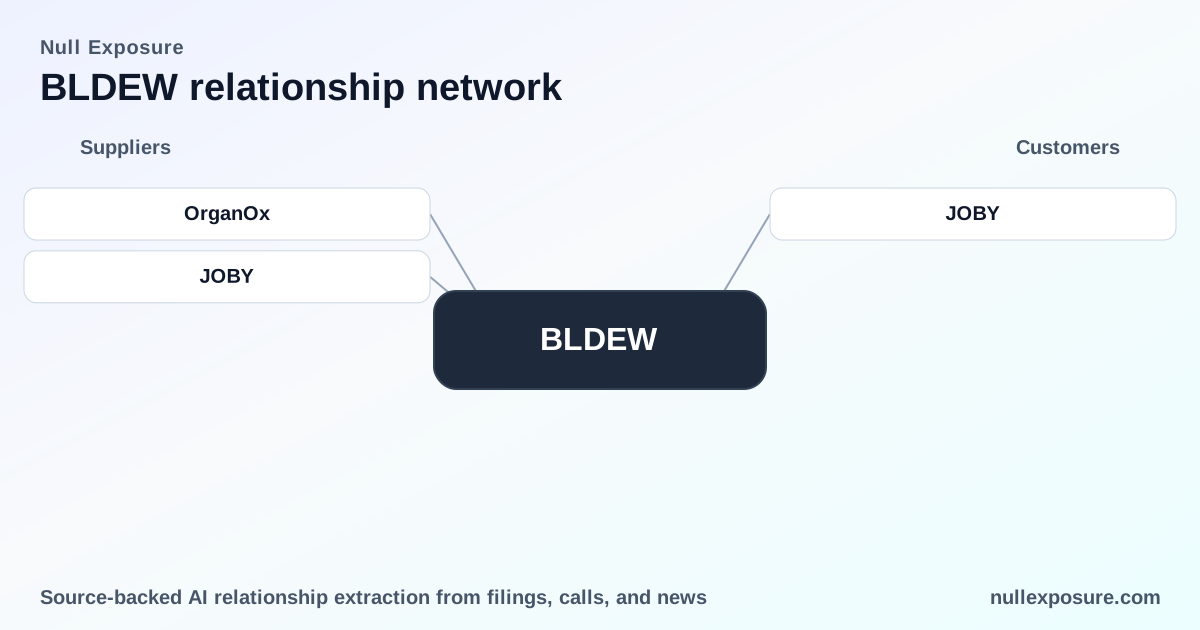
BLDEW supplier relationships: strategic partners and what they mean for investors
BLDEW monetizes through supplier partnerships and operational access agreements that extend its service footprint into specialized medical logistics and next‑generation aviation for healthcare. The company converts long‑term access and accommodation commitments from partners into recurring revenue streams and differentiated service capabilities, positioning itself as an integrator between healthcare technology providers and field logistics operators. For investors this is a play on operational optionality—BLDEW sells access and capability rather than a single product—and on the company’s ability to lock in premium routes and use cases tied to specialized suppliers. Read more company-level intelligence at https://nullexposure.com/.
Why these two supplier agreements matter to BLDEW’s business model
BLDEW’s public disclosures show a focused supplier strategy that emphasizes flexibility to adopt new technology and longer-term access contracts. These attributes influence contracting posture, supplier concentration risk, and the criticality of individual partners:
- Contracting posture: BLDEW positions itself as an accommodating integrator that will “go to lengths” to accept new technology, signaling a proactive supplier management approach that supports bespoke integrations and potentially higher service margins.
- Concentration: The current public record lists a small number of named supplier partners, which implies concentration risk but also strategic depth in each relationship—each partner delivers material capability rather than commodity inputs.
- Criticality: Relationships that grant access to unique assets (for example, eVTOL aircraft for medical use) are operationally critical because they unlock route economics and premium service levels that are hard to replicate.
- Maturity and runway: The agreements disclosed are positioned as growth enablers rather than legacy contracts, indicating BLDEW is in an execution phase where partner rollouts and operational scaling determine near‑term value capture.
These are company‑level signals derived from public filings and earnings commentary rather than vendor‑level contract text.
All supplier relationships surfaced in public reporting
Below are every supplier relationship referenced in BLDEW’s public earnings call snippet set, with a concise plain‑English summary and source reference.
OrganOx
OrganOx is a partner whose technology BLDEW commits to accommodate broadly to ensure the company can “always say yes” to customer requests for new medical technology integrations, highlighting BLDEW’s operational willingness to support innovative devices. According to BLDEW’s 2025 Q2 earnings call (first reported March 7, 2026), the company stressed the lengths it will go to accommodate OrganOx’s technology.
Joby (JOBY)
BLDEW’s Strata unit entered a long‑term partnership to gain access to Joby eVTOL aircraft for medical use across Joby’s operational footprint, securing a unique access channel for rapid aerial medical transport. This arrangement was disclosed in BLDEW’s 2025 Q2 earnings call (first reported March 7, 2026).
What each supplier relationship means operationally and for valuation
OrganOx: strategic integration with cutting‑edge medical tech
BLDEW’s commitment to integrate OrganOx technology signals an intent to be a platform for specialized medical logistics rather than a generic carrier. That posture supports premium pricing on routes that require specialized devices and trained handling, and it demonstrates BLDEW’s sales and operations focus on healthcare verticals where margin structures differ from commodity transport. The earnings commentary frames OrganOx as an example of BLDEW’s service promise to customers, implying that the partnership functions as both an operational capability and a sales differentiator.
Joby: access to eVTOLs as a route economics lever
Securing long‑term access to Joby eVTOL aircraft is a structural value driver: airborne, point‑to‑point medical transport reduces transit time and expands market reach, which lifts per‑shipment willingness to pay. For investors, the Joby relationship converts future aviation technology into today’s addressable market expansion and gives BLDEW an early foothold in airborne medical logistics—an area commanding premium pricing for speed and time‑sensitive care.
Risk profile investors must price in
- Supplier concentration risk. Public disclosures list a small number of named partners; each individual relationship carries outsized operational importance and therefore idiosyncratic risk if integration or deployment falters.
- Execution dependence. BLDEW’s monetization depends on successful field deployment and adoption of partner technologies; execution shortfalls will compress projected premium revenue.
- Technology and regulatory dependencies. Access to eVTOLs and advanced medical devices involves regulatory gates and certification timelines that affect revenue realization schedules. BLDEW’s willingness to accommodate new tech is an asset, but it also ties the company to the pace of external approvals.
Key takeaway: BLDEW’s supplier strategy trades broader diversification for concentrated, high‑value partnerships that boost margins if operational execution holds.
For deeper competitive and counterparty intel, visit https://nullexposure.com/ for a full supplier and risk profile.
How these partnerships influence commercial bargaining and growth strategy
BLDEW’s public comments show a contracting posture that is proactive and partnership‑oriented: the company commits to accommodate partner innovations and to secure long‑term access to differentiated assets. That posture supports a growth strategy centered on vertical specialization (healthcare logistics) rather than horizontal scale alone, and it increases value per route by embedding scarce capability into BLDEW’s service offering.
From a commercial negotiating standpoint, BLDEW gains leverage from exclusivity of access (for example, Joby eVTOLs for medical use) but also creates dependence on its supplier network. Investors should model for both upside from premiumized routes and downside from single‑partner disruptions.
Practical next steps for investors and operators
- Evaluate BLDEW’s operational rollout cadence for each partner and tie revenue recognition expectations to deployment milestones rather than headline partnership announcements.
- Stress‑test valuation scenarios for supplier disruption, particularly for Joby access and any regulatory delays.
- Monitor customer adoption curves on routes using OrganOx technology to verify willingness to pay for the specialized service.
If you want ongoing monitoring of BLDEW’s supplier relationships and counterparty risk, start with the company profile at https://nullexposure.com/ and subscribe for supplier‑level alerts.
Closing recommendation
BLDEW is positioning itself as a specialized integrator by converting supplier access into differentiated service offerings that command higher margins. The two public supplier relationships—OrganOx and Joby—are strategically aligned with a healthcare logistics playbook: they increase per‑shipment economics and expand addressable markets, but they also concentrate operational risk. Investors should value BLDEW with a premium for its differentiated access while applying scenario analysis for partner execution and regulatory timelines.
For full supplier mapping and real‑time relationship tracking, visit https://nullexposure.com/.