Ballard Power Systems (BLDP): supplier relationships that shape commercialization and risk
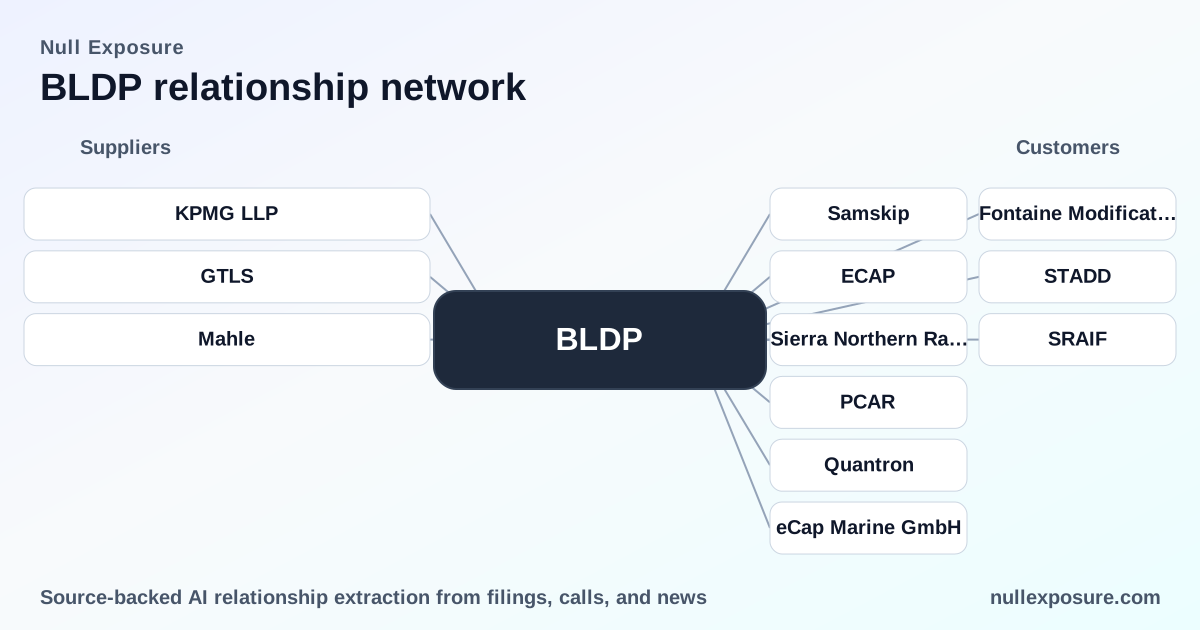
Ballard Power Systems sells proton-exchange membrane fuel cell stacks and integrated power systems to heavy-duty OEMs and system integrators, monetizing through product sales, engineering services and strategic co-development agreements with vehicle and hydrogen infrastructure partners. The supplier relationships documented in recent disclosures and press coverage show Ballard operating as the prime system architect for fuel cell solutions while outsourcing complementary subsystems and relying on established professional services for governance — a model that accelerates time-to-market but concentrates technical and commercial risk in a small set of strategic partners.
For a concise hub of supplier intelligence and relationship tracking, visit the Null Exposure home page: https://nullexposure.com/
Why these partnerships matter for investors now
Ballard’s commercial pathway to scale in heavy-duty transport depends on two structural dynamics evident in the relationships below: technical integration with hydrogen hardware suppliers and outsourced balance-of-plant execution by Tier 1 automotive suppliers. When Ballard is the prime integrator, customers buy a packaged propulsion solution; when partners supply fuel-handling or thermal/electrical subsystems, Ballard accelerates validation cycles but becomes dependent on the partner’s execution and certification timelines.
- Contracting posture: Ballard is taking the lead on system design and the fuel cell stack in co-development work, signaling a supplier posture that preserves core intellectual property and product control while delegating non-core subsystems to third parties.
- Concentration and criticality: Current public disclosures name a small set of strategic partners; each is functionally critical — Chart for hydrogen fuel systems and Mahle for balance-of-plant — so individual partner delays can have outsized impact on program schedules.
- Maturity and commercialization cadence: Demonstrations with established industrial partners reflect a move from prototype to demonstration-stage integration, an inflection point where supplier execution, homologation and scale manufacturing become decisive.
Explore supplier profiles and relationship histories at Null Exposure: https://nullexposure.com/
Supplier relationships you need to track
KPMG LLP — Ballard’s external auditor
Ballard re‑appointed KPMG LLP as its auditor at the 2025 annual general meeting, a governance continuity signal that supports investor confidence in reported financials and controls. (Ballard press release on results of the 2025 AGM, March 9, 2026: https://www.ballard.com/press-release/ballard-power-announces-results-of-2025-annual-general-meeting-of-shareholders/)
Chart Industries, Inc. (GTLS) — hydrogen fuel system compatibility and demonstration partner
A joint demonstration confirmed that heavy‑duty vehicles powered by Ballard fuel cells can use Chart’s HLH2 vehicle fuel systems for liquid hydrogen, directly validating compatibility between Ballard’s stacks/systems and Chart’s onboard cryogenic fuel handling hardware. (ADVFN report, March 2026: https://br.advfn.com/bolsa-de-valores/nyse/GTLS/share-news/87155391/ballard-and-chart-successfully-test-a-fuel-cell-powered-by-liquid-hydrogen)
Mahle — balance‑of‑plant and assembly collaborator
Ballard has prime responsibility for the system design and the fuel cell stack sub-system while Mahle is responsible for balance‑of‑plant components, thermal management, power electronics and system assembly for the complete fuel cell system, positioning Mahle as the Tier‑1 execution partner for integration and manufacturing scale. (TruckingInfo coverage of the Ballard–Mahle collaboration, March 2026: https://www.truckinginfo.com/news/ballard-mahle-collaborate-on-fuel-cell-propulsion-systems)
How to interpret these relationships as an investor or operator
These relationships form an operating architecture that balances Ballard’s core IP control against partner capabilities:
- Commercial validation increases when partners are established OEM suppliers. Chart and Mahle bring industrial credibility and customer channels that accelerate adoption in heavy‑duty fleets; successful demonstrations convert technical risk into procurement conversations.
- Execution risk is concentrated. With Ballard leading stack design and partners supplying key subsystems, single‑partner delays (supply, certification, thermal/hydraulic integration) generate downstream program slippage and potential warranty or performance exposure.
- Governance continuity is intact. Reappointment of a Big Four auditor signals stable reporting and internal control posture, which is material for underwritten commercial arrangements and institutional buyers.
Key indicators to monitor: order intake from OEMs, partner milestone delivery dates, certification status for vehicle platforms, and any supplier change notices from Chart or Mahle that would affect deliveries.
What this means for portfolio risk and opportunity
- Upside: Demonstrations with Chart and a manufacturing/assembly partner like Mahle validate Ballard’s route to productized propulsion systems that buyers can integrate into vehicle platforms with minimized engineering lift. That drives addressable revenue through systems, recurring stack replacements, and service.
- Downside: The small roster of visible strategic partners creates concentration risk: a delay or quality issue with Chart’s fuel systems or Mahle’s balance‑of‑plant work cascades into schedule and revenue risk for Ballard’s customers. Operational due diligence should emphasize partner contracts, milestones, and penalty/acceptance regimes.
Actionable next steps for investors and operators
- Request partner milestone schedules and acceptance criteria in commercial diligence for any pipeline program using Ballard systems.
- Monitor public demonstrations and regulator/vehicle homologation updates from Chart and Mahle for early indicators of commercialization progress.
- Use governance signals — such as the KPMG reappointment — as part of the quality-of-earnings and control review for larger exposures to Ballard.
Learn more about supplier analysis and monitor ongoing relationship updates at Null Exposure: https://nullexposure.com/
Bottom line
Ballard’s supplier relationships show a deliberate trade-off: retain prime system control over the fuel cell core while leveraging Tier‑1 partners for fuel handling and balance‑of‑plant execution to accelerate commercialization. That model produces clear commercialization leverage but concentrates program risk in a small number of execution partners. Investors and operators should treat partner milestone delivery and certification progress as first‑order drivers of Ballard’s near‑term revenue trajectory and program credibility.