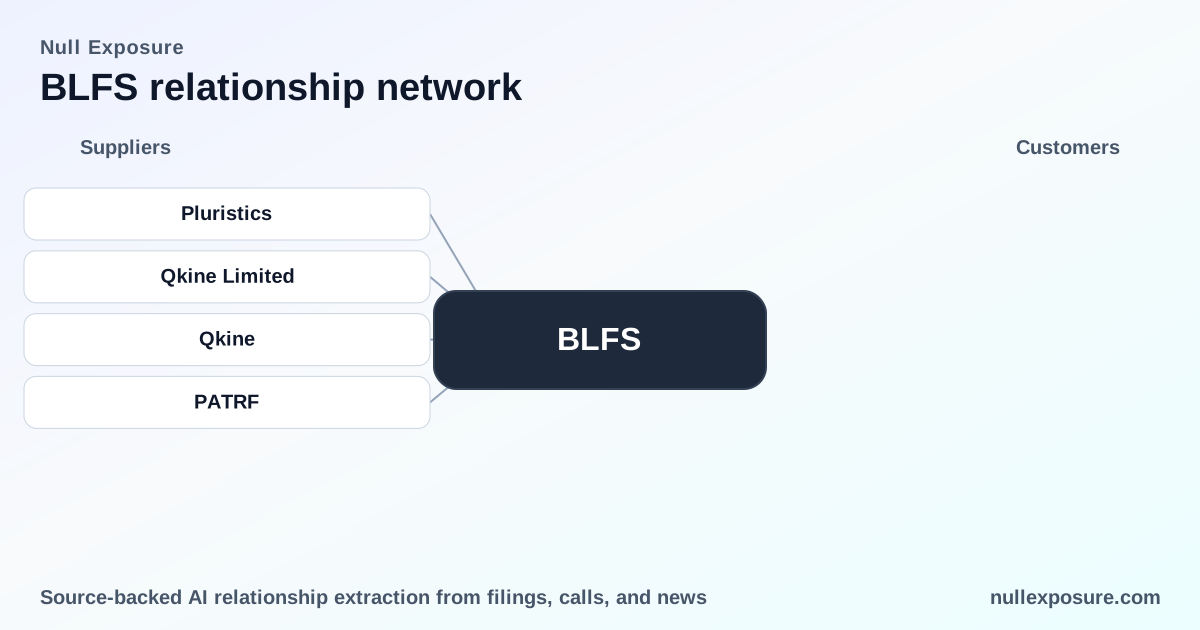
BLFS Supplier Map: Qkine, Pluristics, Panthera — What investors should price in
BioLife Solutions (NASDAQ: BLFS) sells bioproduction tools and consumables into the cell and gene therapy (CGT) market and monetizes through product sales, distribution partnerships, and targeted M&A and minority investments that embed third‑party technologies into its go‑to‑market platform. Revenue growth is driven by expanding the consumables portfolio via distribution agreements (recurring sales) and by acquiring or investing in adjacent IP and manufacturing capabilities (strategic scale and margin enhancement). For direct access to curated supplier intelligence and relationship tracking, visit https://nullexposure.com/.
Relationship-by-relationship: what the filings and press releases show
Qkine Limited — broad multi‑year distribution for cytokines and growth factors
BioLife signed a multi‑year supply and distribution agreement to distribute Qkine’s cytokine and growth factor products globally for cell and gene therapy manufacturing, and plans to integrate select Qkine products into BioLife’s CellSeal® Connect vial system. This arrangement expands BioLife’s consumables portfolio into high‑value reagents used across CGT workflows. A PR Newswire release and multiple market outlets reported the deal on 12 February 2026, and the company referenced a strategic distribution and product development agreement during its 2025 Q4 earnings call. (PR Newswire, Feb 2026; 2025 Q4 earnings call, Mar 2026)
Pluristics — minority investment and platform expansion
BioLife cited an investment in Pluristics as part of its strategy to expand the platform through targeted minority investments and strategic collaboration. The Pluristics position is presented as a complement to acquisitions, intended to accelerate product integration and distribution scale within BioLife’s ecosystem. (2025 Q4 earnings call, Mar 2026)
Panthera — acquisition folded into platform buildout
BioLife completed an acquisition of Panthera and positioned that deal alongside the Pluristics investment and the Qkine partnership as evidence of a deliberate M&A and collaboration strategy to broaden the platform. The Panthera acquisition is presented as an executed element of BioLife’s inorganic growth playbook. (2025 Q4 earnings call, Mar 2026)
What the supplier picture tells you about BLFS's operating posture
BioLife is executing a hybrid commercial model that combines direct product sales, distribution agreements, and strategic equity or outright acquisitions to capture more of the CGT value chain. From the supplier relationships disclosed:
- Distribution agreements are used to rapidly broaden consumables offerings with limited upfront operational integration required, delivering recurring revenue while enabling product bundling with BioLife’s vessel and storage systems.
- Minority investments and small acquisitions are explicit levers to internalize IP and scale go‑to‑market, turning third‑party innovations into cross‑sell opportunities across BioLife’s customer base.
- The company describes manufacturing through third‑party CMOs for specific products, which signals a mixed make‑vs‑buy approach that balances capital intensity with speed to market.
For deeper supplier mapping and scenario analysis, see https://nullexposure.com/.
Operational constraints and company‑level signals investors should price in
The filings and disclosures collectively provide three compact operational signals that shape contractual risk and supplier dependency:
-
Contracting posture: short‑term purchase obligations dominate. The company reports total obligations of $3.7 million as of December 31, 2024, with $3.1 million classified as short‑term, indicating purchasing commitments are predominantly near‑term rather than long lock‑ups. This signal implies flexibility but also susceptibility to short‑cycle supplier pricing and availability shifts. (Company disclosure, Dec 31, 2024)
-
Supplier concentration is low: no single supplier drove more than 10% of purchases in the prior year. This is a positive supply‑chain diversification signal that reduces single‑counterparty risk and supports operational continuity through supplier substitution if required. (Company disclosure, year ended Dec 31, 2024)
-
Manufacturer posture includes reliance on CMOs for specific product lines. BioLife explicitly identifies a U.S. CMO producing its ThawSTAR thawing products, indicating an outsourced manufacturing model for at least some capitalized product lines; that posture reduces fixed cost but creates vendor quality and capacity dependencies. (Company disclosure)
These are company‑level signals; the public disclosures do not attach these constraints to any single supplier relationship beyond the company statements themselves.
Investment implications: growth levers and risk vectors
BioLife’s approach is a classic platform build: acquire or invest to capture novel product capabilities, then use distribution agreements to commercialize at scale without heavy manufacturing capex. That strategy drives a favorable margin pathway when cross‑sell succeeds and preserves capital flexibility. Key investor takeaways:
-
Upside: The Qkine agreement places BioLife into the cytokines and growth factor segment, which commands higher ASPs and recurring reorder frequency in CGT workflows. Pluristics and Panthera positions expand the addressable consumables and services market accessible through BioLife’s sales channels.
-
Risk: Short‑term purchase obligations and reliance on CMOs for certain products concentrate operational risk at the tactical level—disruptions or price pressure can translate quickly into gross margin volatility. Low supplier concentration reduces catastrophic supplier risk but does not eliminate capacity or quality risk tied to specialized CMOs.
-
Execution sensitivity: The commercial value of these relationships depends on BioLife’s ability to integrate SKUs into bundles and drive adoption of bundled workflows (for example, integrating Qkine reagents with the CellSeal® Connect system). Execution here is the primary catalyst or detractor for near‑term revenue growth.
If you are modeling BLFS, compress the timing of revenue recognition for distribution deals into near‑term ramp phases and stress-test GM% for outsourced manufacturing lines under supplier pressure scenarios.
For additional supplier context and ongoing relationship tracking, visit https://nullexposure.com/ and subscribe to supplier intelligence updates.
Bottom line and next steps for investors
BioLife is deliberately layering distribution agreements with targeted minority investments and acquisitions to build a consumables and services platform for CGT customers. The Qkine deal is the most consequential near‑term commercial expansion disclosed, while Pluristics and Panthera are strategic portfolio plays that deepen product breadth. Investors should underwrite execution on SKU integration and monitor short‑term purchasing exposure and CMO dependencies as the principal operational risks.
For detailed watchlists, supplier scoring, and to set alerts on future BLFS relationship disclosures, go to https://nullexposure.com/.