Blue Foundry Bancorp (BLFY) — Supplier map and what it means for investors
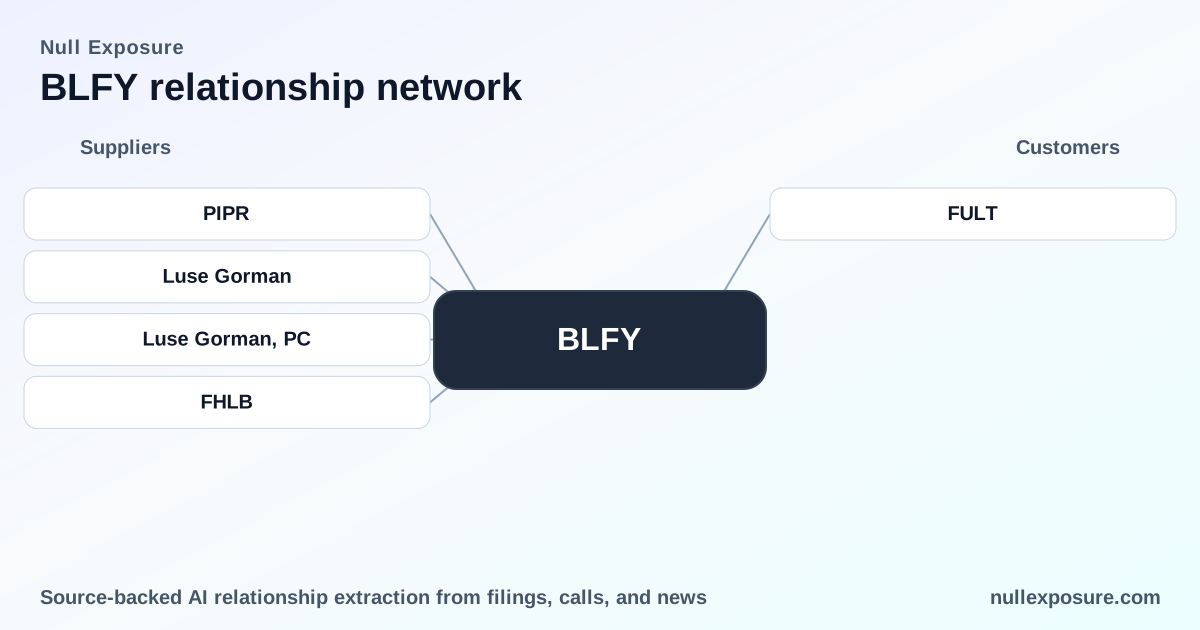
Blue Foundry Bancorp operates as a regional banking franchise that monetizes through traditional bank income streams—net interest margin on lending and deposit-taking plus ancillary fee revenue—while executing growth through strategic transactions and balance-sheet funding. The supplier relationships pulled here show a short list of transactional advisors and funding counterparties that supported a recent strategic merger and ongoing liquidity needs; those relationships reveal both the company’s deal execution profile and points of operational concentration. For a quick look at the data behind this analysis, visit https://nullexposure.com/.
Executive takeaways for investors and operators
- Advisory and legal counsel were engaged for a material M&A transaction in FY2025, highlighting the firm’s reliance on external professional services for strategic execution.
- FHLB is a material funding counterparty used to scale lending and replace deposit outflows as of FY2023.
- Company-level signals show Blue Foundry treats vendors as active, critical service providers under framework-like contractual arrangements, which elevates operational and counterparty risk if those relationships are disrupted.
These three themes—transactional advisors, legal counsel, and FHLB funding—define the supplier risk surface investors should monitor.
The relationships, one by one
Piper Sandler / Piper Sandler & Co. — financial advisor
Piper Sandler served as Blue Foundry Bancorp’s financial advisor in the announced all-stock combination with Fulton Financial, supporting deal structuring and execution. This advisor role is documented in multiple contemporaneous press reports covering the transaction in FY2025, including Pulse2 (March 9, 2026), CityBiz (March 9, 2026) and NJB Magazine (March 9, 2026).
Luse Gorman / Luse Gorman, PC — legal counsel
Luse Gorman acted as legal counsel to Blue Foundry Bancorp on the same transaction, providing transaction documentation and regulatory advice tied to the merger. CityBiz, Pulse2, and NJB Magazine all list Luse Gorman, PC as counsel in their FY2025 coverage of the deal (March 9, 2026).
FHLB — balance-sheet funding counterparty
Blue Foundry increased borrowings from the Federal Home Loan Bank (FHLB) to $399.5 million, up $89.0 million, to support loan growth and to replace deposit attrition—an explicit funding action noted in FY2023 disclosures reported by CityBiz. This positions FHLB as an ongoing liquidity source for the lending franchise.
(Every relationship above corresponds to the entries in the supplier results pulled for BLFY.)
What the vendor signals tell you about operating posture
The constraints extracted alongside the relationship list provide company-level signals about how Blue Foundry manages supplier risk:
- Contracting posture: framework-style agreements. The wording about vendors performing under service level agreements signals that Blue Foundry uses structured contracts and SLAs rather than purely ad hoc engagements. That implies formal vendor governance and measurable KPIs, but also contractual dependence when vendors are critical to operations.
- Materiality: critical. Language about exposure to disruption, reputational damage, and litigation if vendors fail identifies suppliers as potentially material to ongoing operations and financial results. This is a company-level risk flag investors must weight alongside capital and credit metrics.
- Role and stage: active service providers. The firm explicitly relies on external vendors for day-to-day operations, which indicates that some supplier relationships are operationally integrated and not one-off consultancies.
Together, these signals show a hybrid supplier profile: some relationships are transaction-specific (advisors and counsel for the merger), while others—most notably funding counterparties—are persistent and operationally critical.
For deeper supplier mapping and to track supplier changes over time, check the platform at https://nullexposure.com/.
Investment and operational implications
- Concentration of critical functions. FHLB funding and a short roster of external advisors create concentration risk: if funding access shifts or counsel/advisor continuity breaks during deal execution, Blue Foundry’s ability to grow, execute transactions, or stabilize liquidity would be impacted.
- Regulatory and litigation exposure tied to vendor performance. The firm’s disclosures link vendor underperformance to reputational and litigation risk; for a regulated banking franchise, legal and advisory relationships have outsized importance during M&A and capital events.
- Cost and timing sensitivity during strategic transactions. Relying on external financial and legal advisors for M&A increases transaction costs and introduces execution timing risk, both of which affect shareholder value realization.
Practical risk checklist for analysts and operators
- Monitor FHLB borrowing levels relative to deposits and loan growth to track funding concentration and potential refinancing risk.
- Confirm whether advisory relationships (Piper Sandler) are one-off or evolving into ongoing capital markets/coverage roles that could change cost or conflict profiles.
- Validate the scope and exit clauses in framework service agreements so that critical vendor disruption is not coupled with excessive contract lock-in.
- Track regulatory filings and press coverage for litigation or SLA disputes tied to vendor performance, as the company itself ties vendor failure to material adverse effects.
Final read and next steps
Blue Foundry’s supplier map is concise but telling: advisors and counsel executed a material merger in FY2025, while FHLB borrowing underpins the balance sheet as of FY2023. That mix of transactional and operational suppliers creates distinct monitoring priorities—transaction execution risk and funding concentration. To pursue a deeper supplier risk assessment or to watch for changes in these relationships, visit https://nullexposure.com/ for ongoing updates and analysis.
Key relationships summarized earlier: Piper Sandler as financial advisor (Pulse2 / CityBiz / NJB Magazine, FY2025), Luse Gorman, PC as legal counsel (Pulse2 / CityBiz / NJB Magazine, FY2025), and FHLB as a funding source (CityBiz reporting on FY2023 borrowings). These are the supplier touchpoints that should be part of any diligence checklist for BLFY.