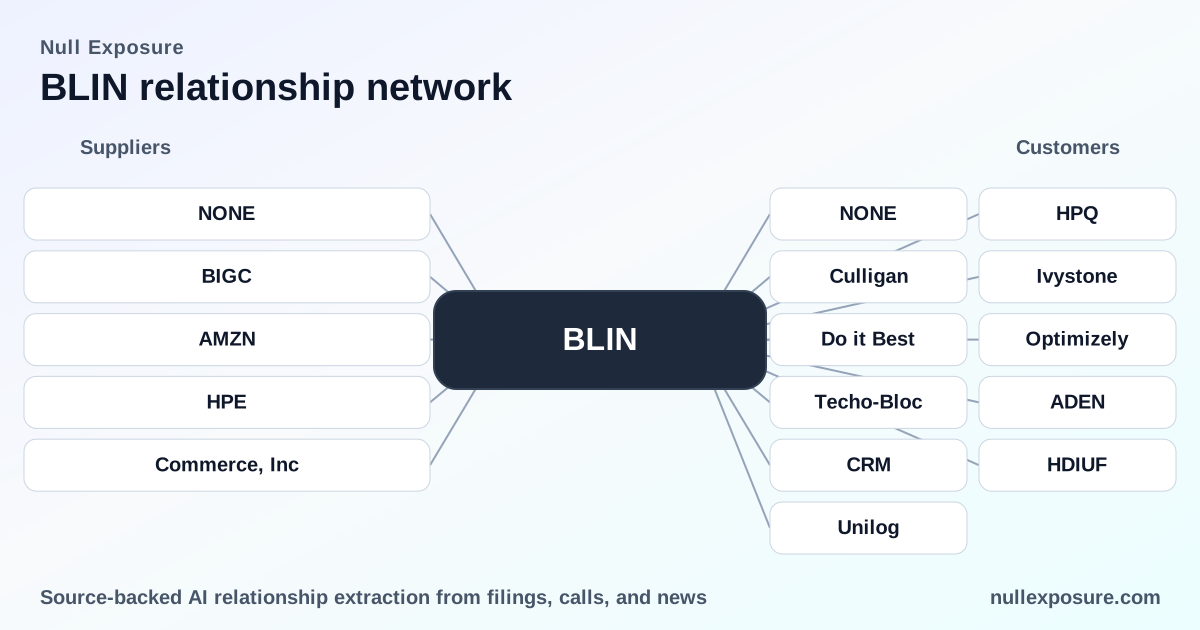
BLIN supplier relationships: what management named, and why it matters for investors
Bridgeline Digital (BLIN) sells search and digital experience software (notably Hawk Search), plus associated hosting and professional services, and monetizes through software subscriptions, managed hosting, and implementation services. Management’s public commentary and press coverage show a blended supplier and partner ecosystem focused on cloud hosting, eCommerce platform integrations, and event/channel co-marketing—AWS is the single critical infrastructure dependency called out in filings. For investors evaluating BLIN’s supplier exposure, the question is whether these partners are strategic, transactional, or materially operational; the disclosures point to mostly commercial and GTM partnerships with a single outsized hosting dependency. Learn more about BLIN’s supplier footprint at https://nullexposure.com/.
How to read BLIN’s supplier signals: marketing partners vs. operational suppliers
BLIN’s public remarks center on customer events and partner participation (virtual summits and trade show dinners), which signals a go-to-market ecosystem more than a classic vendor-supply chain. That pattern implies a contracting posture tilted toward partner agreements and channel relationships, not heavy long-term procurement contracts. At the same time, regulatory and news filings identify third-party cloud hosting as an operational dependency—this is the real supplier risk for uptime, security, and cost.
- Contracting posture: Predominantly partner/channel agreements and service arrangements for implementation and integration.
- Concentration: The partner list is diverse, but Amazon Web Services is a concentrated, single-point infrastructure provider.
- Criticality: Event and integration partners are important for sales and distribution; AWS is critical for SaaS and managed hosting operations.
- Maturity: Partners include large, established platforms (AWS, BigCommerce, Hewlett Packard) and smaller niche vendors used for GTM and integrations.
For deeper supplier risk modeling and to map contractual exposure, start here: https://nullexposure.com/.
Management-named partners and press relationships — line-by-line
Below I cover every relationship that appears in the available disclosures. Each entry includes a concise plain-English takeaway and the supporting reference.
-
Pemberley — Cited as a co-host at a B2B Online dinner event, indicating a marketing/partner relationship rather than a procurement or infrastructure supplier role (BLIN 2025 Q3 earnings call, referenced March 2026).
Source: BLIN 2025 Q3 earnings call (management commentary on B2B Online). -
Chronix — Named alongside Pemberley and DDS as a dinner co-host at B2B Online in Chicago, signaling collaborative channel activity and joint customer outreach (BLIN 2025 Q3 earnings call).
Source: BLIN 2025 Q3 earnings call (B2B Online event mention). -
DDS — Mentioned as a co-host for the same B2B Online dinner, again pointing to a partner or joint-marketing role rather than an operational vendor (BLIN 2025 Q3 earnings call).
Source: BLIN 2025 Q3 earnings call (B2B Online event mention). -
Crescent Electric — Identified as a featured partner at “Insight 25,” BLIN’s Hawk Search virtual summit that drew roughly 400 registrants; this positions Crescent Electric as a commercial or reference partner in BLIN’s vertical outreach (BLIN 2025 Q3 earnings call).
Source: BLIN 2025 Q3 earnings call (Insight 25 virtual summit). -
XEngage — Listed among partners at the Hawk Search virtual summit, indicating an integration or go-to-market collaborator within BLIN’s B2B search ecosystem (BLIN 2025 Q3 earnings call).
Source: BLIN 2025 Q3 earnings call (Insight 25 virtual summit). -
BigCommerce (BIGC) — Identified as a partner at the Hawk Search virtual summit and referenced with the public ticker BIGC, suggesting a platform-level integration or channel relationship that facilitates eCommerce deployments (BLIN 2025 Q3 earnings call).
Source: BLIN 2025 Q3 earnings call (Insight 25 virtual summit). -
Amazon Web Services (AMZN) — BLIN’s filings and news commentary explicitly state that the company hosts its SaaS and managed hosting customers via AWS, making AWS a critical third-party infrastructure supplier; a TradingView write-up of BLIN’s FY2025 10‑K highlights this dependency and the operational risk tied to any disruption (TradingView coverage of FY2025; BLIN constraint excerpt).
Source: TradingView coverage of BLIN’s FY2025 10‑K and BLIN disclosures noting AWS as the hosting provider. -
Hewlett Packard (HPE) — Appears as a featured partner at the Hawk Search virtual summit, positioning HPE as an enterprise channel or technology partner in BLIN’s outreach to larger B2B customers (BLIN 2025 Q3 earnings call).
Source: BLIN 2025 Q3 earnings call (Insight 25 virtual summit). -
Commerce, Inc — News coverage of a BLIN deployment states the implementation occurred on the Commerce, Inc eCommerce platform, underlining BLIN’s role as a search/integration vendor for third-party eCommerce stacks (StockTitan report covering BLIN FY2025 activities).
Source: StockTitan news report on BLIN deployments (FY2025 reporting).
Operating-model constraints and what they imply for investors
BLIN’s public disclosures include one explicit constraint: the company hosts SaaS and managed hosting customers via Amazon Web Services, which is a confirmed service-provider relationship (confidence level cited by BLIN’s disclosures). That single explicit constraint translates into an operational single-point dependency: if AWS experiences outages, pricing shifts, or compliance issues, BLIN’s service continuity and margins are directly exposed.
Other operating-model signals come from the partner list: management emphasizes events and joint marketing with varied partners, which implies low supplier concentration for go-to-market activities but high concentration for core infrastructure. This bifurcated profile—diverse marketing/integration partners plus a concentrated hosting provider—changes the risk calculus: commercial partnerships limit GTM risk, while infrastructure concentration raises operational and continuity risk.
If you model BLIN’s vendor exposure, treat AWS as a high-criticality supplier with contract and contingency importance, and treat the rest as strategic channel partners that support growth more than core operations.
For a full supplier mapping and quantitative exposure assessment, see the platform at https://nullexposure.com/.
Investment implications and what to watch next
- Short-term revenue leverage: BLIN’s event-driven partner engagement and platform integrations (BigCommerce, Commerce, HPE) support customer acquisition and upsell opportunities for Hawk Search and related services. That’s a growth signal for subscription and services revenue.
- Operational risk concentration: AWS is the key single-point supplier risk; investors should monitor BLIN’s disclosure of any multi-region redundancy, contractual SLAs with AWS, and contingency plans in subsequent filings or calls.
- Execution and partner expansion: The mix of large platform partners and niche collaborators suggests BLIN can scale channel arrangements, but the timeline and monetization of those partner relationships deserve scrutiny in future quarters.
If you want a supplier-risk dashboard for BLIN that ties these qualitative signals to contractual risk and outage exposure, explore more at https://nullexposure.com/.
In summary, BLIN’s supplier universe is primarily commercial partners and integrators that advance sales and deployments, with Amazon Web Services standing out as the material operational supplier. Investors should treat partner mentions as GTM evidence and prioritize diligence on cloud-hosting contracts, resiliency, and any disclosures about multi-cloud or vendor diversification before assuming infrastructure risk is mitigated.