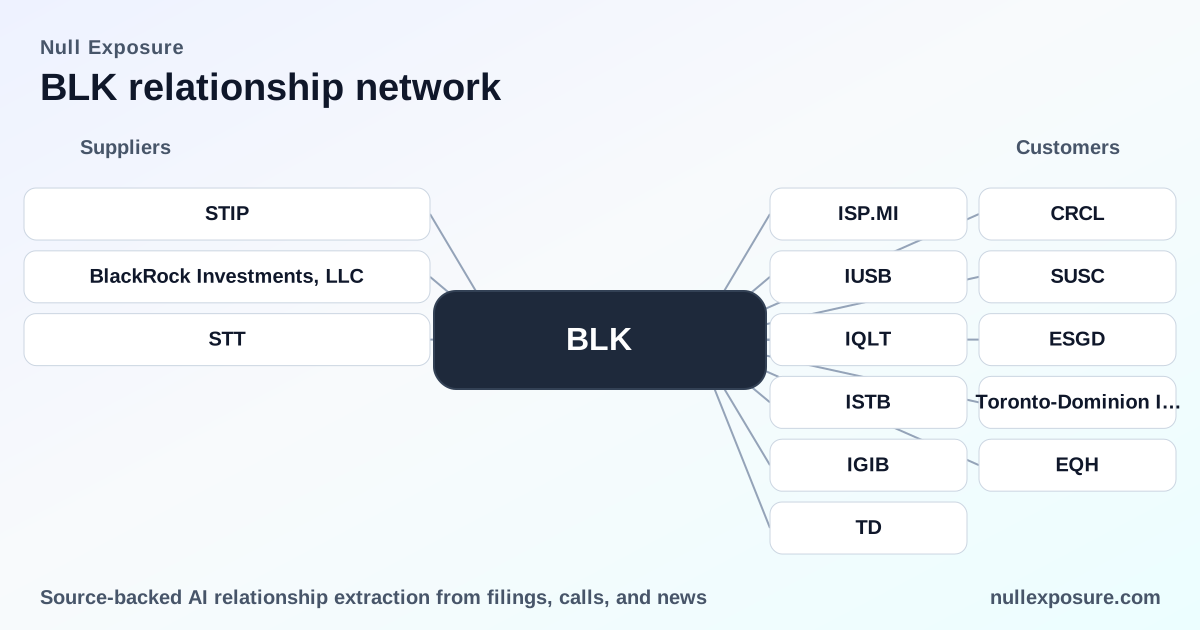
BlackRock (BLK) as a Supplier: where fund sponsors meet custodians, data vendors and distribution partners
BlackRock operates as the world’s largest asset manager, monetizing through management and advisory fees on AUM, ETF securities lending and operational fee recapture for fund services; it sponsors iShares ETFs and contracts external custodians, fund administrators and distribution partners to run those products. For investors evaluating BLK’s supplier footprint, the central question is how BlackRock balances fee capture with outsourced operational dependencies that are critical to fund continuity and regulatory compliance. Learn more about supplier exposures and monitoring at https://nullexposure.com/.
How BlackRock contracts and where material costs show up
BlackRock’s operating model combines vertically integrated investment management with selective outsourcing of non-advisory, operational functions. Public filings and vendor disclosures show that BlackRock regularly purchases custody, fund administration, index reference data, audit, tax, transfer agent and other operational services from third parties. Those third-party expenses flow through as direct fund expenses or as AUM-linked distribution and servicing costs — both of which scale with assets under management and therefore with revenue volatility.
- Contracting posture: BlackRock outsources many fund-administration and custody functions rather than internalizing every operational role, reflecting a pragmatic mix of insourced advisory and outsourced operational work.
- Concentration and criticality: Custody and fund administration are critical single points of failure for funds; reliance on major custodian banks creates counterparty concentration that investors should monitor.
- Cost and revenue linkage: Distribution and servicing payments are AUM-driven, so vendor economics are directly tied to flows and market valuation.
- Maturity of relationships: The language in filings emphasizes continued use of established market providers (custodians, transfer agents, index licensors), implying long-term vendor engagements rather than ad-hoc spot contracts.
These company-level signals should be part of any supplier-risk assessment for BLK, independent of the individual partner relationships documented below.
Relationships surfaced in the record
iShares 0–5 Year TIPS Bond ETF (STIP)
STIP is an iShares product launched on December 1, 2010 and is managed by BlackRock, illustrating BLK’s continuing role as ETF manager and sponsor across fixed-income product lines; a March 5, 2026 report noted BlackRock’s management of the fund in the context of an investor position report. Source: DefenseWorld article, March 5, 2026 — https://www.defenseworld.net/2026/03/05/american-wealth-advisors-llc-takes-3-91-million-position-in-ishares-0-5-year-tips-bond-etf-stip.html.
BlackRock Investments, LLC
A MoneyDJ ETF profile (accessed March 6, 2026) lists BlackRock Investments, LLC as the dealer/distributor for an NYSE-listed municipal bond ETF and details ETF-size, expense ratio and trading metrics, confirming BLK’s role as an on-shore distributor and product sponsor across its iShares lineup. Source: MoneyDJ ETF profile, March 2026 — https://www.moneydj.com/etf/x/basic/basic0004.xdjhtm?etfid=inmu&topc=.
State Street Bank and Trust Company
The same MoneyDJ profile identifies State Street Bank and Trust Company as the custodian for the ETF referenced, confirming that BlackRock uses major third-party custodians for fund safekeeping rather than acting as custodian itself. Source: MoneyDJ ETF profile, March 2026 — https://www.moneydj.com/etf/x/basic/basic0004.xdjhtm?etfid=inmu&topc=.
Why these linkages matter to investors and operators
BlackRock’s supplier map — sponsors (iShares), captive dealer entities and third-party custodians — creates a predictable operational architecture but one with measurable counterparty and operational concentration:
- Operational continuity risk: Custodians and fund administrators execute trade settlement, reconciliation and NAV calculation; failure or disruption at these providers would have immediate operational and reputational consequences for BlackRock-managed funds.
- Fee and margin sensitivity: Because distribution and servicing costs are AUM-driven, large outflows or ETF repricing compress margin and increase the proportion of third-party expenses absorbed by funds versus the firm.
- Regulatory and compliance exposure: Use of third-party providers increases points of regulatory oversight and contractual obligations across jurisdictions, elevating legal and compliance monitoring demands.
- Vendor leverage on service terms: Established custodians and industry data providers command pricing and contractual terms that can affect BlackRock’s cost base; this is an enterprise-level constraint on margin expansion.
If you evaluate BLK as a supplier or counterparty, prioritize visibility into custody agreements, indemnities, SLA terms and the operational redundancy they have in place.
For a structured supplier-risk score and continuous monitoring, see supplier intelligence at https://nullexposure.com/.
Practical due-diligence checklist for investors and operational partners
- Review custody and fund administration agreements for termination rights, back-up provisions and concentration limits.
- Inspect the fund expense breakdown in recent filings to quantify non-advisory third-party costs versus advisory fee capture.
- Assess vendor concentration: identify top custodians, transfer agents and index licensors and their share of BlackRock’s fund universe.
- Analyze AUM sensitivity: model distribution cost elasticity to outflows and fee compression scenarios.
- Verify operational redundancy: check whether alternate custodians or administrators can assume operations under stress.
- Confirm insurance and indemnity coverage for operational losses or reconciliation errors tied to third-party providers.
Bottom line and recommended next steps
BlackRock’s commercial model captures substantial fee economics through asset management while relying on established third-party custodians and distributors to operationalize funds. That structure delivers scale and distribution reach but concentrates operational risk in a small set of service providers. Investors and partners should prioritize contractual visibility and stress-test AUM-dependent vendor costs.
Explore supplier-level analytics and continuous monitoring for BlackRock at https://nullexposure.com/. For bespoke due-diligence or to benchmark BLK’s supplier posture against peers, start with an assessment at https://nullexposure.com/ — the right upstream visibility reduces downside from operational and counterparty shocks.