Blackbaud (BLKB): supplier relationships, operating posture, and what investors should watch
Blackbaud sells cloud software and services to nonprofit, education, healthcare and social-impact organizations, monetizing primarily through subscription SaaS for fundraising and constituent management (notably Raiser's Edge NXT), professional services, and an ecosystem of integrations that extend product functionality. The company generates recurring revenue at scale, layers in services and third‑party integrations to increase customer stickiness, and leverages partnerships and AI enhancements to push product differentiation and retention. For investors evaluating supplier risk and operational leverage, the partner map and disclosed operational constraints reveal where Blackbaud is outsourcing capability, where it is investing for growth, and where legal and service-provider costs concentrate risk.
Explore full supplier intelligence at Null Exposure.
How Blackbaud makes money and why suppliers matter
Blackbaud operates as a vertical SaaS incumbent serving mission‑driven organizations; its core monetization is subscription revenue for cloud platforms such as Raiser's Edge NXT, supplemented by professional services and partner integrations that enable fundraising, grants management, and constituent engagement. Recurring revenue and partner integrations are strategic levers: integrations expand the platform’s addressable use cases while services and third‑party tools increase switching costs for customers.
Financial context: Blackbaud reports roughly $1.13 billion in trailing revenue and positive operating margins, with EBITDA around $260 million, reflecting a mature SaaS operator with healthy profitability but ongoing investments in cloud migration and security. Institutional ownership and product concentration increase operational visibility but also centralize counterparty risk for large vendors. For ongoing supplier monitoring and vendor exposure analysis, visit Null Exposure for detailed supplier maps.
The partner list — what each relationship contributes to operations
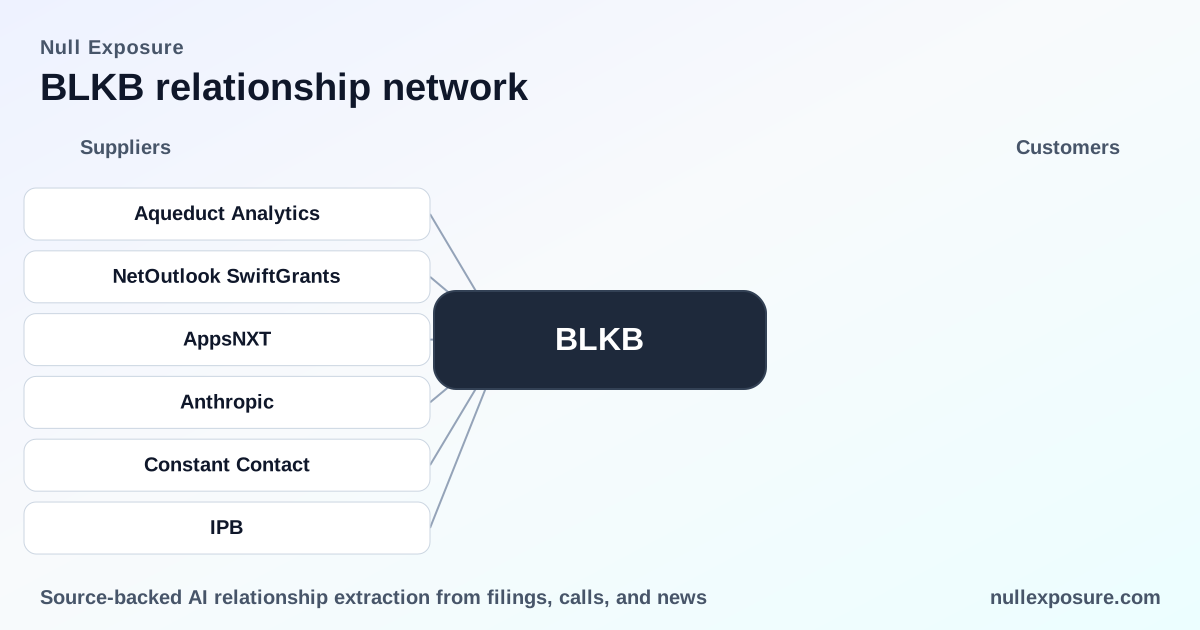
Below I cover every relationship disclosed in the supplier results and summarize the operational relevance and source for each.
-
Aqueduct Analytics
Aqueduct Analytics delivers a comprehensive Raiser's Edge NXT feed into customers’ secure data warehouses so organizations can control and query their fundraising and constituent records outside Blackbaud’s hosted environment. Source: StockTitan news post covering Blackbaud’s accelerator cohort (March 2026). -
NetOutlook SwiftGrants
NetOutlook SwiftGrants embeds grant management directly inside Raiser's Edge NXT, providing a native grants workflow that reduces friction for customers handling proposal lifecycle and reporting. Source: StockTitan news post on Blackbaud’s social-good tech program (March 2026). -
AppsNXT
AppsNXT builds tools that integrate with Blackbaud products to enhance fundraising and event-management workflows for nonprofits, higher education, and healthcare customers, extending Blackbaud’s core functionality through third‑party apps. Source: StockTitan coverage of Blackbaud’s startup partners (March 2026). -
Anthropic
Blackbaud partnered with Anthropic to introduce a purpose‑built AI experience and to strengthen AI capabilities showcased at product briefings and in the fourth quarter product rollout, signaling a strategic push to embed generative/assistant features into its platform. Sources: TradingView summaries of Blackbaud’s Q4 results and product update briefings (March 2026). -
Constant Contact
Blackbaud announced an integration with Constant Contact that brings email, SMS and social channels into Raiser's Edge NXT, enabling social‑impact organizations to manage multi‑channel donor engagement inside the platform. Source: TradingView reporting on strategic integrations (FY2025/coverage March 2026). -
Merrill Lynch (brokerage address recorded)
A recent SEC filing identifies Merrill Lynch (One Bryant Park, New York) as the brokerage handling a sale for Blackbaud, indicating the firm’s use of large investment banks for securities transactions and potential capital markets activities. Source: StockTitan SEC filing summary (FY2026).
What the disclosed constraints tell investors about Blackbaud’s operating model
Blackbaud’s constraint excerpts provide company‑level signals that shape supplier risk and contracting posture:
-
Outsourcing and cloud migration are strategic priorities. The company is actively migrating its infrastructure to leading public cloud providers and increasing cybersecurity investments, which implies critical dependence on cloud service providers and security vendors as operational suppliers (company disclosure, FY2026).
-
Third‑party service spending is material and ongoing. Recorded expenses include payments to third‑party providers and consultants—legal fees and settlement costs are explicitly called out—so professional services and legal vendors represent a recurring cost center rather than a one‑off line item (company disclosure).
-
Operational maturity with concentrated institutional ownership. Blackbaud’s revenue scale and profitability metrics, combined with high institutional ownership, indicate a mature contracting posture where large suppliers and banks (e.g., Merrill Lynch) execute capital transactions and where vendor relationships are strategically managed.
Collectively, these signals describe a company that is outsourcing infrastructure and augmenting product capability through partners, while simultaneously absorbing ongoing legal and third‑party service costs. Investors should treat supplier relationships as both growth enablers (integrations, AI partners) and potential cost drivers (cloud migration, consulting, legal).
Risk and opportunity implications for investors and operators
- Opportunity: Integrations with partners such as Constant Contact, Anthropic, and niche app builders increase the utility of Raiser's Edge NXT and drive retention. Partner-driven feature expansion is a clear revenue lever.
- Risk: Heavy reliance on cloud providers and third‑party service vendors concentrates operational risk — outages, contract disputes, or pricing shifts can affect margins and service delivery. Legal and settlement exposures are nontrivial operating expenses per company disclosures.
- Operational focus: Investors should monitor contract terms with major cloud and AI vendors, renewal cadence of key integrations, and any future SEC/AG disclosures that affect settlement reserves or legal costs.
If you want a supplier‑level risk heat map and counterparty scoring for Blackbaud, visit Null Exposure to run targeted supplier analyses and continuous monitoring.
Final takeaways and investor action points
Blackbaud is a mature, recurring‑revenue SaaS provider that leverages a partner ecosystem to extend product capability while simultaneously outsourcing critical infrastructure and professional services. Key strengths include platform stickiness via integrations and a clear AI push; key risks center on cloud dependency and legal/third‑party expense concentration. For due diligence, prioritize contractual terms with cloud and AI vendors, confirm integration economics for high‑value partners, and track legal‑reserve developments.
For a deeper supplier map and continuous alerts on BLKB counterparties, see Null Exposure.