BillionToOne (BLLN) — Counterparty Map and What the IPO Syndicate Reveals for Investors
BillionToOne builds precision molecular diagnostics and monetizes through laboratory testing services and platform licenses that translate biological quantification into clinical assays; the company converted to a public equity issuer via an upsized IPO in late 2025, raising capital and creating market liquidity for stakeholders. Revenue TTM of $305.1M, strong gross margins, and a roughly $3.28B market cap position BLLN as a high-growth diagnostic platform with public-market funding access. For institutional investors and operators evaluating supplier risk, the composition of the IPO syndicate and a recent EHR integration contract are the most material counterparty signals. Learn more or run a full counterparty analysis at the NullExposure homepage: https://nullexposure.com/.
What the bank syndicate says about BLLN’s market posture
BillionToOne engaged a broad mix of global and middle-market underwriters for its IPO: blue‑chip lead managers and regional partners worked together on pricing, distribution and aftermarket stabilization. A large, diversified underwriting group signals intentional de‑risking of distribution and an emphasis on institutional placement rather than reliance on a single gatekeeper. That structure reduces underwriting concentration risk while giving the company access to multiple distribution channels and research teams covering healthcare diagnostics.
- Contracting posture: The underwriter list reflects a standard public-market contracting posture—one driven by capital markets access and distribution reach rather than supplier exclusivity.
- Concentration: Counterparty concentration is low among banks (multiple book-runners and co-managers); however, shareholder concentration is notable on the equity side, with insiders owning about 46.8% and institutions 32.4%, creating a governance dynamic investors should monitor.
- Criticality and maturity: The syndicate was critical to the IPO outcome in FY2025; as a newly public company, BLLN is in a transitional maturity phase where capital markets relationships and EHR integrations materially affect growth and commercial scale.
If you need a deeper counterparty risk report, visit https://nullexposure.com/ for a tailored analysis.
Counterparty map — the relationships disclosed in public releases and earnings
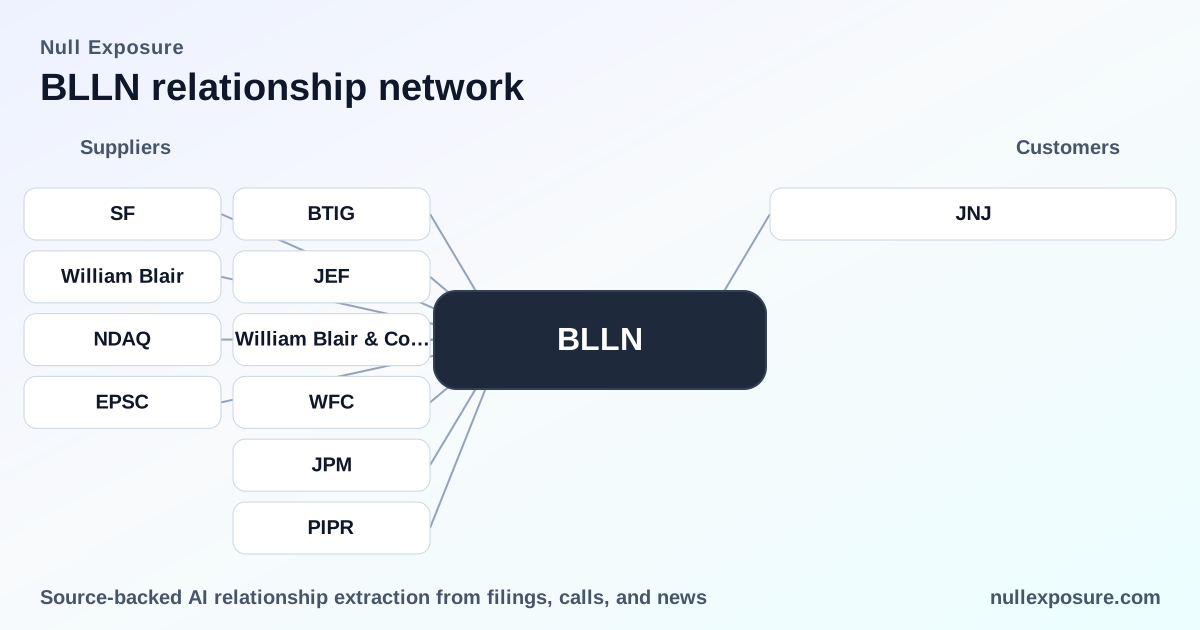
Below are every counterparty referenced in the public reporting and media around BLLN’s IPO and operations, with a plain‑English description and source citation.
-
J.P. Morgan (J.P. Morgan Securities LLC) — Served as a joint book‑running manager on the IPO, leading institutional distribution and pricing activities for the offering. According to the GlobeNewswire and Yahoo Finance filings around the offering, J.P. Morgan was named among the joint book‑runners for the proposed and priced offering in FY2025 (Nov 2025).
Source: GlobeNewswire and finance.yahoo.com releases on the IPO (FY2025). -
Piper Sandler (Piper Sandler & Co.) — Acted as a joint book‑running manager alongside J.P. Morgan and peers, contributing middle‑market placement strength and healthcare sector coverage during the roadshow. The company listed Piper Sandler as a joint book‑runner in its roadshow and closing announcements in FY2025.
Source: GlobeNewswire and QuiverQuant roadshow announcement (FY2025). -
Jefferies (Jefferies LLC) — Named among the book‑running managers and underwriters for the offering; Jefferies supported pricing and distribution functions for the IPO. Multiple press releases and news summaries report Jefferies as a joint book‑runner in FY2025.
Source: GlobeNewswire, RTT News and finance.yahoo.com coverage of the IPO (FY2025). -
William Blair (William Blair & Company, L.L.C.) — Served as a joint book‑runner on the offering, participating in marketing and institutional allocation. Public release materials around the closing and pricing list William Blair in the core syndicate for FY2025.
Source: GlobeNewswire and related news releases on the offering (FY2025). -
Stifel — Participated as a book‑running manager in support of the offering, providing distribution capacity and additional underwriting resources. Stifel was cited in IPO launch and closing releases in FY2025.
Source: StockTitan and GlobeNewswire IPO announcements (FY2025). -
Wells Fargo Securities — Functioned as a supporting book‑running manager for the offering, helping with retail and institutional placement channels. Wells Fargo Securities was noted in multiple press summaries of the IPO pricing and closing (FY2025).
Source: StockTitan, GlobeNewswire and finance.yahoo.com coverage (FY2025). -
BTIG — Acted as a participating book‑running manager, contributing additional distribution support to the syndicate. News reports and syndicate lists from the roadshow and closing reference BTIG in the underwriting group in FY2025.
Source: QuiverQuant and StockTitan articles on the IPO roadshow and closing (FY2025). -
Nasdaq Global Select Market (NDAQ) — Nasdaq was the listing exchange where BillionToOne’s Class A common stock began trading on November 6, 2025, under the ticker BLLN, establishing the company’s public trading venue. The closing release confirms the Nasdaq Global Select Market listing in FY2025.
Source: GlobeNewswire closing announcement (Nov 7, 2025). -
Epic (EPSC) — BillionToOne signed a contract with Epic for Aura implementation to integrate clinical workflow and data exchange, a supplier relationship that influences downstream adoption and revenue capture from health systems. This implementation contract was disclosed on BLLN’s 2025 Q3 earnings call.
Source: BLLN 2025 Q3 earnings call transcript (2025Q3).
How these counterparties influence risk and execution
Underwriting breadth is a strategic positive: a broad syndicate decreases distribution risk, supports aftermarket liquidity and signals institutional acceptance during IPO pricing. However, being a newly public company means BLLN remains dependent on capital markets for scaling investments, so underwriter relationships remain operationally important in the near term.
EHR integration with Epic is a commercial inflection point. The Aura implementation contract ties BLLN directly into provider workflows; successful integration accelerates test ordering, reimbursement flow and customer retention, while implementation delays would slow adoption.
Shareholder structure is consequential. With insiders controlling roughly 46.8% of shares, governance and lock‑up expirations will be meaningful liquidity and control events for investors watching dilution and insider sell-downs after the IPO.
If you want a scenario‑level counterparty risk model built around these relationships, NullExposure can deliver a tailored report: https://nullexposure.com/.
Practical checklist for investors and operators
- Monitor post‑IPO trading volume and book‑runner research coverage to gauge liquidity and institutional conviction. Watch analyst updates from J.P. Morgan, Jefferies and Piper Sandler for flow and sentiment changes.
- Track Epic implementation milestones on subsequent calls and filings; integration timing is a leading indicator for commercial ramp.
- Review insider lock‑up schedules and institutional ownership shifts given the high insider stake; potential near‑term selling pressure is a governance risk to price dynamics.
- Validate revenue cadence versus operating margin targets; BLLN reported a positive operating margin and robust gross profit, but continued execution is required to justify premium valuation multiples.
Bold decisions require clear signals; the IPO syndicate and the Epic contract are the two most consequential supplier relationships for BLLN right now. For a customized counterparty risk dossier and alerts on these counterparties, visit NullExposure and request a deep dive: https://nullexposure.com/.
Key takeaway: BLLN has structured a diversified capital‑markets and integration strategy — the underwriting syndicate reduces distribution concentration while the Epic relationship directly influences clinical adoption. Investors should prioritize monitoring syndicate research coverage, Epic implementation progress, and insider liquidity events as the primary near‑term drivers of valuation and execution risk.