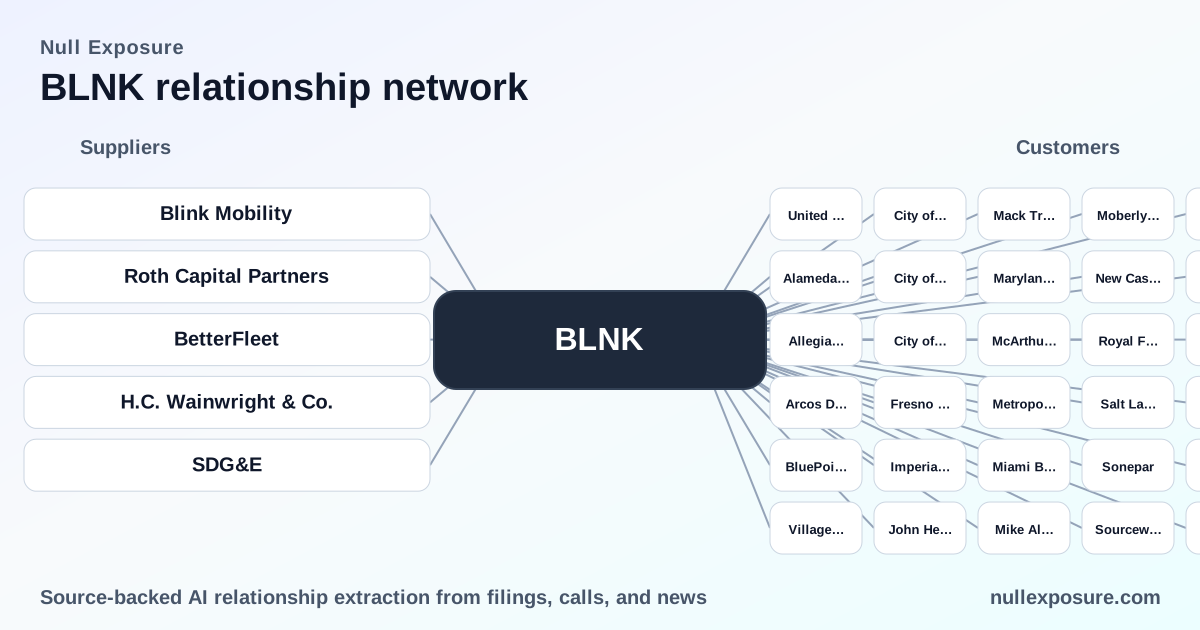
Blink Charging (BLNK) — supplier relationships and what they mean for investors
Blink Charging runs an integrated EV charging business that designs, manufactures, installs and operates charging equipment while monetizing through hardware sales, network services and hosted fleet solutions. The company combines equipment revenue with recurring network fees and fleet services, and offsets capital consumption with periodic equity raises and placement agent arrangements. For investors evaluating supplier exposure, Blink’s commercial ties reveal a mix of financing partners, fleet integration allies, utility program contractors and internal manufacturing posture that together shape execution risk and upside.
Discover deeper supplier maps and counterparty analytics at https://nullexposure.com/.
How Blink monetizes and where suppliers matter
Blink generates revenue through three linked channels: equipment sales, network services and maintenance, and fleet and mobility programs. Revenue TTM of $106.6M and gross profit of $32.2M show product and service mix already delivering margin, but negative operating and net results reflect capital intensity and rapid expansion. Supplier relationships matter because Blink both manufactures hardware in-house and relies on a small set of vendors for component design, testing and aftermarket services — a structure that accelerates time-to-market but concentrates operational risk.
- Capital raising is part of the operating rhythm. Recent placements and co-placement agents are a recurring feature of Blink’s financing strategy and influence liquidity available for installs and manufacturing scale.
- Fleet and utility partnerships drive downstream demand. Integrations with fleet management SaaS and utility fleet programs create multi-year revenue potential that depends on installation execution and uptime provided by suppliers.
Find supplier-level intelligence and relationship summaries at https://nullexposure.com/.
What Blink’s disclosed partner list looks like (plain-English takeaways)
Blink Mobility / Envoy Mobility
Blink operates car-sharing and ride-sharing programs through its wholly owned unit Envoy Mobility, giving the company a direct channel to deploy chargers and capture recurring fleet revenue. According to Blink’s FY2024 Form 10‑K, Envoy Mobility is an owned subsidiary used to run those mobility programs.
Roth Capital Partners
Roth Capital Partners served as an exclusive co-placement agent in a public offering of 26.67 million shares priced at $0.75 per share, reflecting Blink’s reliance on placement agents to access capital markets in FY2025. That financing activity was reported in March 2026 press coverage of the offering.
H.C. Wainwright & Co.
H.C. Wainwright & Co. joined Roth as the exclusive co-placement agent on the same FY2025 equity offering, indicating Blink uses established boutique investment banks to manage dilutive capital raises and market placement, as described in March 2026 news reports.
BetterFleet
Blink announced a partnership with BetterFleet on February 11 to deliver an integrated EV fleet charging management solution across North America, expanding Blink’s product-to-software offering and improving its value proposition to fleet operators, according to news coverage in FY2026.
SDG&E
Blink is accelerating installations for public fleets in collaboration with SDG&E’s “Power Your Drive for Fleets” program, positioning Blink as a contractor executing utility-driven fleet electrification initiatives, as reported in FY2026 coverage of the SDG&E program partnership.
What the disclosed constraints tell investors about Blink’s operating model
Blink’s supplier constraints reveal structured concentration and operational commitments that are company-level signals rather than tied to any single named partner.
- Materiality / concentration: Blink disclosed one supplier represented 12% of total purchases for the year ended December 31, 2024, which is a notable share and signals procurement concentration that can amplify vendor disruption risk.
- Manufacturer posture: Blink reports opening manufacturing facilities in Bowie, Maryland and Bangalore, India, indicating vertical integration and a strategic choice to own production capacity rather than outsource entirely.
- Service-provider dependence: The company relies on a limited number of vendors for design, testing and manufacturing, with several components sole-sourced, and the same vendor set used for aftermarket maintenance and warranty services — a contracting posture that creates single‑point operational criticality.
Taken together, these constraints imply higher supplier concentration risk, elevated switching costs, and meaningful reliance on a small set of technical vendors, while internal manufacturing grants control over product roadmaps but does not eliminate supplier dependency for specialized components.
Risk / opportunity implications for operators and investors
- Risk — supplier concentration and sole-sourcing: The 12% supplier concentration and sole-source components make supply interruptions materially impactful to production cadence and warranty service levels. That concentration elevates delivery and margin volatility during macro shocks.
- Opportunity — vertical integration plus targeted partnerships: Manufacturing assets in the U.S. and India provide Blink with leverage on lead times and cost control, while BetterFleet and SDG&E tie-ups unlock recurring fleet revenue and utility-backed deployment pipelines.
- Capital dependency: Repeated reliance on boutique placement agents for equity issuance indicates a capital structure that accepts periodic dilution as a mechanism for growth financing; investors must price further raises into valuation scenarios.
Key takeaway: Blink’s ecosystem blends internal manufacturing control with outsized dependence on a limited vendor base and periodic capital raises — that combination offers execution leverage but concentrates operational and financing risk.
How to use this intelligence in supplier risk analysis and commercial diligence
- Prioritize operational due diligence around Blink’s sole-sourced component lines and aftermarket service plans; ask for supplier continuity and substitution scenarios.
- Evaluate the economics of fleet contracts sourced through BetterFleet and SDG&E programs to quantify recurring revenue length and installation margin.
- Monitor fundraising cadence and placement agent activity as a near-term liquidity signal that directly affects installation throughput and capex for manufacturing scale.
Explore supplier mappings and counterparty risk models at https://nullexposure.com/ for deeper diligence.
Final assessment
Blink is executing a hybrid model: manufacturing plus managed services, supported by finance partners and strategic fleet/utility integrations. This architecture creates asymmetric outcomes — scaled growth if supplier continuity and capital access hold, material shortfalls if either fails. For investors and operators, the decision is straightforward: underwrite Blink as a high-execution, high-dependency play where detailed supplier and financing scrutiny drives the investment view.