Bluerock Acquisition Corp. (BLRK) — supplier map and commercial posture
Bluerock Acquisition Corp. is a SPAC that raises sponsor capital via a public units offering and monetizes by deploying those trust-proceeds into a business combination; its economics derive from IPO proceeds, sponsor promote and post-merger equity value capture. The company’s commercial relationships around IPO execution and listing are the operational linchpin for liquidity and dealflow, and investors should treat counsel, underwriters and the exchange listing as the primary supplier relationships that enable the SPAC model. For a quick look at supplier footprints and related research, visit https://nullexposure.com/.
How Bluerock generates returns and why suppliers matter
Bluerock issues units to the public, holds the proceeds in trust and hunts for a merger target that creates shareholder value. The firm’s operating model is transaction-driven rather than operating-company-driven: the execution of the IPO and the credibility of its legal and market infrastructure determine its ability to attract private targets and complete a business combination. Supplier relationships — particularly legal counsel and the listing venue — are not peripheral: they are functional enablers of capital raising, regulatory compliance and market access.
Key business-model characteristics:
- Contracting posture: SPACs contract for services (legal, underwriting, exchange compliance) on a deal-by-deal basis; for Bluerock these contracts are foundational to launch and closing a combination.
- Concentration: A newly listed SPAC exhibits concentrated supplier exposure during formation and IPO execution; a small set of providers (counsel, underwriters, exchange) carries outsized importance.
- Criticality: Legal counsel and clearing/listing arrangements are mission-critical — failures or delays directly impair deal timelines, shareholder confidence, and liquidity.
- Maturity: As a recent IPO vehicle, Bluerock’s maturity is limited; supplier relationships are still being realized and will evolve as the SPAC moves into target diligence and negotiation phases.
If you need deeper supplier maps and relationship analytics, explore our coverage at https://nullexposure.com/.
What the supplier landscape looks like right now
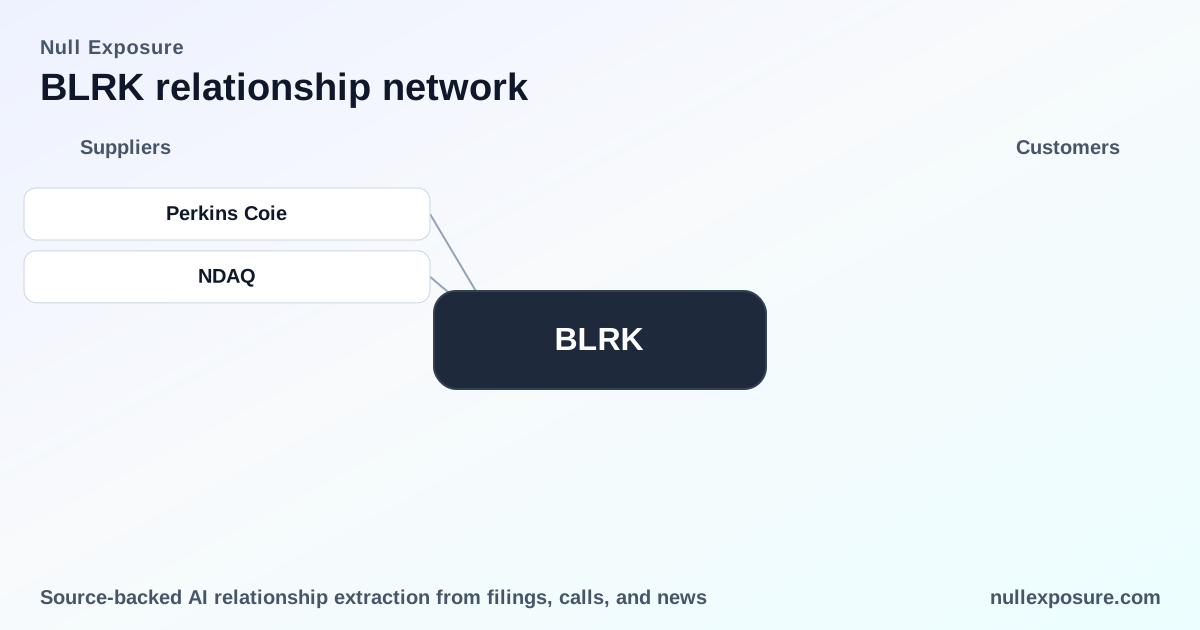
Bluerock’s public disclosures and press coverage identify two primary supplier relationships connected to its IPO and listing. Each relationship below is summarized in plain language with source context.
Perkins Coie — legal counsel on the offering
Perkins Coie served as legal advisor to Bluerock on its initial public offering, which raised $172.5 million via 17.25 million units priced at $10 per unit; that engagement establishes Perkins Coie as the legal backbone for the IPO and initial regulatory filings. According to a Perkins Coie press release (FY2025 / March 2026) announcing the transaction, the firm handled advisory responsibilities on the offering. (Perkins Coie press release, 2026)
Nasdaq Global Market — listing venue for the units
Bluerock’s units were listed on the Nasdaq Global Market under the trading symbol BLRKU, which provides the SPAC with immediate access to public-market liquidity and investor demand for units and later for shares or post-merger equity. The same Perkins Coie announcement notes the Nasdaq Global Market listing for the units (FY2025). (Perkins Coie press release, 2026)
What investors should read into these relationships
Both supplier mentions point to a classic SPAC launch architecture: established law firm counsel and a major exchange listing. That combination signals standard market access and professionalized deal formation, which is necessary but not sufficient for value creation. The presence of Perkins Coie reduces legal execution risk around the offering and documentation, while a Nasdaq Global Market listing provides immediate market visibility and trading infrastructure.
Operationally, investors should treat these relationships as enabling controls rather than value drivers — they constrain deal timing and compliance but do not substitute for the quality of the eventual target, sponsor expertise, or post-deal integration.
Concentration and risk takeaways
- Supplier concentration is high in the formation phase. With a small number of named suppliers tied to IPO execution, any disruption to counsel availability or exchange listing procedures would materially affect deal timelines.
- Legal and listing relationships are critical control points. They are gatekeepers for regulatory compliance and market access.
- Maturity-dependent exposure. As a recently launched SPAC, Bluerock’s reliance on these suppliers will remain elevated until a business combination closes and operating revenues (if any) develop.
Major risk factors to monitor:
- Delays or disputes in documentation or regulatory filings with counsel.
- Listing compliance requirements imposed by Nasdaq that could affect unit conversion mechanics or timetables.
- Sponsor-driven execution risk in sourcing and closing a merger partner.
Quick, actionable read for portfolio and sourcing teams
- If you evaluate counterparty risk, mark Perkins Coie as the legal counterparty that reduced initial IPO execution risk when the offering closed; review any subsequent engagement letters or 10-Q/8-K filings for scope changes. (Perkins Coie press release, FY2025)
- If you evaluate market and liquidity risk, confirm ongoing Nasdaq compliance and ticker activity for BLRKU/BLRK to monitor investor reception and unit-to-share mechanics. (Perkins Coie press release noting Nasdaq Global Market listing, FY2025)
For a tailored supplier report or to map additional counterparties involved in Bluerock’s target diligence and underwriting, start your research at https://nullexposure.com/.
Final assessment and next steps
Bluerock’s supplier footprint today is narrow and focused on IPO execution: established legal counsel (Perkins Coie) and a Nasdaq Global Market listing for the units are the two named relationships that enable the SPAC vehicle to operate. These relationships reduce execution risk for the IPO stage but do not speak to the company’s ability to source, negotiate, and close a value-creating acquisition — the ultimate determinant of returns.
If your investment diligence prioritizes counterparty and operational risk, use the supplier map above as the foundation for deeper document review and monitoring. For continuous updates on supplier exposure across financial issuers and SPACs, visit https://nullexposure.com/ and subscribe to coverage tailored to investors and sourcing teams.