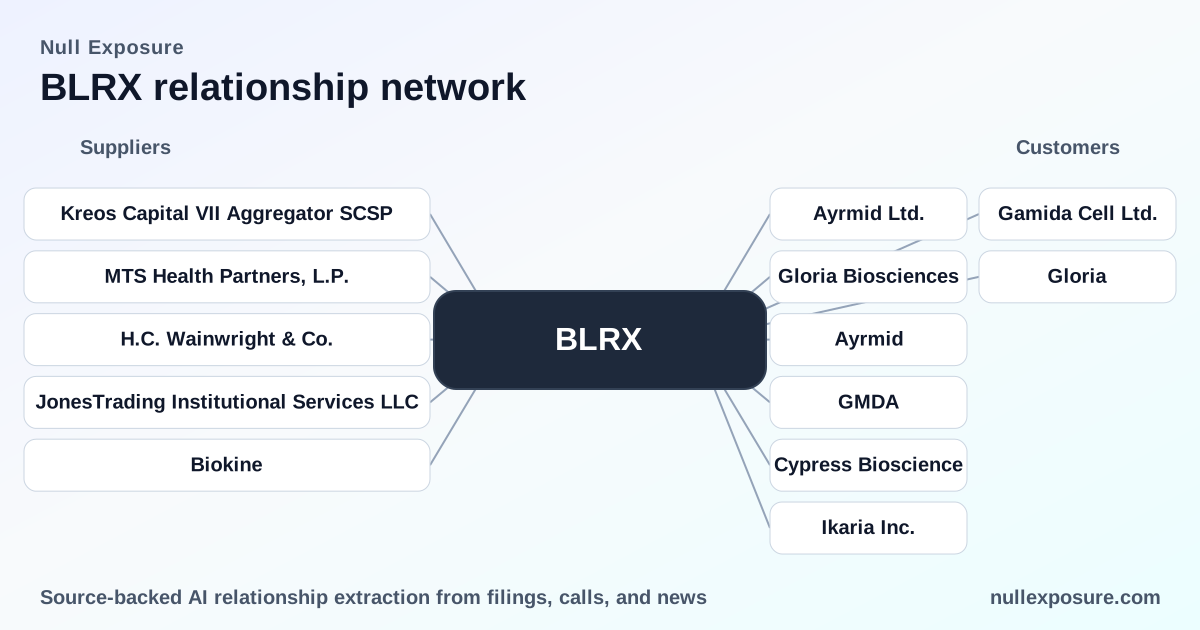
BioLineRx (BLRX) supplier relationships: who controls the capital and commercialization pathways
BioLineRx is a clinical-stage oncology company that monetizes through licensing its lead asset Motixafortide (branded Aphexda), strategic commercialization partnerships, royalty pass-throughs, and periodic capital raises—both equity and debt—to fund launch and operations. The company’s supplier footprint for investors is small and concentrated: placement agents, financial advisers, a prospective lender, and a license-holder that captures royalties. Capital providers and commercial partners therefore function as de facto suppliers to BLRX’s go-to-market strategy, and their terms determine liquidity, timing, and upside capture. For investors and operators tracking counterparty risk, this profile requires active monitoring of placement terms, advisor engagements, and royalty mechanics. Visit https://nullexposure.com/ for an up-to-date supplier map and monitoring tools.
How BLRX runs the business and gets paid
BioLineRx is a clinical-stage biotech headquartered in Israel with revenue driven today by licensing flows and limited commercial pass-throughs rather than product sales. The company’s revenue model centers on licensing agreements and milestone/royalty streams from partners, supported by periodic registered direct offerings and placement-agent-led financings to bridge cash needs. Financial advisory and placement relationships are integral to that model: they structure transactions, place equity or debt, and enable the commercial funding required for a product launch. BLRX’s latest reported TTM revenue is modest relative to development costs, with negative EBITDA and operating margins—a dynamic that elevates the strategic importance of its external capital and commercialization partners (company overview, FY2025–FY2026 filings). If you want ongoing supplier intelligence and alerts on new placement or advisory engagements, see https://nullexposure.com/.
The specific supplier relationships investors should know
Below are all relationships identified in public reporting and press coverage for BLRX, each with a concise, plain-English summary and source.
Kreos Capital VII Aggregator SCSP
Kreos is identified as a potential lender that BLRX would tap for up to $40 million in term loan capacity, accompanied by a proposed $15 million securities offering intended to facilitate the commercial launch of Motixafortide. This frames Kreos as a conditional but material capital provider in the company’s FY2023 planning documents (ChronicleJournal aggregation of reporting; referenced in 2026). (https://markets.chroniclejournal.com/chroniclejournal/article/newmediawire-2023-1-29-rosen-a-top-ranked-law-firm-encourages-biolinerx-ltd-investors-to-secure-counsel-before-important-deadline-in-securities-class-action-filed-by-the-firm-blrx)
MTS Health Partners, L.P.
MTS served as the exclusive financial advisor to BioLineRx in connection with the license transaction that positions Aphexda/Motixafortide for commercialization through Gamida Cell. That advisory role indicates MTS shaped the commercial deal structure and likely assisted valuation and counterparty selection. (PR Newswire release announcing the exclusive license agreement, reported in 2026) (https://www.prnewswire.com/news-releases/biolinerx-and-ayrmid-ltd-enter-into-exclusive-license-agreement-to-commercialize-aphexda-motixafortide-through-gamida-cell-ltd-302312746.html)
H.C. Wainwright & Co.
H.C. Wainwright is acting as the exclusive placement agent for a registered direct equity offering announced by BLRX, positioning the firm as a primary execution partner for equity capital raises in FY2025. Placement-agent exclusivity concentrates execution risk and pricing leverage with the agent. (PR Newswire release, FY2025 announcement) (https://www.prnewswire.com/news-releases/biolinerx-announces-10-million-registered-direct-offering-302343008.html)
JonesTrading Institutional Services LLC
JonesTrading is acting as the exclusive placement agent for an earlier registered direct offering (reported in FY2024), underscoring that BLRX uses single-agent, exclusive engagements for capital raises rather than broad syndicates. That choice compresses counterparty exposure but increases dependence on the agent’s distribution capability. (CityBiz coverage of the FY2024 offering) (https://www.citybiz.co/article/538450/biolinerx-announces-6-million-registered-direct-offering/)
Biokine
Biokine functions as a license-holder and royalty recipient tied to Motixafortide revenues; BLRX’s reported cost of revenues included a $72,000 pass-through identified as a royalty to Biokine. This operational linkage demonstrates a revenue split and a direct payment flow from product receipts to the license-holder. (Zacks / SCR coverage of an ASCO poster and financials, FY2025) (https://scr.zacks.com/news/news-details/2025/BLRX-ASCO-Poster--Abstract-article/default.aspx)
What the supplier map implies for BLRX’s operating model and constraints
BLRX presents a capital-dependent operating posture: funding is critical to commercialization timing and execution. The supplier footprint shows three clear characteristics:
- Contracting posture: BLRX consistently uses exclusive, single-agent placements and dedicated financial advisers, indicating a contracting strategy that concentrates execution authority with one counterparty per deal. This reduces negotiation breadth but increases vendor dependency.
- Counterparty concentration: A small set of placement agents and a named prospective lender create concentration risk; failure or delays by any one supplier could materially affect a planned offering or launch timetable.
- Criticality and maturity: The relationships are highly critical to BLRX’s near-term plan—capital raises and advisory support underpin the product launch—while company maturity remains early: clinical-stage profile, negative profitability, and limited institutional ownership magnify supplier significance.
No supplier-level contractual constraints were identified in the available reporting; absent specific constraint excerpts, these observations function as company-level signals about how supplier relationships are structured and where risk concentrates.
Investor implications and action checklist
BLRX’s commercial progress is tightly coupled to its capital providers and license mechanics. Key investor takeaways:
- The company’s ability to launch Motixafortide depends on timely financing (debt or equity) and on enforceable commercialization agreements with license partners.
- Exclusive placement-agent arrangements centralize execution risk—monitor placement agent capacity and track whether offerings are fully subscribed.
- Royalty pass-throughs (Biokine) reduce net revenue capture and should be assessed when modeling cash flow from product sales.
Recommended actions for investors and operators:
- Track placement-agent activity and deal terms to assess dilution and timing.
- Review lender covenants and availability schedules if Kreos financing is pursued.
- Monitor royalty mechanics with Biokine to quantify net economics of Aphexda.
For a continuous supplier intelligence feed and to get alerts when BLRX signs new placement agents or lenders, see https://nullexposure.com/.
Final view and next steps
BioLineRx runs a lean supplier base where a handful of capital and commercialization counterparties drive liquidity and launch timing. Investors should treat those relationships as operational levers rather than peripheral disclosures—the placement agents, financial adviser, prospective lender, and license-holder collectively determine the speed and economics of the company’s commercialization path. For ongoing monitoring, scenario analysis, and supplier concentration scoring tied to BLRX and its peers, visit https://nullexposure.com/ and subscribe for alerts.