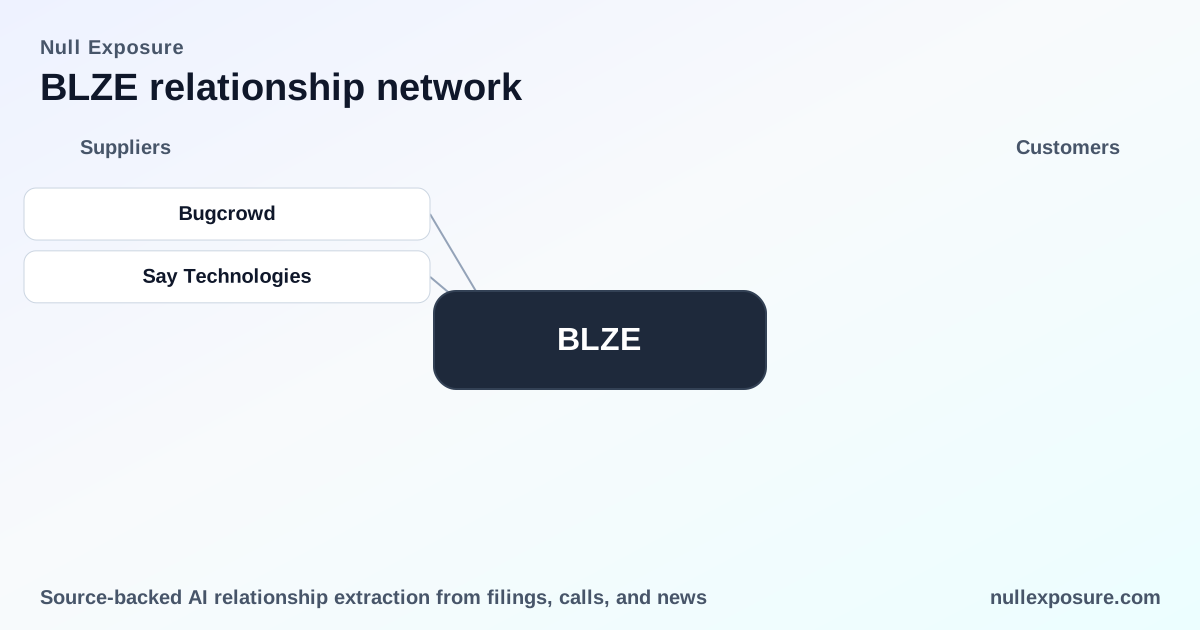
Backblaze (BLZE): Supplier relationships that shape security, ops, and investor risk
Backblaze is a cloud storage platform that monetizes primarily through subscription storage services for businesses and consumers and by managing storage infrastructure at scale. Revenue derives from recurring customer plans and usage-based services; profitability depends on hardware cost control, data center footprint, and third-party services that support security and investor communications. For investors evaluating supplier exposure, the most material supplier links are to security crowdsourcing (bug bounty) and investor-engagement software—both affect operational continuity, reputational risk, and governance signaling.
Explore further supplier intelligence at https://nullexposure.com/.
Why supplier relationships matter for a storage specialist
Backblaze’s business is capital- and operationally-intensive: hardware purchases, leased data center capacity across multiple regions, and external security programs are core inputs to delivering reliable, low-cost storage. The company reports Revenue (TTM) of $145.8M and Gross Profit of $88.9M, while remaining unprofitable on the bottom line (negative EPS and EBITDA), which makes cost predictability and supplier terms strategic priorities. The firm’s market capitalization (~$213.7M) and concentrated cost drivers mean single-vendor issues or sudden contract changes can have outsized earnings implications.
Operationally, Backblaze balances owned engineering with outsourced capabilities:
- Hardware procurement and finance leases for drives and infrastructure support capacity expansion. According to the company’s disclosure for the year ended December 31, 2024, increased depreciation reflects purchases of additional hard drives and related infrastructure and the common use of finance lease arrangements for such equipment.
- Geographic footprint is diversified across North America and EMEA with leased data center facilities in California, Arizona, Virginia, Toronto, and Amsterdam, creating both redundancy and multi-jurisdictional supplier complexity.
Supplier detail: Bugcrowd (security crowdsourcing)
Backblaze has opened its Bugcrowd Bug Bounty Program to all security researchers, formalizing an external channel for vulnerability discovery and remediation. According to a StockTitan news item on March 9, 2026, Backblaze publicly expanded its Bugcrowd program to invite broader researcher participation, a move that strengthens external security validation and threat detection cadence. (Source: StockTitan, March 9, 2026 — https://www.stocktitan.net/news/BLZE/page-14.html)
Supplier detail: Say Technologies (investor engagement)
Backblaze uses Say Technologies to manage investor interaction during earnings and investor calls, enabling investors to upvote questions so management addresses priority concerns. A StockTitan report dated March 9, 2026 described the partnership and its role in structuring investor Q&A on calls, improving governance transparency and the mechanics of stakeholder engagement. (Source: StockTitan, March 9, 2026 — https://www.stocktitan.net/news/BLZE/page-14.html)
How these supplier ties translate into operating constraints and risk signals
The company disclosures collectively highlight several operational constraints that investors should treat as company-level signals rather than vendor-specific caveats:
-
Geography and redundancy: Backblaze leases data center facilities across North America and EMEA, which reduces single-site risk but increases multi-jurisdictional supplier management complexity and compliance exposures. This footprint is a deliberate trade-off: redundancy for resilience at the cost of dispersed vendor contracting (as disclosed in public filings regarding leased sites in California, Arizona, Virginia, Toronto, and Amsterdam).
-
Capital intensity and hardware dependence: The company explicitly notes rising cost of revenue driven by depreciation from additional hard drives and infrastructure and commonly uses finance lease arrangements to obtain hardware. This signals a contracting posture that relies on equipment financers and OEM partners, generating ongoing fixed obligations and sensitivity to drive pricing and supply cycles.
-
Spend concentration and commitment bands: Backblaze reports non-cancelable purchase commitments totaling $1.0M payable in 2025 and $0.4M in 2026, placing these known liabilities in the $1M–$10M spend band. For a company of Backblaze’s scale, these commitments are meaningful to working capital planning and supplier negotiation leverage.
Taken together, these signals imply:
- Contracting posture: Mix of leasing and finance lease programs for hardware suggests medium-term locked commitments and dependence on fewer large hardware suppliers for capacity scaling.
- Concentration: Hardware and data-center leasing represent concentrated cost buckets; vendor shocks in drive supply or lease renewals would materially affect margin trajectory.
- Criticality: Security and investor-engagement suppliers are operationally critical—security through Bugcrowd affects platform integrity and reputation; Say Technologies affects investor relations quality and disclosure control.
- Maturity: The vendor relationships reflect a company mature enough to outsource specialized capabilities (crowdsourced security, investor engagement) while retaining capital-intensive core infrastructure management.
If you need a deeper supplier risk map or scoring for Backblaze, review our platform at https://nullexposure.com/ for detailed supplier analytics.
Practical investor takeaways
- Security posture is increasingly externalized. The formal Bugcrowd program broadens remediation visibility and reduces latent vulnerability risk, which is a positive governance signal for investors focused on operational reliability.
- Hardware procurement and lease obligations are material cost levers. Depreciation increases and finance leases for drives make margins sensitive to hardware cost trends and supply-chain dynamics.
- Investor communications are being standardized. The Say Technologies partnership professionalizes Q&A and reduces friction in reporting events, improving the effective transparency of management’s dialogue with shareholders.
- Regional footprint mitigates single-site risk but raises contracting complexity. Multi-region leases are resilience-positive, yet increase the supplier-management burden and multi-jurisdictional compliance considerations.
Recommended next steps for investors and operators
- For investors: prioritize questions about vendor concentration and lease renewal timelines in upcoming earnings calls; assess how hardware financing terms evolve if growth accelerates.
- For operators: codify escalation paths with security crowdsourcing partners and confirm SLAs for remediation triage; review lease expirations and negotiate flexibility where possible.
- For diligence teams: obtain vendor-level contracts where possible to quantify termination rights, price reopener clauses, and escalation SLAs.
Backblaze’s supplier posture shows an intentional balance between internal control of infrastructure and outsourcing of specialized functions—a structure that supports scale but requires active supplier governance. For targeted supplier intelligence and a supplier risk scorecard for Backblaze, visit https://nullexposure.com/ to start a tailored review.