BLZRW — What investors should know about Trailblazer Acquisition Corp. warrants and their supplier ties
Trailblazer Acquisition Corp. is a SPAC vehicle; BLZRW represents the company’s publicly traded warrant class that delivers optionality to acquire shares contingent on a business combination. Investors in BLZRW monetize through changes in the underlying equity value post-merger: warrants convert into equity value only when a qualifying transaction and subsequent conversion mechanics create tradable common stock value. The sponsor complex (management team, underwriters and placement agents) captures fees and economics around deal origination and financing, while warrant holders capture leveraged upside to any successful transaction outcome. For a concise, supplier-focused dossier on this exposure, see https://nullexposure.com/.
Quick read on how value is created and who gets paid
Trailblazer’s business model is a transaction-first construct: capital is raised through a public offering, underwriters and placement agents execute the financing, the SPAC sources an acquisition target, and the economic value to warrant holders flows through the post-deal equity price. That chain creates three monetization buckets: sponsor/promote economics for deal originators, underwriting and placement fees for financial intermediaries, and residual upside for public investors who hold warrants or shares. Because BLZRW is a warrant instrument rather than an operating company, its fortunes are tied directly to successful deal execution, the quality of the target, and the underwriting syndicate that priced and placed the offering.
Explore the broader supplier map and structural exposures on the NullExposure homepage: https://nullexposure.com/.
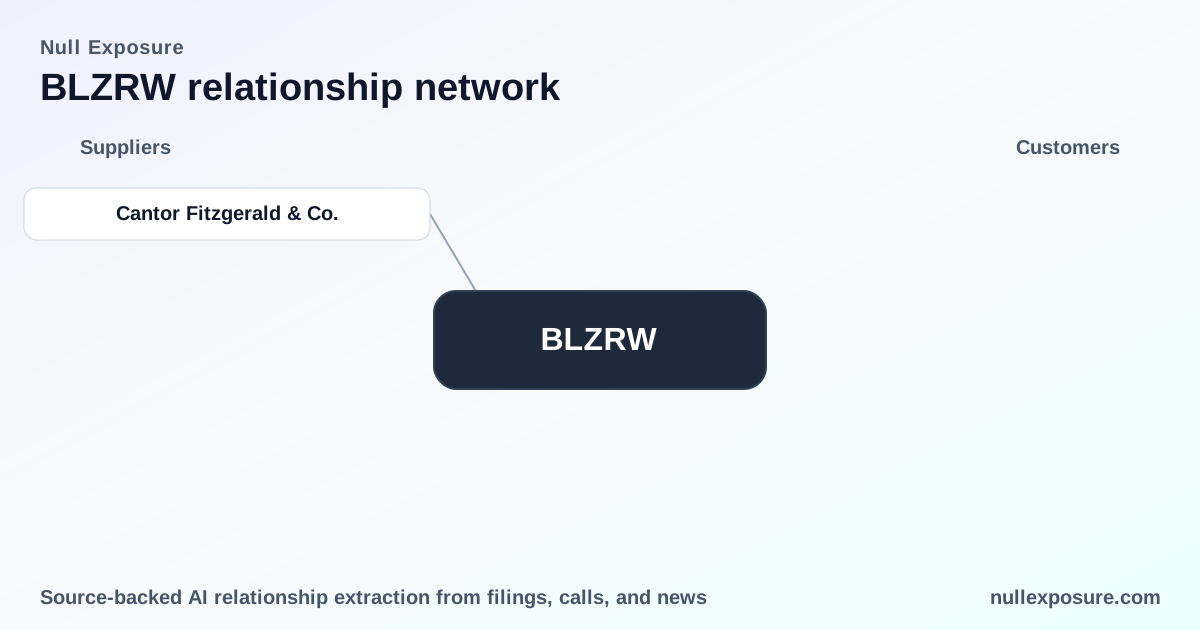
The single supplier relationship the record shows — Cantor Fitzgerald & Co.
Trailblazer’s supplier relationship footprint in public filings and news coverage is currently sparse. The one identified relationship in our review is with Cantor Fitzgerald & Co.:
- Cantor Fitzgerald & Co. is acting as the sole book-running manager for the offering. According to a news posting on March 9, 2026, Cantor Fitzgerald served as the lead underwriter in the upsized offering associated with Trailblazer’s capital raise. (Source: StockTITAN news item, March 9, 2026 — https://www.stocktitan.net/news/BLZR/trailblazer-acquisition-corp-announces-the-pricing-of-upsized-240-k3ow73d0cjoj.html)
This relationship is straightforward: Cantor Fitzgerald is the primary capital markets counterparty executing the raise, which places it at the center of transactional execution risk for the SPAC’s financing needs.
Why the Cantor Fitzgerald tie matters for warrant holders
- Execution and distribution risk are concentrated: having a single book-runner implies concentration of execution in one counterparty, which can accelerate deal flow when underwriting capacity is strong but concentrates placement risk if markets turn illiquid.
- Pricing and syndication influence warrant economics: underwriters set pricing guidance and arrange institutional allocations; these mechanics shape how the public and institutional tranches interact and ultimately determine the supply-demand dynamics that affect warrant trading post-announcement.
- Reputation and distribution muscle matter: Cantor Fitzgerald’s role signals that the sponsor chose an underwriter with significant capital markets capability, which is relevant for investors assessing the likelihood of a smooth IPO/financing and eventual merger pipeline.
(Source context: the March 9, 2026 news notice describing Cantor Fitzgerald as sole book-running manager.)
Operating-model constraints and company-level signals
There are no explicit contractual constraints or supplier limitations disclosed in the reviewed relationship data. As a company-level signal, that absence is itself meaningful for counterparty and operational analysis:
- Contracting posture: Trailblazer operates as a deal-originating SPAC with customary transactional vendors rather than long-term operational suppliers. The SPAC model drives short-term, high-intensity contracting around underwriting, legal, accounting, and target diligence services rather than long-duration supplier agreements.
- Concentration: supplier engagements are typically concentrated around a small set of counterparties (underwriters, law firms, auditors). The documented Cantor Fitzgerald relationship indicates a concentrated distribution partner rather than a diffuse vendor base.
- Criticality: underwriting and distribution are mission-critical to SPAC success; failure, poor execution, or reputational issues with a lead underwriter will have immediate effects on capital access and investor confidence.
- Maturity: the business is pre-combination and thus immature in operating terms — the warrant instrument reflects option-value rather than revenue-generating operations. Sponsor and underwriter capabilities substitute for operating maturity in investor assessment.
These structural characteristics define how to think about operational counterparty risk for BLZRW: concentrated, high-impact, transaction-focused supplier relationships rather than diversified vendor ecosystems.
Investment implications: what this means for portfolio and operational managers
- Binary, deal-driven payoff: BLZRW is fundamentally dependent on successful deal execution and post-merger equity performance. Underwriting quality and distribution execution are direct drivers of short-term liquidity and longer-term conversion value.
- Counterparty concentration is a risk lever: the reliance on a single book-runner for the offering concentrates execution and reputational risk. Investors should monitor any signals about syndication distribution, underwriting commitments, and market appetite around the financing.
- Transparency is limited by instrument type: warrant holders lack operational disclosures typical of operating companies; therefore, counterparty monitoring and event-driven diligence (announcements, amendments, underwriting notices) are the sensible risk-management levers.
If you want a structured supply-side view across SPAC instruments and their critical counterparties, the NullExposure homepage maintains the searchable supplier map: https://nullexposure.com/.
Practical next steps for institutional and operator audiences
- Track announcements and filings for any changes in underwriting syndicate, pricing amendments, or syndication details — these are the most actionable supplier-related signals for warrant valuations.
- Evaluate sponsor track record and Cantor Fitzgerald’s distribution notes for indications of institutional appetite; underwriting behavior is a leading indicator of post-merger liquidity conditions.
- For operators considering SPAC partnerships or underwriting roles, consider the concentration trade-off: a single, strong book-runner can accelerate execution but creates single-point-of-failure risk for downstream counterparties.
For an in-depth supplier risk report and ongoing monitoring of SPAC counterparties, visit the NullExposure homepage and sign up for alerts: https://nullexposure.com/.
Bottom line
BLZRW is a pure optionality instrument tied to a sponsor-led SPAC process; the singular public supplier relationship identified — Cantor Fitzgerald & Co. as sole book-running manager — places distribution and execution squarely at the center of investor outcomes. With no disclosed long-term supplier constraints, the core analytic focus for investors and operators should be underwriting execution, sponsor track record, and the quality of any target announced in the next phase. For continued tracking of supplier ties and event-driven exposures in the SPAC market, return to NullExposure: https://nullexposure.com/.