Biomea Fusion (BMEA): underwriting partners, supplier posture, and operational constraints investors need to track
Biomea Fusion is a development-stage biopharma focused on irreversible small molecules for genetically defined cancers. The company monetizes primarily through equity and capital markets activity—raising financing to fund preclinical and clinical programs—while outsourcing nearly all manufacturing and many development functions to third parties. With no product revenue and an FY2025 operating profile that shows negative EBITDA and zero revenue, capital markets relationships and contract manufacturing/service providers are the operational lifelines that determine program continuity and dilution risk. For immediate access to more supplier-relationship intelligence visit https://nullexposure.com/.
Underwriters and recent capital markets activity: who is steering the financing
-
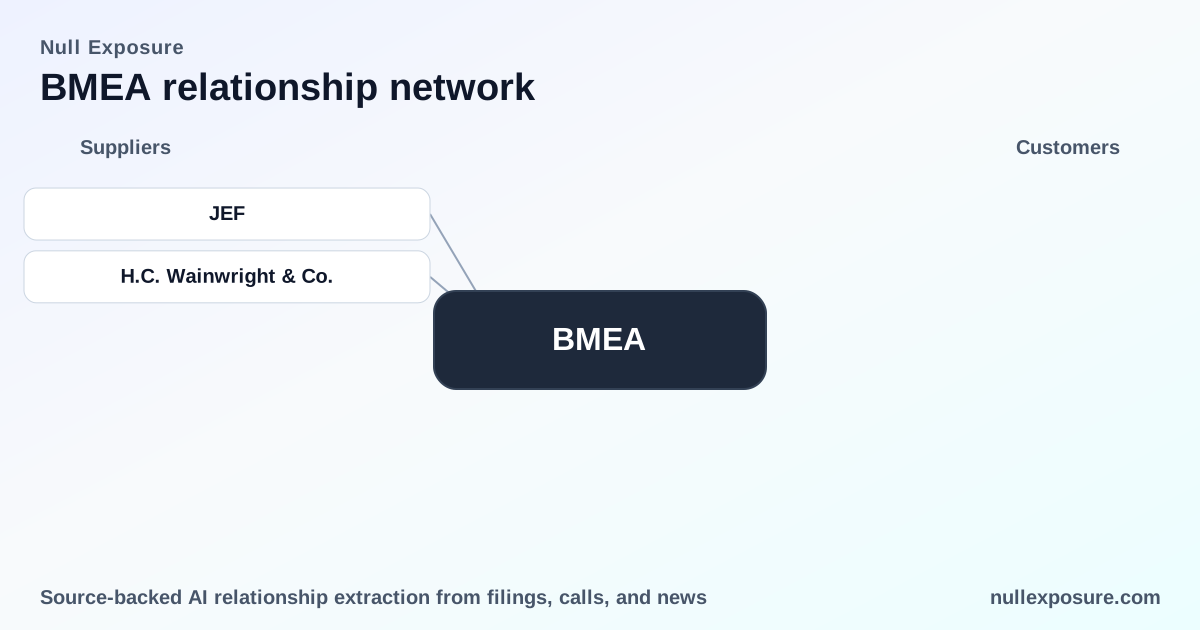
Jefferies / Jefferies LLC — sole book-running manager for the proposed offering. According to a company press release on October 6, 2025, Jefferies was named the sole book-running manager for Biomea Fusion’s proposed public offering; subsequent pricing information published October 7, 2025, repeated Jefferies’ role in the deal (GlobeNewswire, Oct 6–7, 2025). Multiple wire services carried the same text to market (StockTitan, Oct 2025), underscoring consistent market messaging from the issuer.
-
H.C. Wainwright & Co. — lead manager on the pricing announcement. The October 7, 2025 pricing release identifies H.C. Wainwright as the lead manager for the same offering, indicating a syndicate arrangement where H.C. Wainwright performs a principal distribution role alongside Jefferies (GlobeNewswire, Oct 7, 2025; StockTitan, Oct 2025).
These entries are documented across the company’s issuer releases and third‑party newsfeeds in October 2025, confirming the financing channel and the placement agents involved.
Why these relationships matter for valuation and execution
Biomea’s current model relies on intermittent equity raises to finance R&D and to bridge pre‑revenue operations. The appointment of Jefferies as sole book‑runner and H.C. Wainwright as lead manager signals a traditional underwritten equity syndication approach rather than private placements or structured debt—an important tilt for investors modeling dilution, timing, and pricing dynamics. Underwriters’ distribution capacity and market appetite will directly affect how quickly programs receive funding and whether Biomea must accept deeper dilution in weak markets.
For ongoing intelligence and to monitor how these capital relationships evolve, see https://nullexposure.com/.
Operational posture and supplier constraints: manufacturing, geography, and leases
The company-level disclosures present a consistent operating posture:
-
Outsourced manufacturing and development. Biomea does not operate internal manufacturing facilities or staff; it relies on contract manufacturing organizations (CMOs) and third‑party service providers for preclinical and clinical supply as well as R&D tasks. This is a structural dependency: product execution, batch transfers, and scale‑up are controlled largely off‑balance-sheet.
-
Geographic outsourcing includes APAC capacity. Biomea contracts certain development and manufacturing activities outside the U.S., including in China, which introduces cross‑jurisdictional dependencies and supply‑chain complexity.
-
Single‑source and material supplier risk. Company disclosures explicitly warn that disruption from any single‑source supplier or service provider could materially affect operations and financial condition.
-
Lease commitments indicate multi‑year facilities exposure. The company entered a four‑year lease (commenced Jan 2023, expires Jan 2027) for additional lab space and reports leases in Redwood City and San Carlos that run through January 2032, indicating fixed occupancy costs and infrastructure commitments.
-
Spend scale for certain line items sits in the $1–10M band. Operational cash flows tied to lease payments and manufacturing outsourcing are non-trivial relative to a development-stage balance sheet.
These attributes combine into an outsourcing-first model with high supplier criticality, geographic concentration risk in APAC, and medium-term infrastructure fixed costs.
Relationship-level summaries (complete coverage of the reported ties)
Jefferies / Jefferies LLC — Jefferies is documented as the sole book‑running manager on Biomea’s October 6, 2025 proposed offering and repeated in the October 7, 2025 pricing release; the same announcements were distributed through multiple wire services (GlobeNewswire; StockTitan, Oct 2025). This positions Jefferies as the primary underwriter charged with bookbuilding and price discovery for the equity raise.
H.C. Wainwright & Co. — The October 7, 2025 pricing announcement lists H.C. Wainwright as the lead manager of the offering, signaling a significant syndicate role in distribution and placement (GlobeNewswire; StockTitan, Oct 2025). This complements Jefferies’ book‑running responsibilities and reflects a conventional underwriter split.
Implications for investment diligence and counterparty monitoring
-
Execution risk is dominated by capital markets and vendor continuity. Given zero product revenue and negative EBITDA, the company’s runway, program cadence, and dilution profile are driven by the success of transactions led by underwriters and by uninterrupted supply from CMOs.
-
Concentration and criticality elevate counterparty due diligence. Investors should prioritize monitoring contract terms, single‑source suppliers, and any APAC manufacturing partners for relocation, regulatory, or geopolitical exposures.
-
Maturity is early; the firm is pre‑revenue and dependent on equity markets. Model scenarios should stress-test pricing environments and underwriter capacity while accounting for lease cash flows and outsourced manufacturing spend.
How investors and operators should act next
-
Institutional investors evaluating exposure should obtain copies of the offering prospectus and material supplier agreements to quantify dilution runways and single‑source concentration clauses. Underwriter selection is a liquidity lever; monitor syndicate allocations and greenshoe provisions closely.
-
Operational managers and supply‑chain teams should map CMO critical paths, identify alternative suppliers in lower‑risk jurisdictions, and stress test timelines against potential regulatory or logistical interruptions.
For continuous tracking of supplier and capital‑markets relationships for Biomea Fusion, visit https://nullexposure.com/.
Bottom line
Biomea Fusion operates a pure development-stage model: no revenue, heavy reliance on equity financing, and outsourced manufacturing that is both material and geographically dispersed. The October 2025 underwriting activity—Jefferies as book‑runner and H.C. Wainwright as lead manager—defines the immediate financing channel and therefore the most actionable short-term variable for valuation and program continuity. For an investor-grade supplier and counterparty briefing tailored to BMEA, explore the full relationship intelligence at https://nullexposure.com/.