Bluemount Holdings (BMHL): Underwriters and Counsel Tie the IPO to a Small, Insider-Controlled Capital Markets Play
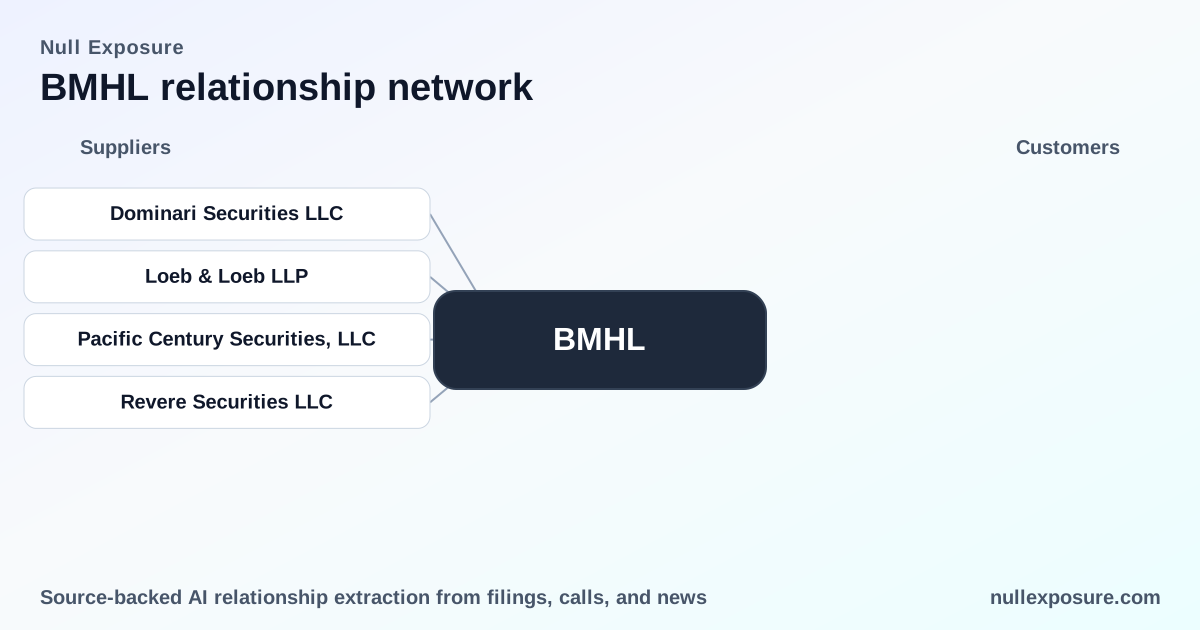
Bluemount Holdings monetizes through financial consulting services and the trading of luxury watches, generating revenue from client advisory fees and transactional margins on secondary-market luxury goods. The company completed a US listing alongside a modest $5.5 million initial public offering, using a set of specialist underwriters and two law firms to execute the raise — a supplier footprint that signals a tightly controlled capital strategy and concentrated ownership. For a quick look at how we map these supplier relationships to risk and opportunity, visit the NullExposure homepage: https://nullexposure.com/.
How Bluemount operates and what drives value
Bluemount is a dual-line boutique business: client-facing financial consulting and luxury watch trading. Revenue of $53.5 million over the trailing twelve months and a positive profit margin indicate the business already produces operating cash, but the company’s listed metrics register characteristics of an early-stage public firm rather than a mature capital markets player.
- Market capitalization near $94 million and a trailing P/E of 73.6 position Bluemount as a premium multiple growth or scarcity stock on the Nasdaq.
- Insider ownership is extreme at 96.2%, while institutional ownership is negligible at 0.52%, creating a concentrated control structure that limits public float and liquidity.
- Price-to-book of 19.1 and EV/Revenue of 13.57 reflect a valuation that discounts scale risk and prizes either unique intellectual property or anticipated growth.
These company-level signals imply a tight contracting posture: management controls strategic decisions, external suppliers hired for capital markets transactions operate in discrete, project-based roles, and future capital raises will rely on the same small set of specialists. The supplier relationships that closed the IPO are therefore operationally critical for funding and regulatory navigation but not ongoing service providers to core operations.
Who Bluemount hired to get public — the relationships
The company disclosed a single offering closing and the core parties that executed the transaction. Each relationship below is sourced to the company press release announcing the offering.
Dominari Securities LLC
Dominari Securities acted as the representative of the underwriters for the initial public offering that closed at $5.5 million. According to the company press release on ACN Newswire (March 9, 2026), Dominari led the underwriting syndicate and coordinated allocation and distribution.
Pacific Century Securities, LLC
Pacific Century Securities served as a co-underwriter on the offering, partnering with Dominari to place shares with investors and support the deal’s bookbuild. The ACN Newswire release documenting the closing lists Pacific Century Securities as a co-underwriter (March 9, 2026).
Revere Securities LLC
Revere Securities joined the syndicate as a co-underwriter, providing distribution support and participating in the underwriting commitment for the $5.5 million offering. The closing announcement on ACN Newswire (March 9, 2026) includes Revere Securities as a named co-underwriter.
Loeb & Loeb LLP (and VCL Law LLP)
Loeb & Loeb LLP acted as legal counsel to Bluemount for the offering while VCL Law LLP represented the underwriters, providing securities, transactional, and compliance legal services required for the listing. The ACN Newswire press release (March 9, 2026) references both firms in their respective advisory roles.
(Press release source for all relationship notes: ACN Newswire announcement of the closing of Bluemount Holdings’ initial public offering, March 9, 2026 — https://www.acnnewswire.com/press-release/english/100993/bluemount-holdings-limited-announces-closing-of-$5.5-million-initial-public-offering)
What these supplier choices reveal about operational posture
The supplier set is compact and transaction-focused, which defines the company’s contracting posture: project-based external partners for discrete capital events rather than long-term vendor relationships. That posture creates several investor-relevant implications:
- Criticality: Underwriters and securities counsel were critical to achieving listing and liquidity. For a company with limited institutional ownership and a small float, future capital access will remain dependent on a handful of capital markets partners.
- Concentration risk: With insiders holding more than 96% of shares, liquidity and governance are highly concentrated, reducing the bargaining power of minority investors. The small group of underwriters used for the IPO indicates the company runs concentrated supplier relationships for capital formation as well.
- Maturity and repeatability: The choice of boutique underwriters suggests a go-to-market tailored to small offerings and specialized investor channels rather than broad institutional distribution; recurring capital raises at scale would require expanding or upgrading the syndicate.
- Contracting leverage: Bluemount retains leverage in vendor selection due to the episodic nature of these supplier services, but reputational and execution risk lies with the chosen advisers when future, larger capital events are necessary.
If you are tracking counterparty networks for governance or financing scenarios, these patterns are important to document; NullExposure maps these ties on an ongoing basis: https://nullexposure.com/.
Investment implications and operator-level playbook
For investors, Bluemount is a small-cap, insider-led company that has proven access to primary capital through a $5.5 million IPO, but it still reads as a firm in the early public innings. Key takeaways:
- Opportunity: The company generates operating profits and has a focused business model with clear monetization levers in luxury trading and consulting. If management leverages the listing to scale distribution, there is upside to the current valuation multiple.
- Risk: Extraordinary insider concentration, limited institutional ownership, and a small public float create governance and liquidity risk. Reliance on boutique underwriters and external counsel keeps execution risk concentrated during capital events.
- Actionable operator playbook: Management should broaden investor outreach to reduce concentration, diversify underwriter relationships to lower execution risk on future raises, and disclose a clearer capital allocation plan to reduce valuation uncertainty.
Explore more supplier relationship profiles and capital markets counterparties at NullExposure to operationalize this intelligence: https://nullexposure.com/.
Final recommendation
Bluemount is an operationally profitable, small public company that trades with the strategic footprint of a founder-controlled business. Underwriters and counsel that closed the IPO are mission-critical for Bluemount’s next steps in growth or refinancing, and the current supplier profile implies both efficient, targeted execution and elevated concentration risk. Investors should track subsequent capital raises and any shifts in institutional ownership as the clearest indicators of a transition from boutique public company to a broadly supported market issuer.
For continuous monitoring of supplier relationships and capital-event counterparties relevant to Bluemount, visit NullExposure: https://nullexposure.com/.