BMN (BlackRock 2037 Municipal Target Term Trust) — Supplier Relationship Brief
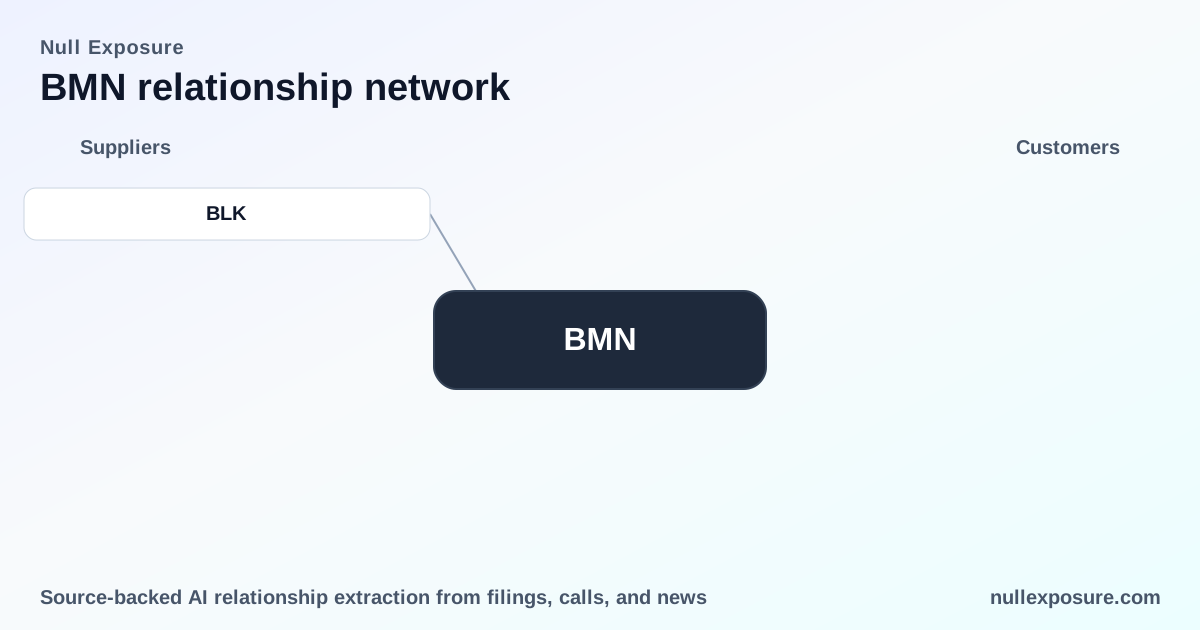
BMN is a closed-end municipal bond trust listed on the NYSE that is operated under the BlackRock brand and monetizes through investment management fees and the yield spread between underlying municipal securities and fund operating expenses. As an investor or operator evaluating BMN’s supplier posture, the primary commercial relationship to assess is BMN’s operational and management linkage to BlackRock, which provides portfolio management, distribution and back-office services that are critical to the vehicle’s ongoing liquidity and fee capture. For sourcing deeper signals and ongoing monitoring, visit https://nullexposure.com/ to access curated supplier intelligence and relationship tracking.
How BMN’s manager relationship drives economics
BMN’s economics are simple: the trust earns interest on municipal securities, charges shareholders expenses and management fees, and distributes net income. The manager—BlackRock—fundamentally controls investment strategy, liquidity provisioning and the fee schedule, making the manager relationship the primary supplier dependency for both yield delivery and operational continuity. That linkage creates concentrated operational exposure and a clear channel for governance and performance risk.
The reportered relationship entries: what the records show
Each of the three items in the supplied relationship feed references BlackRock in the context of the BMN listing. All references are news releases from StockTradersDaily that identify the fund as “Blackrock 2037 Municipal Target Term Trust Of Beneficial Interest (NYSE: BMN).”
- A StockTradersDaily release referencing the fund in FY2025 identifies the vehicle by name, confirming BlackRock’s brand-sponsorship of the trust (news release, March 2026). (https://news.stocktradersdaily.com/news_release/134/BMN_Movement_Within_Algorithmic_Entry_Frameworks_110525013402_1762324442.html)
- A separate StockTradersDaily item in FY2026 highlights trading-system reactions to BMN volatility and again names the trust as a BlackRock-managed instrument, signaling market attention to price action under the BlackRock label (news release, March 2026). (https://news.stocktradersdaily.com/news_release/134/Trading_Systems_Reacting_to_BMN_Volatility_022326022401_1771874641.html)
- A third StockTradersDaily piece in FY2026 summarizes “key findings” for the BlackRock 2037 Municipal Target Term Trust, reinforcing that public commentary and short-form research treat BMN as a BlackRock-managed municipal trust (news release, March 2026). (https://news.stocktradersdaily.com/news_release/22/BMN_and_the_Role_of_Price-Sensitive_Allocations_020126114801_1769964481.html)
Collectively these items corroborate a single, dominant supplier relationship: BlackRock as the named manager and operational sponsor.
What the absence of explicit constraints signals about BMN
No supplier-specific constraints were reported in the relationship feed. As a company-level signal, the lack of disclosed procurement or contractual constraints implies:
- Mature supplier posture: BMN operates within a conventional closed-end fund governance model where sourcing and procurement are largely internal to the manager’s ecosystem rather than outsourced to multiple external vendors.
- High concentration and centralization: The absence of multiple named suppliers in the feed reinforces that BlackRock handles the bulk of portfolio management and operational services—an efficiency for scale, and a concentration risk for counterparties.
- Standard contracting posture: Expect institutional master servicing and management agreements typical for closed-end municipal trusts rather than bespoke, multi-vendor contracting. That reduces procurement complexity but increases single-vendor criticality.
These are company-level inferences drawn from an absence of explicit constraints, not from any constraint document naming a third party.
Risk profile and operational implications for investors and operators
BMN’s supplier construct—centralized management by BlackRock—creates a clear set of operational and investment risks:
- Concentration risk: With BlackRock as the dominant supplier, governance failures or strategic shifts at the manager would have direct impact on BMN’s distribution policy, liquidity management and fee generation.
- Liquidity and market-sensitivity: News items flagging BMN volatility indicate that price-sensitive allocations and algorithmic trading responses can amplify fund-level NAV and market-price divergence. That is important for investors who use closed-end funds for predictable muni exposure.
- Fee and expense control: The manager captures recurring fees; small changes to expense ratios materially affect investor yields in a fixed-income vehicle. Active monitoring of fee disclosures and proxy materials is essential.
- Operational maturity advantage: BlackRock’s scale delivers advanced trading, custody and compliance infrastructure—a stabilizing factor for BMN relative to smaller sponsors.
Practical takeaways for portfolio managers and operators
- Prioritize monitoring of BlackRock disclosures and fund commentary. Given the concentrated supplier relationship, changes in management commentary, fee schedules, or distribution policy will be the earliest indicators of material change.
- Stress-test liquidity assumptions. Use scenarios that reflect elevated volatility events, since market attention to BMN trading dynamics has been documented in news releases.
- Treat the manager as both a counterparty and a vendor. Operational due diligence should include contractual terms in the management agreement and the manager’s policy on NAV support and buybacks.
- Maintain governance levers. For larger institutional holders, engage with the fund’s board and monitor proxy materials to influence expense and distribution decisions.
For ongoing monitoring tools and supplier relationship analytics for funds like BMN, visit https://nullexposure.com/ to set up alerts and get curated supplier intelligence.
Final view and action items
BMN is a closed-end municipal trust whose supplier posture is characterized by high concentration, managerial centrality and operational maturity through BlackRock. That configuration is both a strength—providing scale, compliance and trading capability—and a single-point-of-failure risk for performance and governance. Investors should focus diligence on the manager’s contractual terms, fee trajectory and liquidity-management playbook, while operators should integrate market-volatility scenarios into operational runbooks.
If you need a tailored supplier risk brief on BMN or comparable funds, or want continuous tracking of manager-related signals, start here: https://nullexposure.com/. For research subscriptions and bespoke monitoring of manager-supplier interactions, return to https://nullexposure.com/ to request coverage and alerts.