Bank of Montreal: supplier and partner landscape that shapes earnings and risk
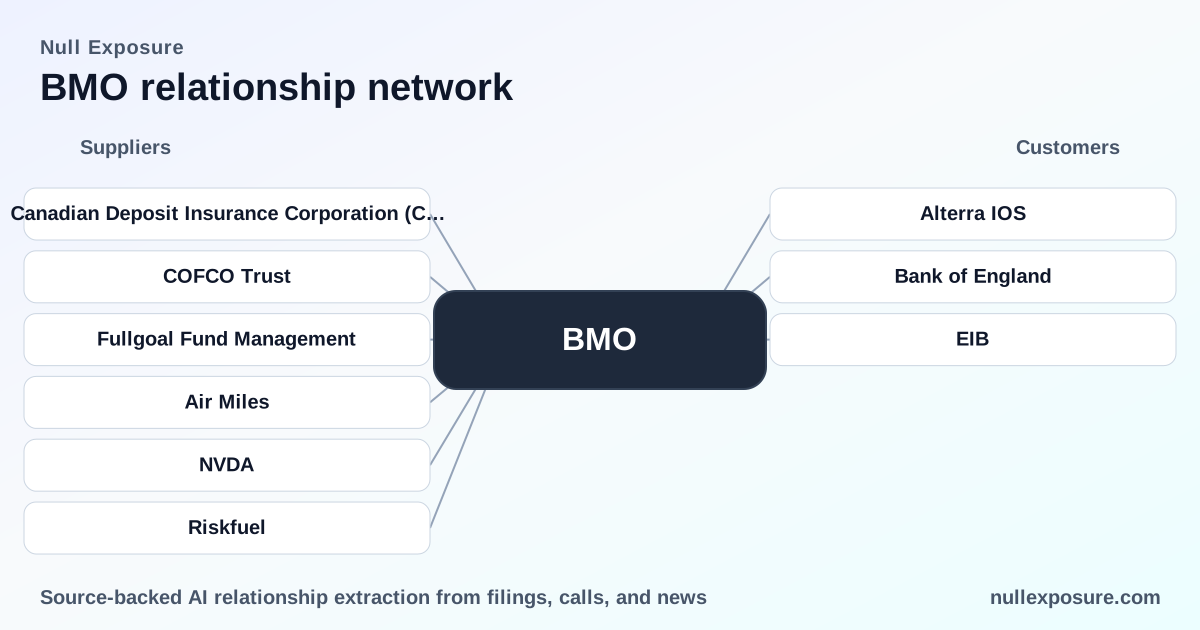
Bank of Montreal (BMO) operates as a diversified North American bank that monetizes through a mix of net interest margin on lending and deposits, fee-based wealth and capital markets services, and strategic minority investments that generate both fee and equity returns. Its supplier footprint mixes regulated market protections (deposit insurance), consumer-facing partners (rewards programs), strategic technology vendors for trading and pricing, and equity stakes in foreign asset managers that expand distribution and fee pools. For investors, these relationships are complementary to core banking economics—they lower deposit risk, extend product reach, and accelerate trading capabilities—while also concentrating political and execution risk in select geographies and vendors.
Explore the full supplier mapping at NullExposure homepage.
What each partner relationship means in plain language
Canadian Deposit Insurance Corporation (CDIC)
BMO’s guaranteed investment certificates (GICs) are eligible for protection under CDIC, which reduces retail deposit risk and supports consumer confidence in term products. According to a NerdWallet review of BMO GIC products (FY2025), CDIC coverage is explicitly referenced for BMO GIC offerings. https://www.nerdwallet.com/ca/p/best/banking/best-bmo-gic-rates
Air Miles
BMO offers co-branded GICs and other retail products that link to the Air Miles rewards program, using the brand to deepen customer engagement and product differentiation in the retail channel. NerdWallet’s FY2025 product overview calls out a BMO Air Miles GIC that lets customers earn rewards. https://www.nerdwallet.com/ca/p/best/banking/best-bmo-gic-rates
COFCO Trust
BMO holds an equity stake—reported at roughly 16 percent—in COFCO Trust, a Beijing-headquartered trust company, positioning the bank to access Chinese onshore wealth management and trust distribution channels. A China Daily piece in FY2026 documents BMO’s approximate 16 percent stake in COFCO Trust, reflecting the bank’s targeted foothold in China. https://global.chinadaily.com.cn/a/202601/16/WS6969bceca310d6866eb34253.html
Fullgoal Fund Management
BMO owns an equity stake of about 28 percent in Shanghai-based Fullgoal Fund Management, giving the bank exposure to local fund-management fees and product shelf access for institutional and retail investors in China. China Daily’s FY2026 reporting cites the bank’s roughly 28 percent ownership in Fullgoal. https://global.chinadaily.com.cn/a/202601/16/WS6969bceca310d6866eb34253.html
NVIDIA
BMO has worked with NVIDIA-accelerated solutions to speed complex derivative pricing and analytics, which directly improves the efficiency of its capital markets and structured products franchises. An NVIDIA blog post covering the partnership and technology benefits references BMO’s use of NVIDIA acceleration in FY2022. https://blogs.nvidia.com/blog/riskfuel-derivative-models-bank-of-montreal/
Riskfuel
Riskfuel provided advanced derivative-modeling software that BMO adopted to replace slower CPU models for structured notes pricing, demonstrating BMO’s willingness to integrate specialized fintech vendors into core trading workflows. NVIDIA’s FY2022 coverage of Riskfuel’s project with BMO describes the coupling of Riskfuel models with GPU acceleration for improved performance. https://blogs.nvidia.com/blog/riskfuel-derivative-models-bank-of-montreal/
Why these relationships matter to operations and margins
These partnerships collectively reveal BMO’s operating posture: diversified, strategic, and targeted. Rather than large-scale outsourcing, BMO pursues a blended model of owned distribution (retail GICs, branded products), minority equity stakes (China fund and trust firms), and selective vendor integration (Riskfuel + NVIDIA) to enhance margins and reduce friction in capital markets. The mix supports fee income growth and product differentiation while keeping the bank’s core balance-sheet and regulatory control intact.
Key operating-model characteristics:
- Contracting posture: BMO favors minority equity investments and selective vendor partnerships over full operational transfers, preserving governance while accessing local distribution and specialist capability.
- Concentration: Geographic concentration risk is meaningful on the China exposure side (COFCO Trust, Fullgoal) and on technology vendors for advanced trading functions (Riskfuel/NVIDIA).
- Criticality: Some third parties are operationally critical—technology for derivative pricing directly affects trading speed and risk management—whereas CDIC is a regulatory backstop that reduces retail liability during stress.
- Maturity: Relationships span mature regulatory frameworks (CDIC) to relatively recent fintech integrations (Riskfuel/NVIDIA), indicating a blend of established and evolving dependencies.
If you want a granular map of these supplier ties and how they influence counterparties and risk, see more at NullExposure homepage.
Investment implications and concentrated risk signals
These supplier relationships generate both earnings leverage and identifiable risk:
- Positive earnings drivers: Minority stakes in onshore Chinese asset managers provide fee income and local market access, while rewards partnerships and CDIC backing strengthen retail deposit gathering and product cross-sell.
- Cost and capability gains: Adoption of GPU-accelerated models through Riskfuel and NVIDIA increases throughput for structured-product desks, improving pricing agility and possibly reducing capital consumed for hedging.
- Concentration and geopolitical risk: The material stakes in Chinese financial firms create political and regulatory sensitivity that investors must monitor separately from BMO’s North American operations.
- Vendor dependency: Advanced trading capability now depends on a small set of specialized vendors; operational resilience and vendor-contract terms deserve scrutiny given the direct impact on trading operations.
Suggested focus areas for ongoing monitoring:
- Governance and exit rights on the COFCO and Fullgoal holdings.
- Service-level and contractual protections in fintech arrangements that are critical to pricing and risk systems.
- Changes to deposit insurance rules or limits that could affect retail product attractiveness.
Learn how these relationship signals are translated into exposure scoring and counterparty dashboards at NullExposure homepage.
Bottom line for investors
BMO’s supplier and partner footprint is strategic and earnings-accretive: deposit insurance and rewards partnerships shore up retail franchises, minority stakes in Chinese asset managers extend fee pools, and selective fintech integrations accelerate capital-markets capabilities. These relationships drive fee diversification and operational efficiency, but they also concentrate geopolitical exposure in China and operational dependence on specialized vendors for derivative pricing. For an investor, the trade-off is clear: enhanced growth vectors with defined external dependencies that require active governance oversight.
For investors and operators evaluating counterparty risk or supplier strategy, BMO’s mix is a case study in using minority investments plus targeted vendor integration to amplify bank economics while retaining core control—an approach that delivers upside if governance and vendor resilience are tightly managed. Explore deeper supplier analytics and monitoring tools at NullExposure homepage.