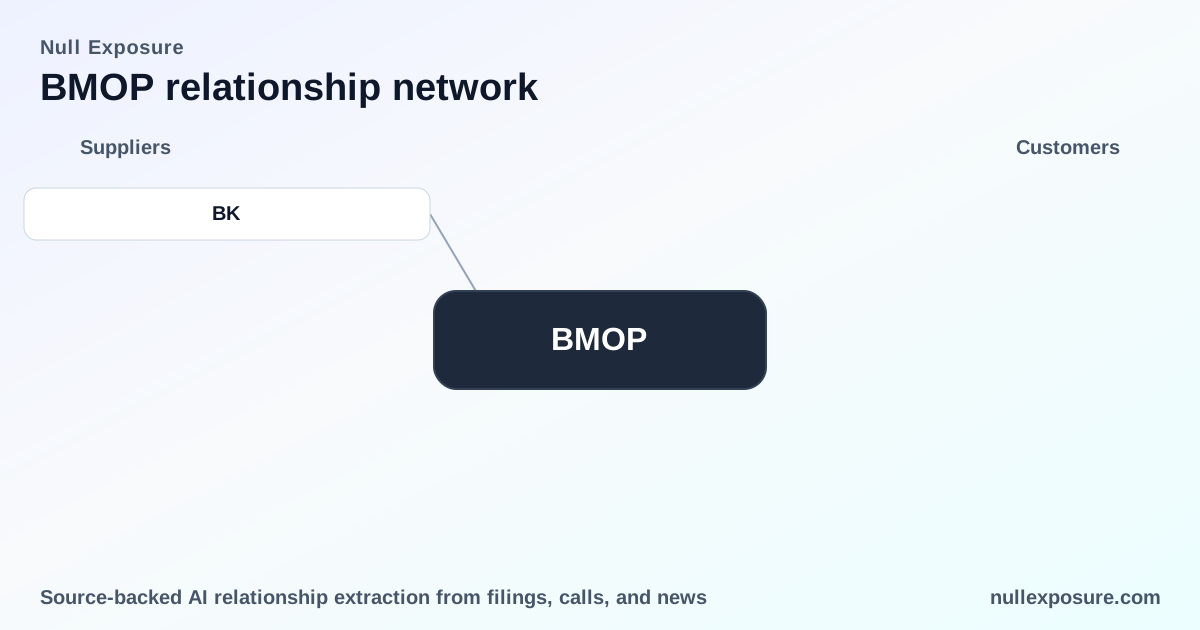
BMOP supplier profile and what BNY Mellon exposure signals for investors
BMOP operates as a market-facing municipal opportunities investment vehicle that monetizes through investment management and servicing fees charged to investors and underlying accounts. Its economic model depends on fee capture from portfolio management, custody/administration services, and distribution channels; those service relationships determine both cost structure and operational resiliency. Investors should read supplier linkage as a direct line into the fund’s operational risk and cost base—custodians, administrators, and large banks are not optional partners for this style of vehicle.
Explore the full supplier map and related supplier intelligence at https://nullexposure.com/.
What the public relationship list contains today
The available records identify a single public mention linking BMOP with a major custody and institutional bank. That mention is concise but meaningful for operational due diligence: it confirms a visible connection between the fund and an incumbent financial services provider.
BNY Mellon — a visible institutional partner
BNY Mellon is referenced on BMOP’s market news page, indicating a publicly-visible association between the two entities. According to QuiverQuant’s BMOP stock page, the connection was recorded on March 9, 2026, with one mention in the news listing. (QuiverQuant, BMOP stock page, March 9, 2026.)
How to read this relationship: operational mechanics and implications
The presence of BNY Mellon in BMOP’s public mentions is significant for several reasons that affect valuation, operational continuity, and counterparty risk:
- Service role inference: Large custodial banks like BNY Mellon commonly serve as custodian, transfer agent, clearing partner, or administrator for funds. That functional set directly influences fee levels, settlement reliability, and compliance controls used by the fund.
- Operational maturity signal: A link to a major global custodian is a positive indicator of operational maturity and institutionalization, which supports scaling and institutional sales channels.
- Counterparty concentration and systemic risk: Reliance on one dominant provider for custody or administration concentrates operational risk; disruptions at a primary servicer can have immediate cash-movement and NAV reporting consequences.
These points are structural observations about typical fund/vendor dynamics and are consistent with the single recorded mention connecting BMOP and BNY Mellon (QuiverQuant, BMOP stock page, March 9, 2026).
Company-level supplier constraints and what their absence indicates
The available supplier constraint record returns no explicit contractual constraints or flagged supplier terms for BMOP. This absence is a company-level signal: no constraint disclosures were provided in the public supplier summary, which itself conveys information about contracting posture, concentration, criticality, and maturity.
- Contracting posture: The lack of disclosed constraints suggests an open contracting posture—standard institutional agreements rather than bespoke restrictive clauses that would appear in constrained records.
- Concentration: With only one public mention, the record does not document high supplier diversity; this implies potential concentration around a small number of large providers, a common pattern for funds that outsource custody and administration.
- Criticality: The single large-bank relationship indicates high criticality for core services (settlement, custody, reporting), a routine but important risk vector for investors to monitor.
- Maturity: A public association with a major custodian is consistent with standardized, mature fund operating practices.
Treat these as directional operating signals. For line-item contractual constraints you would expect in-depth filings or service agreements; those documents are not present in the supplier record.
Risks investors and operators must track
Key operational and investment risks tied to supplier relationships for BMOP:
- Counterparty concentration: Heavy reliance on a major bank for custody or admin creates single-point operational risk. Plan contingency arrangements and liquidity buffers.
- Fee compression and service cost: Administrative and custody fees are a direct drag on net return; negotiate scale-based fee schedules and monitor fee transparency in reporting.
- Operational continuity: Settlement failures, reporting lags, or system outages at a primary servicer can impair NAV accuracy and investor redemptions.
- Regulatory and reputational exposures: A supplier under regulatory scrutiny transfers compliance risk to the fund and triggers investor concern.
These risk vectors flow from standard fund operations when paired with large institutional service providers; confirm specific roles and contractual protections in formal filings.
Due diligence checklist for investors and operators
Before committing capital or entering a commercial relationship with BMOP, validate the following:
- Confirm the exact role of BNY Mellon (custodian, transfer agent, administrator, or other) in fund filings and prospectuses.
- Review service agreements for termination rights, SLAs, redundancy provisions, and indemnities.
- Request recent operational incident reports and third-party audit outcomes to assess continuity planning.
- Compare fee schedules and contract tenure versus peer funds to gauge cost competitiveness.
Need a structured supplier due-diligence brief? Get a focused view of BMOP’s supplier footprint and exposure at https://nullexposure.com/.
Closing verdict: what this means for investment decisions
BMOP’s visible linkage to BNY Mellon is a net positive for operational credibility and institutional alignment—it signals that the fund operates with established financial services partners that support custody, settlement, and reporting functions. However, the narrowness of the public supplier record is an investor red flag for concentration risk and information completeness. Robust diligence requires confirmation of the provider’s precise contractual role, service-level protections, and contingency planning.
For investors and operators evaluating BMOP, prioritize contractual clarity and operational contingency over headline associations. For comprehensive supplier intelligence and to map counterparty exposure across your holdings, visit https://nullexposure.com/.
Bold takeaway: a credible institutional partner increases operational confidence, but limited public supplier disclosure amplifies the need for targeted contract and continuity review.