BMRC supplier intelligence: how counterparties shape Bank of Marin’s funding and market position
Bank of Marin Bancorp operates as a regional bank holding company that earns net interest margin from lending and invests heavily in liquid government and agency securities, while supplementing deposits with short-term lines of credit and secured borrowing when necessary. The company monetizes customer deposits, fee income and an investment portfolio concentrated in U.S. government and GSE securities; supplier relationships—ratings agencies, market venues, correspondent banks and advisory firms—directly influence funding cost, market access and M&A optionality. For investor due diligence, the supplier map is as material to risk as loan credit trends or local GDP. Explore full supplier intelligence at NullExposure homepage.
How BMRC’s supplier ecosystem underpins the business model
Bank of Marin runs a classic community/regional bank model: deposit gathering and commercial lending in the San Francisco Bay Area, with an investment portfolio that provides liquidity and interest income. Public-market positioning matters for funding and M&A: the company listed on Nasdaq and recently transferred to a more stringent tier, which improves trading liquidity and governance signaling. Balance-sheet signals in the public filings show heavy government/GSE investment concentration (85% of the investment portfolio at year-end 2024) and reliance on unsecured correspondent lines for short-term borrowing. Market cap and valuation metrics — modest market capitalization (~$387m) and a price-to-book below 1 — frame the stock as a small-cap regional with compressed market multiples but differentiated local franchise economics.
Visit NullExposure homepage for the consolidated supplier view and alerts.
The supplier relationships investors need to track
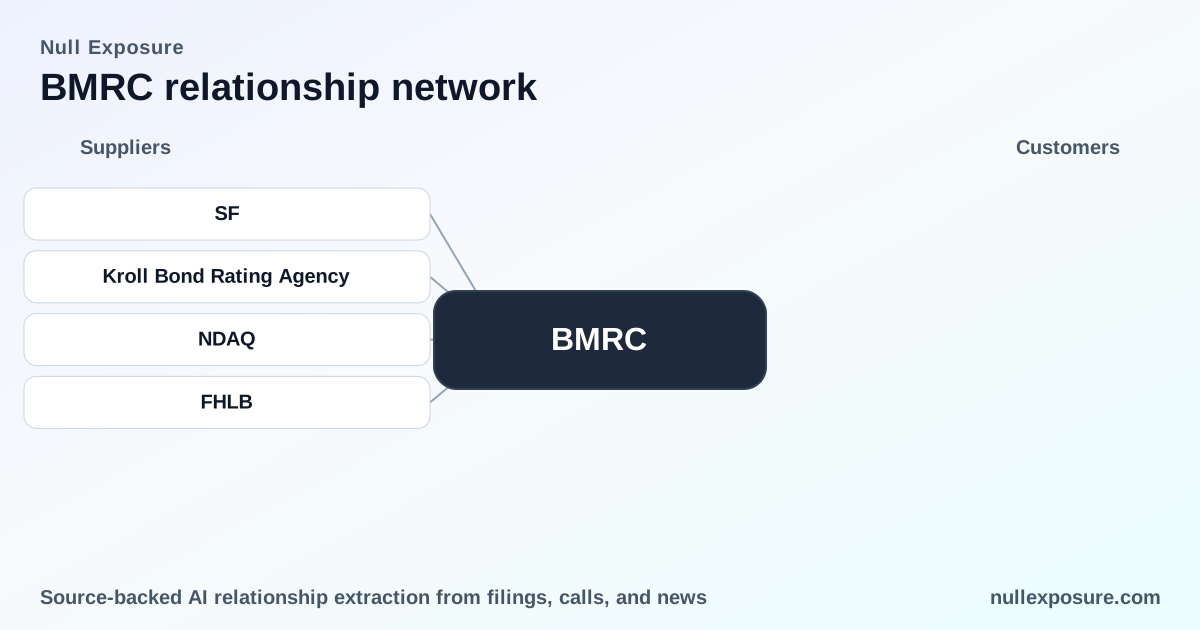
Below are the relationships surfaced in public filings and press coverage, summarized in plain language with source context.
Keefe, Bruyette & Woods, A Stifel Company
Bank of Marin engaged Keefe, Bruyette & Woods as financial advisor and received a fairness opinion in connection with the American River Bankshares transaction; legal counsel was provided by Stuart Moore Staub. This engagement signals institutional M&A advisory capacity and experience executing bank-sector deals. (Source: GlobeNewswire merger announcement, April 2021.)
Kroll Bond Rating Agency (KBRA)
KBRA assigned a BBB+ deposit rating for the bank and a BBB- subordinated debt rating for the holding company according to an 8-K disclosure in FY2026, providing an independent measure of credit quality that influences funding spreads and investor appetite for subordinated issuance. (Source: company 8‑K reported via StockTitan, FY2026.)
Nasdaq Capital Market
Bank of Marin previously listed on the Nasdaq Capital Market; public notices reference the company’s listing history and compliance trajectory. Historical listing on the Capital Market contextualizes the firm’s path to a higher-tier exchange. (Source: press reporting on the company transfer, FY2026.)
Nasdaq Global Select Market
Effective January 13, 2026, Bank of Marin transferred its common stock listing to the Nasdaq Global Select Market, indicating compliance with more stringent corporate governance, financial and liquidity thresholds and likely improving investor perception and trading liquidity. This upgrade is a positive structural change for market access and shareholder base. (Source: company announcement reported by The Globe and Mail, January 2026.)
FHLB (Federal Home Loan Bank) lines
The company reports sizable FHLB borrowing capacity cited in its material event filing, and external financing figures show a line of credit consistent with FHLB usage; this provides a source of liquidity and collateralized funding for balance-sheet management. (Source: company 8‑K and related reporting via StockTitan, FY2026.)
Operating constraints that shape supplier risk and strategy
Public disclosures and filings produce three clear company-level signals about BMRC’s operating posture:
- Short-term contracting posture: BMRC relies on unsecured lines of credit with correspondent banks for short-term liquidity — $125.0 million at December 31, 2024 (down from $135.0 million at year-end 2023). This indicates tactical reliance on wholesale short-term funding, which increases sensitivity to market tightness and counterparty confidence during stress.
- Concentration in government/GSE counterparties: Investments in U.S. government and GSE securities composed ~85% of the investment portfolio at December 31, 2024, reflecting a conservative liquidity allocation but concentrated counterparty exposure that compresses yield and ties interest income to policy rates.
- Service-provider relationships for liquidity: Correspondent banking arrangements function as critical service-provider relationships for short-term borrowing and settlement; these are operationally essential rather than peripheral.
Those constraints signal that funding stability and market perceptions (ratings and listing tier) are first-order drivers of the bank’s cost of capital.
Investment implications — what to watch and why it matters
- Ratings matter for spreads: The KBRA deposit and subordinated ratings directly affect borrowing costs and the economics of issuing junior securities; upgrade or downgrade will change funding economics materially.
- Listing tier improves liquidity and governance: The move to Nasdaq Global Select is a structural positive for shareholder liquidity and institutional access; expect improved bid-side depth and lower execution friction.
- Short-term funding dependence is a vulnerability: Unsecured correspondent lines expose BMRC to roll-over and confidence risk during market stress; monitor utilization rates and covenant changes quarterly.
- Concentration reduces credit risk but compresses yield: Heavy U.S. government/GSE allocation minimizes credit loss exposure but limits interest income upside and ties performance to the yield curve.
Key metrics to track each quarter include deposit growth, utilization of correspondent lines, investment portfolio composition, and any changes to KBRA or other credit opinions.
Explore supplier scoring and alerts at NullExposure homepage.
How investors should monitor these counterparties going forward
Investors should incorporate three monitoring practices into regular diligence:
- Track rating agency updates and 8‑K filings for covenant or rating actions.
- Monitor quarterly disclosures on lines of credit and FHLB borrowings to detect rising reliance on wholesale funding.
- Use market and exchange notices (Nasdaq filings) to gauge changes in listing status or shares eligible for trading tiers.
Actionable next steps: integrate KBRA rating movements and correspondent-line utilization into the bank’s liquidity stress model, and treat Nasdaq Global Select status as a positive governance and liquidity signal when benchmarking comparable regional banks.
For ongoing supplier signals and alerts tailored to financial institutions, visit NullExposure homepage.
Final takeaway: BMRC’s supplier relationships — ratings agencies, exchange listing status, correspondent banks and FHLB access — are not ancillary; they are core levers that control funding cost, market liquidity and strategic optionality. Investors must evaluate these relationships with the same rigor applied to credit and deposit dynamics.