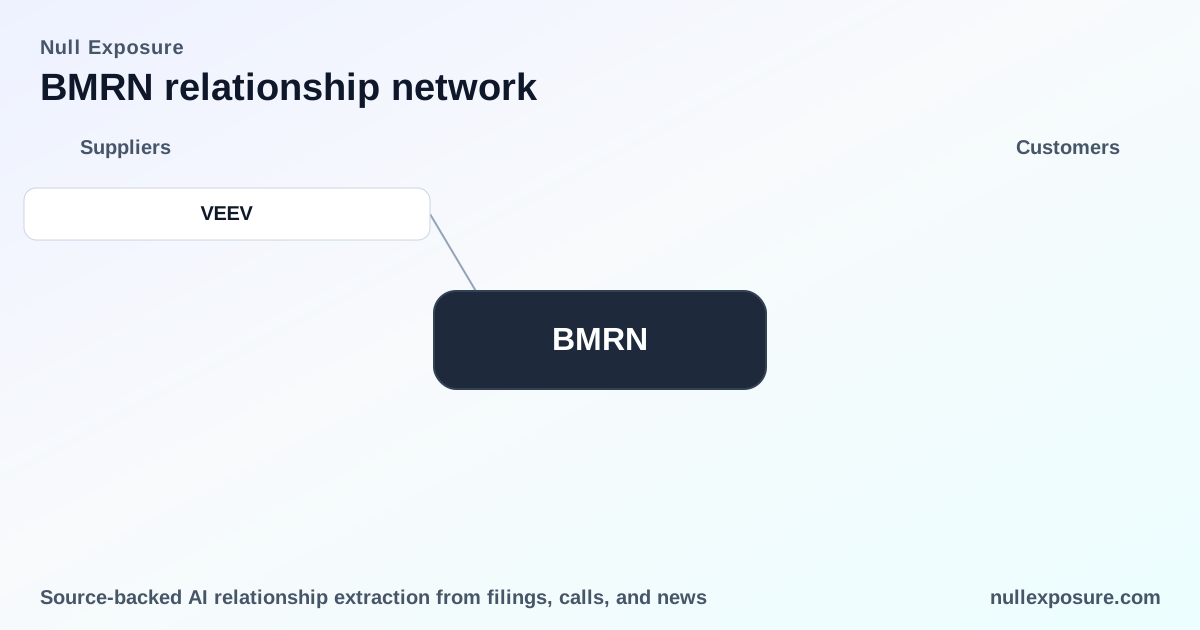
BioMarin (BMRN) — Supplier Relationship Profile and Strategic Risk Outlook
BioMarin develops and commercializes therapies for rare and serious diseases and monetizes primarily through product sales of specialty biologics, supplemented by licensing, collaborations, and strategic vendor partnerships that accelerate development and commercial execution. For investors evaluating supplier exposure, the company’s commercial scale (roughly $3.2bn revenue TTM, market cap ~$11bn) sits atop a manufacturing and logistics model that is outsourced, concentrated, and operationally critical — meaning third‑party relationships directly influence margin stability and product availability. Explore supplier intelligence and strategic context at https://nullexposure.com/ to convert this view into monitoring workflows and due‑diligence checklists.
What the Veeva partnership signals for operators and investors
BioMarin announced an expanded, long‑term strategic partnership with Veeva Systems to deepen use of Veeva’s software, data, services, and consulting — a move designed to improve speed, operational efficiency, and the customer experience for healthcare professionals and patients. This is a clear corporate decision to outsource and standardize critical commercial operations on an enterprise SaaS platform rather than build bespoke internal systems. According to PR Newswire, the partnership was disclosed in March 2026 and framed as multi‑year and strategic. (PR Newswire, March 9, 2026)
- Why it matters: outsourcing commercial infrastructure to a single enterprise vendor reduces internal IT complexity and can compress go‑to‑market cycles, but concentrates operational dependency on that vendor for critical commercial functions.
All reported supplier / vendor relationships (complete coverage)
Below are every relationship mention surfaced in the results, each summarized in plain English with its reporting source.
Veeva Systems — PR Newswire release (March 9, 2026)
BioMarin expanded a long‑term strategic partnership with Veeva to leverage Veeva’s software, data, services and consulting across commercial and patient engagement functions to increase speed, agility and operational efficiency. (PR Newswire, March 9, 2026)
Veeva Systems — SahmCapital news repost (January 8, 2026 / noted March 9, 2026)
A SahmCapital item reiterated the expanded Veeva partnership, describing the arrangement as intended to optimize both healthcare professional and patient experiences via Veeva’s product suite. (SahmCapital, January 8, 2026; referenced March 9, 2026)
Veeva — StockTitan market summary (January 2026)
A StockTitan summary bundled the Veeva partnership with other corporate developments (leadership changes, J.P. Morgan presentation and preliminary 2025 results), noting expectations around a ROCTAVIAN inventory or write‑down as part of the broader corporate update. (StockTitan, January 2026)
Operational constraints and what they mean for supplier risk
BioMarin’s public disclosures and the relationship evidence combine into a consistent operational picture. Translate these constraints into investment‑grade signals:
-
Concentration and criticality: BioMarin relies on single‑source suppliers for critical raw materials and a limited number of manufacturing facilities to produce finished therapies. This creates high concentration risk where a disruption at one supplier or site would directly impact product supply and revenue. (Company filings)
-
Outsourced manufacturing posture: The company contracts third parties for significant portions of product manufacture, including API and finished‑product processes (vials, syringes, tablets, powders). This is an operational model optimized for capital efficiency but dependent on contract manufacturing organization (CMO) performance and capacity availability. (Company filings)
-
Third‑party service dependence: Logistics, security, cybersecurity consulting, and foreign exchange hedging are handled by external providers — signaling ongoing reliance on service providers for core operational resilience. The forward contract counterparties are described as creditworthy multinational banks, reducing counterparty credit risk for hedging operations. (Company filings)
-
Maturity and vendor selection: The Veeva relationship is characterized as an expanded, long‑term strategic partnership — a sign that BioMarin is moving from ad hoc vendor use toward integrated, enterprise vendor agreements designed for scale.
Collectively these constraints indicate a deliberate outsourcing strategy: capital light, but with high counterparty dependency and a premium on third‑party governance, contract terms, and supplier redundancy.
Strategic and financial implications for investors
BioMarin’s supplier posture intersects with its financial profile in ways investors must price and monitor.
-
Margin and delivery sensitivity: Outsourced manufacturing reduces fixed capital but amplifies operational margin risk if CMOs fail to meet quality or capacity commitments. A supply disruption for a major product would have immediate revenue and gross margin consequences given the company’s product concentration.
-
Operational leverage from Veeva: The Veeva partnership is a positive operational lever that should improve commercial efficiency and potentially reduce variable SG&A over time, but it consolidates a critical commercial layer with a single enterprise vendor.
-
Risk mitigation signals: Use of large multinational banks for hedging decreases counterparty credit exposure on FX forwards. However, the existence of single‑source inputs and limited manufacturing facilities elevates the need for contingency provisions in contracts and visible redundancy planning.
Key takeaway: BioMarin’s business model rewards scale and commercial execution, but its outsourced manufacturing and concentrated supplier base are the main vectors for operational shocks.
Explore tailored supplier risk models and continuous monitoring options on the Null Exposure platform: https://nullexposure.com/.
Actionable investor checklist
- Review contract length, termination clauses, SLAs, and escalation provisions with CMOs and critical suppliers to assess shift costs and replacement timelines.
- Demand visibility on inventory buffers and dual‑sourcing plans for critical raw materials to quantify downtime exposure.
- Quantify the commercial dependency on Veeva: which functions are covered, data portability and exit provisions, and cybersecurity responsibilities.
- Monitor hedging counterparties and FX forward exposures to understand cash‑flow smoothing versus counterparty concentration.
Final read: what to watch next and how to engage
For investors, the immediate monitoring priorities are (1) CMO performance and any capacity constraints, (2) contractual terms with Veeva that could constrain agility or impose vendor switching costs, and (3) inventory and single‑source raw material disclosures that reveal recovery time objectives. BioMarin’s scale and pipeline are real growth drivers, but operational dependence on third parties turns supplier governance into an active investment theme.
If you need a supplier‑level monitoring plan or a dashboard to track these exact relationships and constraints, begin with our research hub at https://nullexposure.com/ and convert intelligence into investable signals.