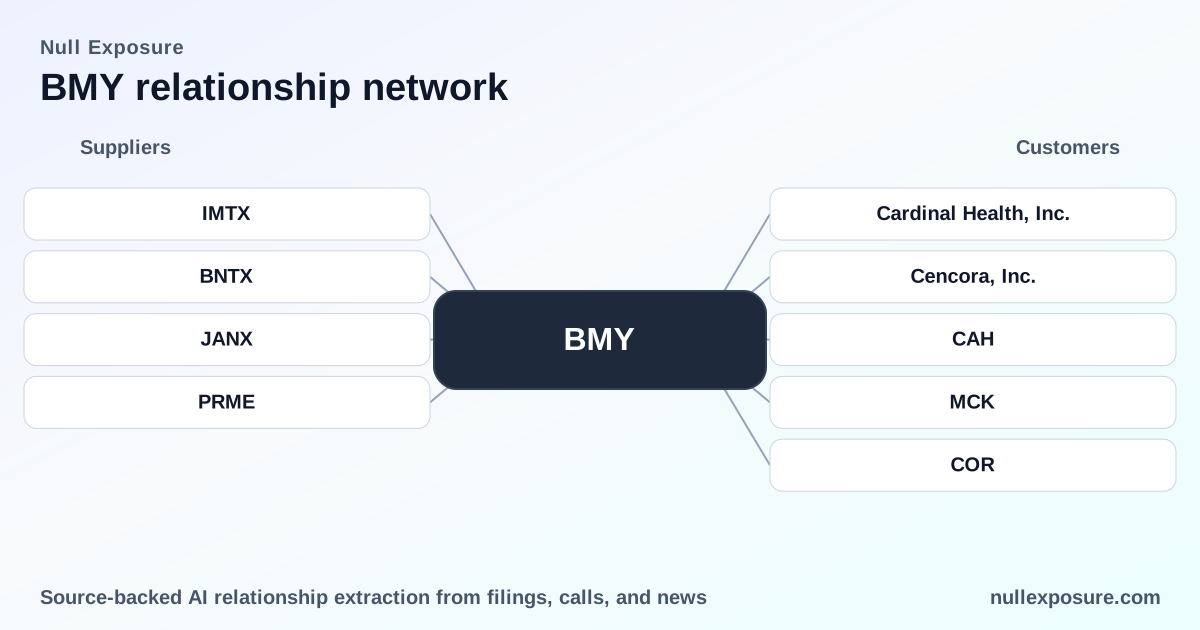
Bristol-Myers Squibb (BMY): supplier relationships, contract posture and operational implications for investors
Thesis: Bristol-Myers Squibb monetizes a global pharmaceutical franchise through a mix of product sales, milestone and upfront licensing payments, and royalty-sharing co-development agreements; the company outsources significant portions of research, manufacturing and services to external partners, monetizing its late‑stage assets through strategic collaborations and capturing value via upfront payments and royalty/earnout mechanics.
For a quick look at how we track these partnerships and supplier signals, visit the NullExposure research hub: https://nullexposure.com/
What the partnership map looks like right now
Below I summarize every supplier/partner mention captured in the results set and what each relationship implies for BMY’s operating model. Each relationship summary is concise and sourced from the underlying reports.
Immatics N.V. — collaboration termination and revenue acceleration
Bristol Myers Squibb terminated its IMA401 and ACTallo® collaborations, which triggered a one‑time non‑cash recognition of accelerated deferred revenue in Immatics’ FY2026 results; the termination indicates BMY’s willingness to end underperforming external programs and crystallize accounting impacts. According to Immatics’ FY2026 filing reported on InvestingNews, the revenue decrease recorded was primarily due to that acceleration following the collaborations’ termination (InvestingNews, FY2026).
BioNTech — co-development, milestone payments and shared economics
BMS continues a high‑profile collaboration with BioNTech that provided substantial upfront payments and shared economics for programs such as BNT327 and others; the partnership also produced clinical readouts, including a global phase II update for pemigatinib in advanced triple‑negative breast cancer reported in BMY’s 2025 Q4 commentary. BMS’s earnings call (2025 Q4) referenced the pemigatinib phase II data (BMY 2025 Q4 earnings call), while market reports credit the deal with large upfronts and royalty sharing, citing $2 billion plus a 50% royalty share in one report and $1.5 billion in upfronts in another (Finviz and Ad‑hoc‑News coverage, FY2026).
Janux Therapeutics Inc — exclusive license for tumor‑activated therapeutics
Bristol Myers Squibb entered an exclusive worldwide license and collaboration with Janux to develop a tumor‑activated therapeutic for solid tumors, positioning BMS to extend its oncology pipeline via external innovation and licensing economics. The announcement was published on Finviz and reported in FY2026 news coverage regarding Janux’s clinical progress (Finviz, FY2026).
Prime Medicine, Inc. — strategic research collaboration for ex vivo T cell products
In September 2024 Prime and BMS formalized a strategic research collaboration and license to develop and commercialize multiple ex vivo T cell products in immunology and oncology, reflecting BMS’s strategy of securing external platform technologies for cell therapy applications. This agreement is documented in Prime Medicine’s SEC‑related reporting summarized on StockTitan/PRME filings (StockTitan/PRME SEC filing summary, FY2026).
What constraints and contract signals reveal about BMY’s operating model
The extracted constraint signals provide company‑level insight into BMS’s contracting posture and supplier exposure.
- Long‑term contracting and capital commitments. Evidence of long‑dated instruments (e.g., notes due 2031) indicates a corporate finance posture that accepts multi‑year obligations and supports long‑horizon R&D and commercial strategies through fixed‑term funding arrangements (Form 8‑K and related indenture exhibits cited in 2023 filings). This suggests capital structure stability for sustaining multi‑year programs and supplier commitments.
- Outsourcing and manufacturing dependence. BMS explicitly recognizes exposure to third‑party manufacturing shortfalls; that language signals critical reliance on external manufacturers for bulk active and finished product. This is a company‑level operational risk, not tied to a single vendor in the evidence set.
- Broad use of service providers. Multiple excerpts list suppliers, vendors, outsourcing partners and alliance partners that BMS uses to handle R&D, manufacturing, commercialization, and administrative functions (marketing, HR, finance, IT, data). The company’s operating model is highly outsourced across both technical and non‑technical functions, which increases vendor management importance and introduces concentrated operational risk if key providers fail to meet obligations.
Commercial and investment implications
- Value capture through dealmaking is central. BMS consistently converts external science into monetizable assets—upfronts, milestones and royalty splits are core revenue levers, as seen in BioNTech and Janux agreements. Partnership economics materially affect near‑term and recurring revenue profiles.
- Termination flexibility produces volatility. The Immatics termination demonstrates BMS will discontinue programs that no longer fit its portfolio, which can generate one‑time accounting impacts (deferred revenue acceleration) and alter future cost/revenue run‑rates. Investors should treat such exits as deliberate portfolio pruning rather than operational failure.
- Supplier concentration requires active oversight. Dependence on third‑party manufacturers and multiple service providers creates operational single points of failure that can affect supply continuity, regulatory filings, and launch timelines. The company’s financial commitments (long‑term notes) suggest it is structurally positioned to fund mitigation efforts, but vendor risk remains a material monitorable factor.
- Clinical readouts remain a driver of re‑rating. Clinical data from partnered programs—such as the reported pemigatinib phase II readout with BioNTech—directly influence collaboration milestones, subsequent payments and the value realization timeline for BMS.
For deeper partner mapping and supplier risk scoring, explore NullExposure’s interface: https://nullexposure.com/
Recommended monitoring checklist for investors
- Track forthcoming milestone and royalty schedules from BioNTech and Janux agreements reported in 2025–2026 press coverage.
- Monitor SEC/8‑K filings for any additional terminations or accelerations similar to the Immatics case to assess one‑time earnings noise.
- Watch third‑party manufacturing disclosures and supply‑chain updates, as these will be leading indicators for launch timing and product availability.
Bottom line and next steps
Bristol‑Myers Squibb runs a partnership‑driven commercialization engine that balances internal R&D with licensed external innovation, capturing value through upfront payments, milestones and shared royalties while outsourcing material execution to third parties. Investors should weigh the upside of high‑value collaborations against the operational risk of manufacturing and service provider dependency and the accounting volatility from deal terminations.
For ongoing tracking of BMS partner exposures, supplier constraints, and event‑driven alerts, start a tailored watchlist at NullExposure: https://nullexposure.com/