Brookfield Corporation (BN): Capital markets partners and legacy asset ties investors should price in
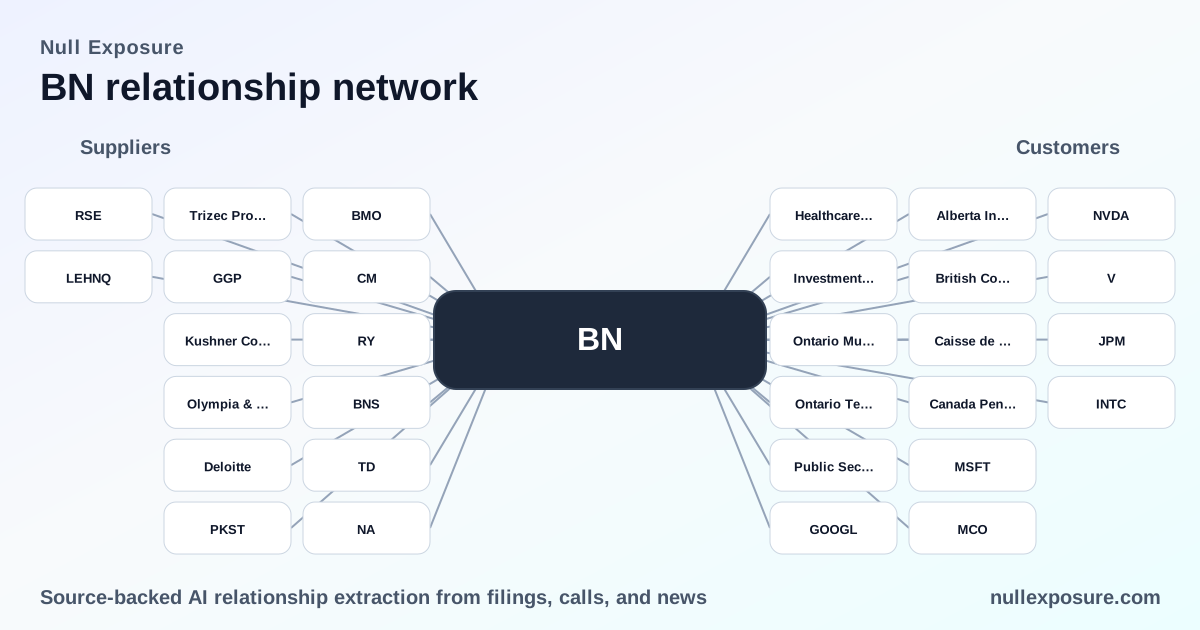
Brookfield Corporation operates as a global alternative asset manager and REIT operator, monetizing through management fees, performance fees (carried interest), recurring REIT distributions, and capital recycling from real estate and infrastructure assets. The firm funds growth and liquidity both from operating cash flow across its asset platforms and by tapping capital markets — most recently via a bought‑deal preferred share issuance underwritten by a Canadian banking syndicate. For investors and operating partners, Brookfield’s supplier footprint is dominated by major investment banks for distribution and a set of legacy real‑estate counterparties and service providers that underpin asset sourcing, auditing and valuation. Learn more about supplier risk and partner mapping at https://nullexposure.com/.
Why the underwriting syndicate matters to investors
Brookfield's issuance of Class A Preference Shares, Series 54 demonstrates a deliberate capital‑markets posture: the company relies on top-tier Canadian banks to underwrite and distribute capital instruments, reducing execution risk but creating concentrated counterparty exposure during raises. The underwriting group — led by Scotiabank, BMO, CIBC, National Bank Financial, RBC and TD Securities — is a commercial relationship that supports Brookfield’s liquidity and cost of capital. According to a GlobeNewswire release (Nov 19, 2025) and corroborated by reporting on March 9, 2026, the offering was conducted on a bought‑deal basis by that syndicate.
- Key takeaway: Brookfield’s capital‑raising model is operator‑led and distribution‑reliant; underwriting partners are strategic suppliers whose execution quality and market reach directly affect funding velocity and terms.
Explore structured supplier intelligence and counterparty maps at https://nullexposure.com/.
The supplier and counterparty list — what each relationship means for BN
Below I cover every relationship flagged in the source material. Each entry contains a plain‑English summary and a concise source mention.
-
BMO Capital Markets — BMO led (as part of the syndicate) distribution of Brookfield’s preferred share offering, acting as an underwriter on a bought‑deal basis that supported the public placement and immediate liquidity for the issuance. (Source: Yahoo Finance / QuiverQuant reporting on March 9, 2026.)
-
CIBC Capital Markets — CIBC participated as an underwriting member of the bought‑deal syndicate for the Series 54 preferred shares, providing distribution capacity within Canadian institutional channels. (Source: GlobeNewswire release, Nov 19, 2025.)
-
RBC Capital Markets — RBC served in the underwriting syndicate distributing Brookfield’s Class A Preference Shares, helping place the offering across RBC’s institutional network. (Source: Yahoo Finance coverage, March 9, 2026.)
-
Scotiabank — Scotiabank is identified as a lead underwriter on the bought‑deal, indicating a primary role in price execution and syndicate coordination for the preferred share issuance. (Source: GlobeNewswire release, Nov 19, 2025.)
-
TD Securities Inc. — TD participated in the underwriting syndicate, contributing distribution reach and sales capacity to the offering that Brookfield used to secure capital. (Source: QuiverQuant and Yahoo Finance reporting, March 9, 2026.)
-
National Bank Financial Inc. — National Bank Financial was a syndicate member for the preferred share transaction, adding regional distribution that aided the deal’s absorption in Canadian markets. (Source: QuiverQuant reporting, March 9, 2026.)
-
Trizec Properties — Trizec represents a legacy acquisition target: Brookfield bought Trizec in 2006, acquiring key downtown Los Angeles towers and expanding Brookfield’s institutional real‑estate base. This historical deal informs Brookfield’s long cycle of asset consolidation. (Source: TheRealDeal feature, August 2023.)
-
GGP (General Growth Properties) — Brookfield acquired select malls from GGP as part of its retail/real estate portfolio build‑out, illustrating Brookfield’s strategy of buying large retail portfolios to reposition or integrate into broader REIT platforms. (Source: TheRealDeal feature, August 2023.)
-
Kushner Companies — Brookfield purchased 660 Fifth Avenue from Kushner Companies in 2018 and invested materially in renovations; the asset’s leasing performance is a continuing operational variable for Brookfield’s Manhattan office exposure. (Source: TheRealDeal reporting citing Brookfield commentary, August 2023.)
-
Olympia & York — Brookfield acquired prime assets from the troubled Olympia & York era, including what is now Brookfield Place; these legacy purchases underpin Brookfield’s long‑dated trophy assets in Lower Manhattan. (Source: TheRealDeal feature, August 2023.)
-
Deloitte — Deloitte audits Brookfield’s IFRS valuations and the company publishes that it uses third‑party appraisals on portions of its portfolio; Deloitte’s role is material to investor confidence in Brookfield’s reported asset values. (Source: TheRealDeal feature, August 2023.)
-
Peakstone Realty Trust — Brookfield completed acquisitions including a $1.2 billion purchase that involved Peakstone (formerly PKST) assets, a transaction advising and sale process that expanded Brookfield’s real‑estate holdings. (Source: StockTitan news, FY2025 announcement.)
-
Rouse — Brookfield purchased assets from Rouse as part of mall portfolio consolidation, reflecting an active strategy to acquire and reposition retail real estate from regional mall operators. (Source: TheRealDeal feature, August 2023.)
-
Lehman Brothers — Historical purchases included assets at discounted pricing during post‑Lehman periods; such opportunistic acquisitions explain a component of Brookfield’s value creation track record. (Source: TheRealDeal feature, August 2023.)
What investors should watch in the supplier mix
Brookfield’s supplier universe exposes several company‑level business model characteristics that investors should internalize:
-
Contracting posture: Brookfield contracts capital markets partners on a transaction basis (bought‑deal underwriting) and relies on major global auditors and appraisers to validate asset values — a mix of one‑off and ongoing supplier engagements.
-
Concentration: Underwriting and distribution are concentrated among large Canadian banks and international dealers; capital‑raising concentration is a leverage point that affects execution risk and pricing in stressed markets.
-
Criticality: Relationships with auditors (Deloitte) and distribution partners are critical — audit credibility affects valuation multiples and sponsor reputation, while underwriting partners affect Brookfield’s ability to access capital quickly.
-
Maturity: Many supplier ties are mature and historical (legacy acquisitions from Trizec, Olympia & York, GGP), signaling institutional experience in asset consolidation and long holding periods that reduce turnover risk but increase exposure to long‑cycle property markets.
Risk focus: investors should price counterparty concentration risk on capital raises and continuity risk in audit/valuation services since any disruption would have outsized effects on Brookfield’s cost of capital and reported NAV.
Mid‑report action: if you evaluate institutional supplier exposure or need a counterparty map for BN, start a focused supplier review at https://nullexposure.com/.
Final assessment and investor implications
Brookfield’s supplier relationships are consistent with a large alternative asset manager that uses top‑tier banks for funding distribution, legacy M&A counterparties for asset roll‑up, and major auditors for valuation assurance. The underwriting syndicate for the Series 54 preferred shares demonstrates both Brookfield’s continued access to capital markets and a concentration of execution risk in a small group of Canadian financial institutions. Investors should treat these relationships as strategic operating suppliers: they are value‑creating in normal markets and potential friction points under stress.
If your investment or operational decision requires deeper counterparty intelligence or a tailored supplier risk assessment for BN, review supplier profiles and relationship timelines at https://nullexposure.com/.
Bold takeaway: Brookfield’s capital and audit suppliers are strategically important — they enable growth but concentrate execution and reputational risk that investors must price into BN’s valuation.