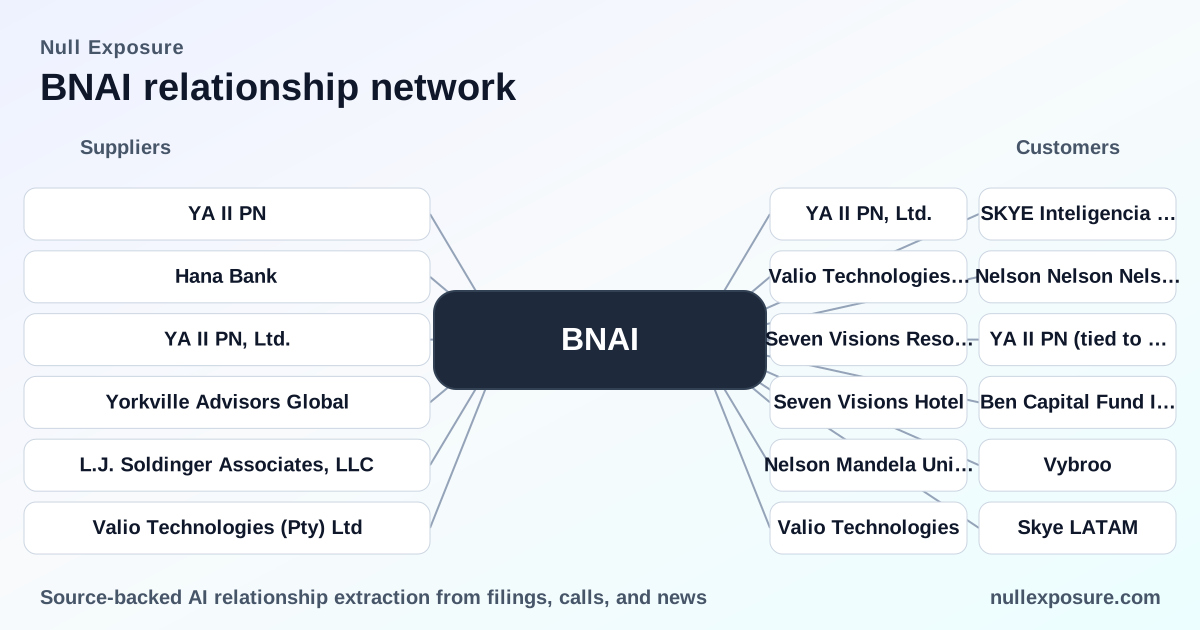
Brand Engagement Network (BNAI): supplier and capital partners investors should track
Brand Engagement Network builds conversational AI and human‑like avatars sold to enterprises, governments and kiosks, monetizing primarily through licensing, strategic equity investments and revenue‑share partnerships that turn intellectual property into recurring income streams. BNAI funds technological development with targeted private placements and short‑term credit facilities, while monetization hinges on licensing deals and partner revenue shares in international markets. For deeper counterparty intelligence and supplier due diligence, visit https://nullexposure.com/.
Recent counterparties that changed BNAI’s funding and go‑to‑market profile
Below I cover every counterparty identified in market reporting and filings. Each relationship note is a plain‑English take with a source citation.
-
YA II PN — Brand Engagement Network terminated a Standby Equity Purchase Agreement with YA II PN effective February 4, 2026, removing a previously available $50 million equity‑line facility and shifting the company away from that committed funding source. According to TradingView’s report on the termination (March 9, 2026), the end of the agreement directly altered BNAI’s liquidity optionality.
Source: TradingView report, March 9, 2026. -
YA II PN, Ltd. — The company’s regulatory filing reiterated the termination of the $50 million equity line with YA II PN, Ltd., an affiliate of Yorkville Advisors Global, effective Feb. 4, 2026, which investors interpreted as a de‑risking move for share dilution but also a loss of standby capital. The filing was reported in market coverage on March 9, 2026.
Source: TS2.Tech coverage of regulatory filing, March 9, 2026. -
Yorkville Advisors Global — As the parent affiliate behind the YA II entities, Yorkville’s role ended with the termination of the standby purchase agreement; the corporate relationship therefore transitioned from an available capital partner to a closed counterpart. Market reports referenced a regulatory filing confirming the effective termination on Feb. 4, 2026.
Source: TS2.Tech coverage referencing the regulatory filing, March 9, 2026. -
Hana Bank — In January 2026 BNAI repaid roughly $640,332.46 in outstanding loans, of which about $630,332.46 related to obligations with Hana Bank in South Korea, thereby satisfying legacy liabilities under a prior Asset Purchase Agreement. Multiple press releases and market writeups (January–March 2026) present the repayment as a balance‑sheet cleanup tied to a recent capital raise.
Source: SahmCapital analysis and PR Newswire release, January–March 2026. -
L.J. Soldinger Associates, LLC — Shareholder materials show BNAI asked investors to ratify L.J. Soldinger Associates, LLC as independent auditor for 2025 as part of its proxy materials, indicating continuity in the company’s external audit arrangement and related governance oversight. The detail appears in SEC filing summaries circulated in early March 2026.
Source: SEC filing recap on StockTitan, March 2026. -
Valio Technologies (Pty) Ltd — BNAI entered a strategic partnership to pursue exclusive AI licensing in government and commercial sectors across Africa, structured with a $2.05 million preferred equity investment and a 35% revenue share on associated offerings, positioning Valio as a commercial channel for BNAI in the region. Market coverage from late January 2026 frames this as a growth‑market monetization strategy.
Source: SahmCapital coverage and company announcements, January 23, 2026.
What the mix of counterparties reveals about BNAI’s operating model
BNAI’s counterparty activity over the last 12 months reflects a company executing three simultaneous plays: capital consolidation, geographic expansion, and partner‑led commercialization.
-
Capital posture: Terminating the Yorkville/YA II equity line removes a standby source of dilution‑buffer capital and suggests management prefers immediate, priced private placement capital over open equity availability. The company completed a premium private placement that closed legacy debt, including loans with Hana Bank, which signals an intent to clean the balance sheet ahead of commercial scaling (PR Newswire, Jan 2026).
Key takeaway: the company is prioritizing direct private capital injections over standby equity lines that could introduce rapid dilution. -
Geographic footprint and supplier role: Evidence shows an active APAC operational presence — BNAI entered an office lease in South Korea (term through September 14, 2027), and repaid related legacy loans to Hana Bank. These facts constitute a company‑level signal of APAC operational exposure and local service‑provider activity, and imply ongoing costs and regulatory touchpoints in the region.
Key takeaway: APAC is an operational priority that brings both market opportunity and regional counterparties to monitor. -
Commercial strategy via partners: The Valio arrangement is an example of an exclusive licensing and revenue‑share model to monetize IP in markets where local distribution and government access matter. A 35% revenue share is material for unit economics and means BNAI’s upside in Africa depends on partner execution rather than direct sales alone.
Key takeaway: revenue concentration risk is shifted toward partner performance in targeted regions. -
Governance and maturity signals: Seeking auditor ratification through L.J. Soldinger Associates and retiring legacy sponsorship obligations (the Korea University sponsorship is no longer active per company disclosures through Dec 31, 2024) show movement toward formalized governance and a cleanup of one‑off contractual commitments. These are maturity signals investors value when assessing supplier counterparty risk.
Key takeaway: management is actively tidying the liability and governance profile ahead of growth initiatives.
For more granular supplier intelligence and to map how each counterparty affects BNAI’s operational risk, see the full supplier view at https://nullexposure.com/.
Implications for investors evaluating supplier relationships
BNAI is a small‑revenue, high‑investment growth company: revenue is limited and margins are negative, while market capitalization and valuation multiples imply future expectations that are outsized versus current financial scale. Counterparty actions — repayment to Hana Bank, termination of the Yorkville equity line, and the Valio revenue‑share deal — materially change both liquidity flexibility and revenue concentration. Investors assessing supplier risk should focus on three priorities:
- Counterparty continuity: track whether partners like Valio convert pilot licensing into recurring revenue; partner execution directly impacts realization of expected growth.
- Liquidity and dilution pathways: termination of standby equity facilities forces management to choose between higher‑priced private placements or operational slowdown.
- Regional operational risk: APAC office lease and historical sponsorships establish exposure to South Korean counterparties and regulatory contexts.
If you want a consolidated, repeatable supplier risk profile for BNAI that pulls filings, news and contract signals into one view, start with our platform at https://nullexposure.com/.
Bottom line
BNAI is repositioning from opportunistic, standby capital to curated private capital and partner monetization while formalizing governance and reducing legacy liabilities. That strategy reduces immediate dilution risk but increases execution risk tied to partners and private‑placement economics. Active monitoring of the Valio revenue‑share pipeline, Hana Bank repayments, and any new standby facilities should be central to supplier‑risk diligence for investors and operators. For ongoing updates and to map these counterparties in a single interface, visit https://nullexposure.com/.