BNCWW (CEA Industries): Supplier map, concentration risk, and governance signals investors must price
CEA Industries sells environmental control systems and related services to controlled environment agriculture operators through its subsidiary Surna Cultivation Technologies. The company monetizes by selling and leasing equipment, delivering integration services, and supporting facility operations for indoor growers across the U.S. and Canada; that model depends on third‑party manufacturing, a concentrated procurement base, and active media/IR channels that shape investor access to material disclosures. For investors evaluating supplier relationships, the twin facts of high supplier concentration and recent governance disclosures tied to external asset managers are the dominant lenses for risk and opportunity. Learn more or run a targeted supplier exposure review at https://nullexposure.com/.
The supplier landscape in plain English
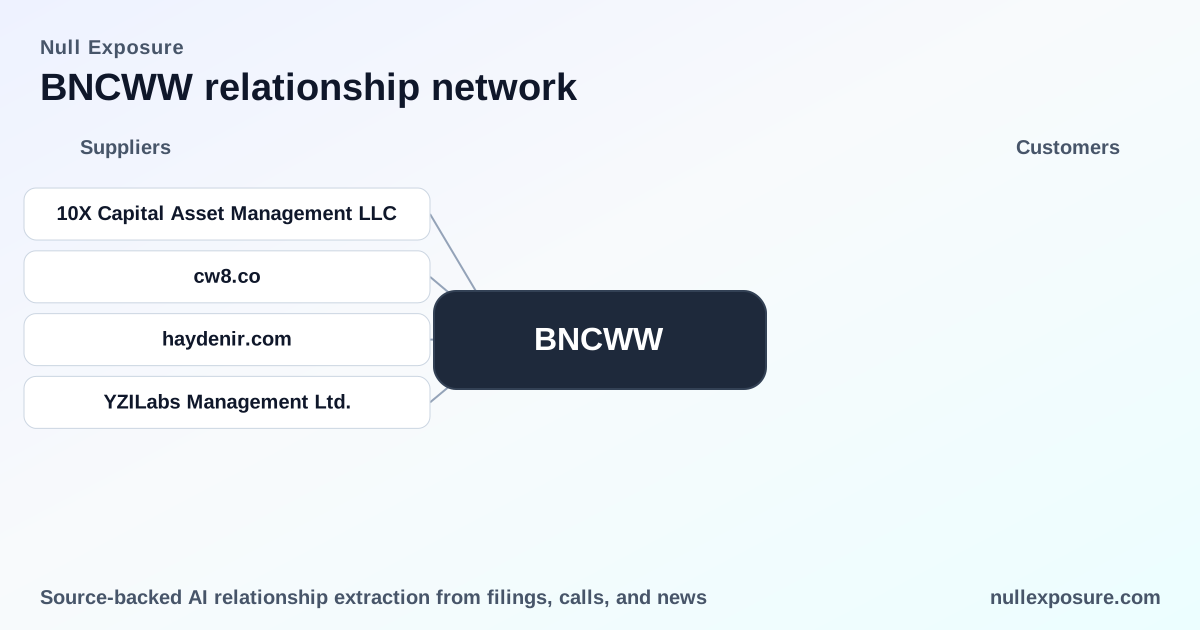
CEA’s commercial model is not vertically integrated across all components: the company sources key equipment from third‑party manufacturers and supplements sales with leases and services. That operating posture creates classic supplier counterparty risk, and the public record contains three external relationship touchpoints that affect procurement, communications, and governance.
10X Capital Asset Management LLC
CEA has publicly asked 10X to confirm termination of a “Secret Side Agreement” tied to 10X’s asset management agreement, a disclosure that alleges diversion of fees to a third party. According to a March 9, 2026 news post, CEA requested that 10X and a related party terminate that undisclosed arrangement, making governance and fee flows an investor issue. (Futunn, Mar 9, 2026: https://news.futunn.com/en/post/68434668/cea-industries-requests-that-10x-capital-and-yzi-labs-terminate)
YZILabs Management Ltd.
The company’s filing and subsequent reporting allege that YZi Labs received a portion of fees under the secret arrangement with no defined services, which raises questions about undisclosed fee diversion and related-party economics. CEA publicly named YZi Labs in the same March 2026 disclosure as a counterparty to diverted fees. (Futunn, Mar 9, 2026: https://news.futunn.com/en/post/68434668/cea-industries-requests-that-10x-capital-and-yzi-labs-terminate)
cw8.co (media distribution for corporate communications)
CEA’s media contact information was distributed via a press release routed by Sahm Capital and carried on cw8.co, indicating the company uses third‑party distribution networks for investor and media relations. The Oct. 9, 2025 release lists bnc@cw8.co for media inquiries, underscoring reliance on outsourced communications channels. (Sahm Capital release distributed Oct 9, 2025: https://www.sahmcapital.com/news/content/cea-industries-bnc-appoints-financial-media-veteran-jon-najarian-as-chief-evangelist-2025-10-09)
haydenir.com (investor relations provider)
CEA lists an investor relations contact at Hayden IR in the same public release, showing that IR functions are at least partially outsourced to a specialized firm and that investor messaging is routed through third parties. (Sahm Capital release distributed Oct 9, 2025: https://www.sahmcapital.com/news/content/cea-industries-bnc-appoints-financial-media-veteran-jon-najarian-as-chief-evangelist-2025-10-09)
What the constraints tell investors about how CEA operates
The company‑level evidence in filings and press material creates a coherent operating picture:
- Critical concentration: One supplier accounted for 80% of inventory purchases for the year ended Dec 31, 2024, which is a procurement single‑point-of-failure. That level of concentration is a structural risk: supply interruptions, price shifts, or commercial disputes would materially impair margins and delivery schedules.
- Buyer posture with manufacturing dependence: CEA acts as a buyer and reseller/lessor and relies on third‑party manufacturers for equipment it sells or leases. This positions the company as downstream integrator rather than upstream producer, magnifying counterparty risk and limiting margin control over component costs.
- Active, ongoing relationships: The record signals active supplier engagements and indemnification exposure, consistent with normal commercial arrangements but meaningful given concentration and physical delivery risk.
- Multi‑segment exposure: The company’s operations span distribution, manufacturing, and infrastructure—it acquires assets for retail and manufacturing (through acquisitions like Fat Panda) while holding leases for manufacturing and office space. That mix implies exposure to capex cycles, lease obligations, and retail supply chains.
These constraints are company‑level signals drawn directly from public excerpts and should be priced as core operational characteristics rather than peripheral footnotes.
Risk and opportunity — what investors should price now
The combination of very high supplier concentration plus third‑party manufacturing reliance creates an asymmetric downside: supply interruption or adverse contractual terms can compress revenue and push repair/replacement costs into the P&L. Governance noise around asset manager fee arrangements (10X / YZi Labs) introduces an additional investor relations and shareholder governance risk that can depress valuation multiples independent of operating performance.
Key takeaways:
- Concentration is the single largest supplier risk. One supplier supplying 80% of inventory is effectively a monopoly supplier to CEA; investors should treat this as a material ESG/operational factor.
- Manufacturing outsourcing constrains margin control. CEA captures integration and services revenue but depends on supplier pricing for cost of goods sold.
- Governance disclosures matter for liquidity and access. Public demands to terminate side agreements (10X/YZi Labs) create potential litigation and reputational risk; monitor SEC filings and material event notices.
Actionable next steps for investors:
- Validate counterparty diversity: request supplier roll‑forward or percentage of spend by vendor for the most recent fiscal year.
- Monitor procurement contract terms and lead times for the top supplier that supplies 80% of inventory.
- Track governance developments tied to 10X and YZi Labs and any proxy or SEC correspondence that might follow.
For structured intelligence on supplier concentration and governance risk, run a focused exposure scan at https://nullexposure.com/ — it streamlines the process of mapping vendor criticality and disclosure timelines.
Practical implications for operators and procurement teams
Operators should treat supplier concentration as a procurement emergency: diversify to alternative manufacturers, lock in priced supply agreements where possible, and build buffer inventory or service-level agreements with penalties. IR teams should centralize external communications—current practice shows reliance on third‑party distributors and IR firms, which amplifies the need for clear, timely disclosures to counter governance rumors.
If you want a bespoke supplier concentration assessment or governance watchlist for your portfolio holdings, start at https://nullexposure.com/ and engage our research workflow.
Bottom line
CEA Industries runs a reseller/integration model in controlled environment agriculture that generates revenue through sales, leases, and services but depends on concentrated procurement and outsourced manufacturing. The recent public dispute referencing a secret fee diversion to YZi Labs via 10X elevates governance and disclosure risk alongside operational concentration. Investors must price in both operational counterparty exposure and the potential market effects of governance fallout when valuing BNCWW‑linked instruments.