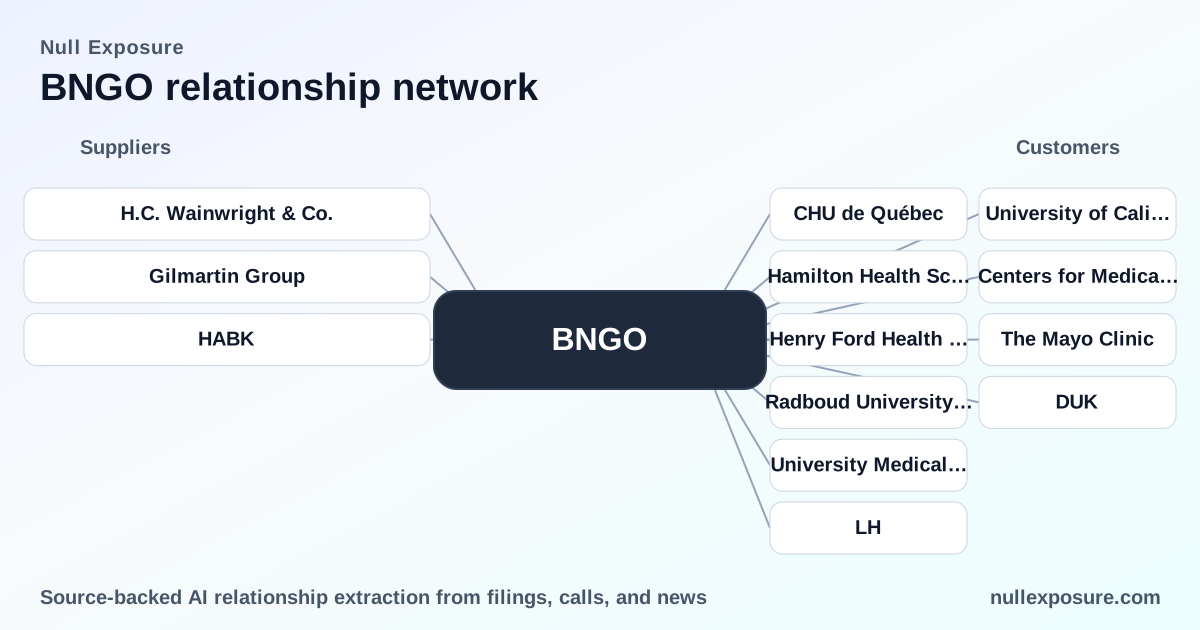
Bionano Genomics (BNGO) — Supplier relationships and what they mean for investors and operators
Bionano Genomics sells optical genome-mapping instruments and recurring consumables, monetizing through capital equipment sales backed by a consumables and reagents revenue stream. The company funds growth through equity raises and investor relations activity while operating with a manufacturing and reagent supply model that creates both operational leverage and supplier concentration risk. For investors and procurement teams, the relevant question is simple: is the supply base resilient enough to support recurring kit sales while Bionano scales and raises capital? Learn more about supplier signals and implications at https://nullexposure.com/.
How Bionano’s supplier footprint actually drives the business
Bionano’s commercial model is classic med‑tech hardware + recurring consumables: instruments generate one‑time revenue and the company captures higher-margin, repeatable revenue from assay kits and reagents. That model places outsized importance on reliable reagent suppliers and contract manufacturers: instrument availability is a gating factor for sales, while reagents determine recurring revenue performance. Capital raises and placement-agent activity are part of the funding story that supports inventory purchases and commercial expansion.
Company-level supply constraints you need on your checklist
The documentary evidence produces several clear, company-level signals about contracting posture, concentration, criticality and maturity:
- Contracting posture blends long‑term commitments with short, tactical prepayments. Filings reference monthly purchase commitments that ran for defined multi‑year terms and separate short‑dated arrangements that use weekly deposits to secure future inventory (company disclosures through FY2023–FY2025).
- Supplier concentration is material. Bionano discloses reliance on a single contract manufacturer for multiple instrument lines and a limited set of suppliers (including single‑source reagents) for OGM reagents and ITP reagents, creating replacement lead‑time risk.
- Criticality of inputs is high. Reagents are described as difficult to replace quickly; validating alternatives would require time and could disrupt kit supply and sales cadence.
- Maturity of relationships is mixed. The record shows terminated purchase commitments (fixed two‑year terms that ended in 2023) alongside prospects and ongoing negotiations for new instrument manufacturing arrangements (activity in 2025).
- Financial exposure is real but bounded. Reported spend bands show mid‑single‑million annual commitments, plus isolated smaller prepayments (e.g., a $60k prepayment), indicating working‑capital exposure without extreme single‑vendor spend concentration.
These points frame procurement priorities: minimize single‑source risk, align cash management to deposit schedules, and validate reagent alternatives before demand spikes.
The named relationships in the public record — concise takeaways
H.C. Wainwright & Co. — Investment banker and placement agent for equity capital. According to GlobeNewswire press releases in September 2025, H.C. Wainwright acted as the exclusive placement agent for Bionano’s roughly $10 million public offering that closed in mid‑September 2025. Additional press aggregators reiterated that placement‑agent role in March 2026 reporting. (GlobeNewswire, Sept 16–17, 2025; QuiverQuant/StockTitan, March 2026.)
Gilmartin Group — Investor relations and PR support. Multiple press notices list Kelly Gura at Gilmartin Group as Bionano’s IR contact for the September 2025 offering and subsequent publications; press wires and news aggregators in late 2025 and early 2026 show Gilmartin Group handling investor communications. (GlobeNewswire, Sept 2025; StockTitan/QuiverQuant, March 2026.)
Hamilton (HABK) — Commercial collaboration on product integration (historical). Reporting from 2022 documented a collaboration between Bionano and Hamilton on a product initiative; that public reference establishes a past partnership on instrument/product work rather than a current, disclosed supply contract in the 2025 filings. (InvestorPlace, Oct 2022.)
What investors and operators should prioritize now
The relationship map and constraints point to a narrow set of operational imperatives:
- Supply concentration is the single largest operational risk. The firm’s reliance on a single contract manufacturer and limited reagent suppliers is a direct constraint on growth predictability; validate second sources and accelerate qualification where possible.
- Capital activity is an operational signal. Placement agent work and public offerings (the September 2025 $10M raise led by H.C. Wainwright) provide liquidity but also indicate ongoing reliance on equity to fund working capital and manufacturing scaling. Monitor financing cadence as part of supplier‑risk modeling.
- Contract structure matters for working capital management. Evidence of both multi‑year minimum purchase commitments and short‑term prepayment/deposit arrangements suggests the company balances longer purchase guarantees with tactical prepay to manage inventory; counterparty payment terms and deposit timing affect cash runway and vendor dependency.
- Regional demand trends affect suppliers. Reported APAC slowdown has downstream effects on manufacturing partners reliant on government funding—this is a commercial risk that translates into supplier liquidity and priority decisions.
If you are evaluating a supplier relationship with Bionano or underwriting BNGO exposure, the immediate actions are to stress‑test single‑vendor scenarios, model reagent replacement lead times into revenue sensitivity analysis, and incorporate capital‑raise cadence into covenant or financing timelines.
Explore more supplier intelligence and actionable monitoring at https://nullexposure.com/ — it’s a practical next step for diligence teams serious about vendor resilience.
Tactical recommendations for procurement and investors
- Force‑rank suppliers by criticality (OGM reagents first), then run qualification programs for at least one backup reagent supplier and an alternate contract manufacturer.
- Convert implicit inventory risk into contractual protections: require defined lead times, service levels, and allocation clauses where possible.
- Track investor relations activity and placement-agent disclosures as short‑term indicators of funding needs; an equity raise often precedes larger inventory purchases or new deposit schedules.
- Use spend‑band signals to set exposure limits: mid‑single‑million commitments and occasional prepayments imply measurable but not outsized vendor credit exposure.
Bottom line and next steps
Bionano’s supplier profile combines structural strengths of a hardware‑plus‑consumables business with operational vulnerabilities from supplier concentration and episodic regional demand headwinds. For investors, the tradeoff is clear: recurring consumables justify upside if supply continuity holds; procurement and treasury must control counterparty and cash exposures to preserve that upside.
If you want a structured supplier risk brief or ongoing monitoring feed tailored to med‑tech vendors like Bionano, start here: https://nullexposure.com/.