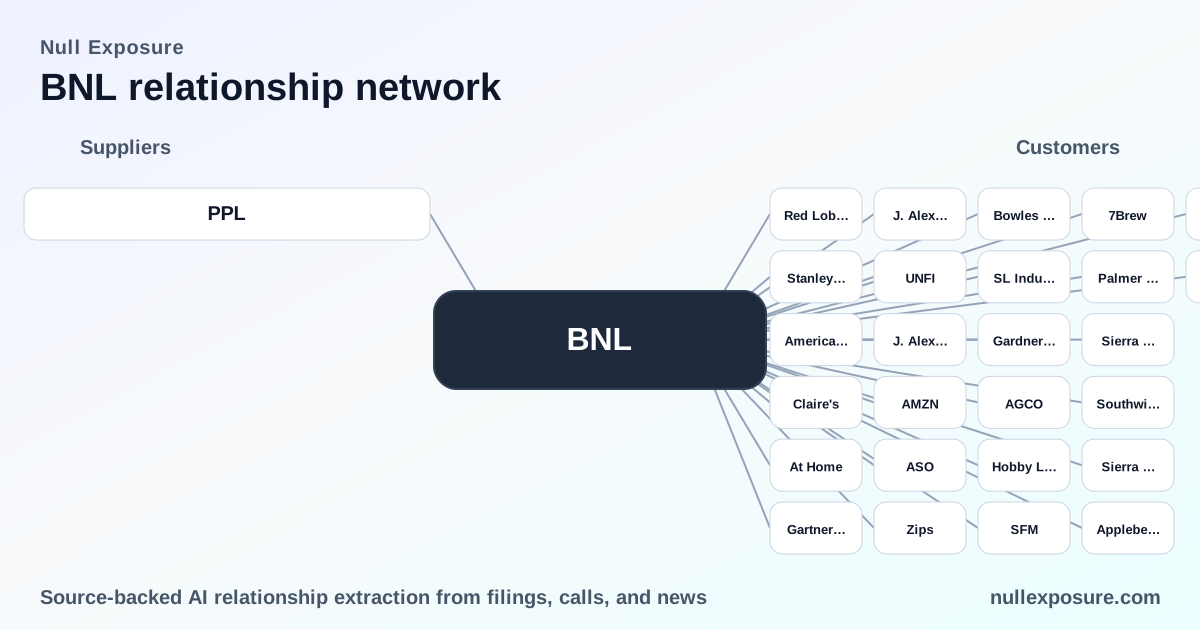
Broadstone Net Lease (BNL): supplier relationships and what they mean for investors
Broadstone Net Lease is an internally managed REIT that acquires, owns and operates predominantly single‑tenant commercial real estate on long‑term net leases. The company monetizes through steady rental cash flows, portfolio rotation and leverage—supplemented by interest‑rate management via swaps—and its creditor and service relationships underpin both cash‑flow stability and funding flexibility. For investors evaluating supplier and counterparty risk, the combination of long‑dated contracts, large‑bank counterparties and material borrowing activity is the dominant structural story. Learn more at https://nullexposure.com/.
How Broadstone runs its supplier and counterparty program
Broadstone operates with a contracting posture aligned to the economics of single‑tenant net leases: contracts are long term and credit‑oriented, designed to lock in rental income and isolate property‑level volatility. Public disclosures show the company leverages large financial counterparties for interest‑rate swaps and financing, and it limits counterparty selection to major banks that meet internal credit and capital guidelines—an explicit governance choice that supports predictable earnings and financing access. According to Broadstone’s year‑end disclosures, borrowings under its revolving facility totaled roughly $1.0 billion as of December 31, 2024, with $939.5 million swapped to fixed rates, illustrating active interest‑rate risk management.
- Contracting posture: Long‑term relationships predominate, consistent with the REIT’s lease tenor and hedging profile.
- Counterparty profile: The company restricts exposure to very large banks and institutional counterparties as part of its credit management.
- Spend and leverage: Aggregate financing and hedging activity reside in the >$100 million band, reflecting material funding needs for portfolio operations and acquisitions.
- Operational role of suppliers: Broadstone uses third‑party service providers for IT, security and other business functions, which creates operational dependency beyond pure financing relationships.
- Valuation impact: Credit valuation adjustments are reported as immaterial to derivative valuations at year‑end 2024, indicating limited balance‑sheet sensitivity to counterparty credit on current positions.
What was said on the record: supplier conversations logged by Null Exposure
Below are the recorded relationship entries captured in the supplier scope. Each item is described in plain language and linked to its published source.
-
Broadstone management referenced ongoing discussions with PPL about “different load ramps” during the Q4 2025 earnings call; the comment was logged in the Q4 2025 transcript published March 7, 2026. This indicates active operational conversations involving power/load considerations with PPL. (Source: Broadstone Q4 2025 earnings call transcript, March 7, 2026.)
-
A separate publication captured management describing the engagement with PPL in more detail, noting that the power conversation was being considered in two phases and that the first phase contemplated 300 megawatts; this was reported by InsiderMonkey on March 9, 2026. The reference reinforces that Broadstone’s dialogue with PPL includes capacity‑scale planning relevant to energy or load provisioning. (Source: InsiderMonkey coverage of BNL Q4 2025 earnings call, March 9, 2026.)
Each of these results references the same counterparty, PPL, but they come from two distinct public records: the company’s own earnings call and a third‑party transcript/news report.
Why these supplier notes matter for investors
The PPL references are concise but meaningful in context: Broadstone is engaged in operational planning that touches the energy or power provisioning side of its assets, which could influence tenant operations, property availability, or utility pass‑through arrangements on larger single‑tenant installations. That operational layer sits on top of the financial plumbing described earlier—long leases, large counterparty hedges and >$100 million funding lines—so any supplier engagement that affects utilities or load profiles should be read as a tactical matter with potential operational and cash‑flow implications.
If you are modeling downside scenarios, assume the operational dialogues with counterparties like PPL can affect uptime or tenant servicing on a localized basis; structurally, however, Broadstone’s long‑term leasing model and use of large, creditworthy counterparties reduce the probability of systemic supplier disruption. For a deeper read on counterparty and supplier trajectories, visit https://nullexposure.com/ for the full supplier mapping.
Constraints and what they reveal about Broadstone’s business model
Several company‑level signals extracted from public filings and management disclosures clarify how Broadstone’s supplier posture supports its REIT model:
- Long‑term contract orientation. Evidence in the company’s notes and swap schedules supports a long‑dated contracting strategy that aligns hedging with lease cash flows, reducing short‑term rollover risk.
- Counterparty selection bias toward large institutions. Broadstone explicitly limits counterparties to major banks that satisfy credit guidelines; this is a deliberate concentration on quality, not a reflection of narrow access.
- Materiality control on derivative credit adjustments. The company assessed credit valuation adjustments and concluded they are immaterial to overall derivative valuations as of December 31, 2024, indicating limited mark‑to‑counterparty credit exposure at current positions.
- Service providers carry operational access. Broadstone uses third‑party IT and security providers that have access to sensitive systems and data—this is an operational dependency to monitor for resilience and for negotiation of SLAs.
- High‑scale funding and hedging. The scale of borrowings and swaps (>$1.0 billion in borrowings, most swapped) places Broadstone in a high‑spend band where supplier terms and bank relationships materially influence the cost of capital.
These signals collectively paint a business model that is mature, credit‑focused and structured to minimize short‑term supplier risk while accepting concentrated exposures to a small set of large financial partners.
Investment implications and portfolio action points
- Positive structural features: Broadstone’s long leases and active hedging provide predictable cash flows and reduce interest‑rate volatility at the portfolio level. Large‑bank counterparties and immaterial CVA findings lower counterparty credit risk.
- Areas to monitor: Operational dialogues with energy suppliers (e.g., PPL) could translate into localized operational risk or capital projects that affect specific assets; service‑provider access to systems elevates outsourcing and cybersecurity oversight needs.
- Capital structure vigilance: Given the >$1.0 billion borrowings and substantial swap book, investors should watch financing covenant metrics and leverage ratios ahead of rate cycles.
If you want a practitioner‑grade view of Broadstone’s supplier map and counterparties, start your analysis at https://nullexposure.com/ for supplier‑level detail and sourcing.
Bottom line
Broadstone Net Lease runs a supplier strategy that matches its single‑tenant, long‑lease business model: long contracts, high‑quality financial counterparties, and substantial hedging and financing activity. The public record shows active operational engagement with PPL on power/load issues; investors should treat that as a tactical operational factor layered above a structurally conservative counterparty posture. For ongoing monitoring and supplier intelligence that supplements earnings calls and filings, see https://nullexposure.com/.