Bank of Nova Scotia (BNS): Supplier Relationships and Operational Implications for Investors
Bank of Nova Scotia runs a diversified retail and corporate banking franchise across the Americas and internationally and monetizes through net interest margin, fee income from transaction and wealth services, and capital markets activities. With a market capitalization roughly USD 86.6 billion and trailing revenue of ~USD 33.3 billion, Scotiabank leverages scale in branch networks, cross-border payments, and structured-product issuance to generate predictable earnings, while returning capital via a 6.34% dividend yield and a modest payout backed by mid-teens P/E multiples. For investors evaluating supplier risk and service dependencies, the supplier footprint is primarily operational and customer-facing, where disruptions translate directly into customer experience and regulatory exposure. Explore deeper supplier signals and relationship detail at https://nullexposure.com/.
Quick read: what the new supplier action indicates
A recent rollout of in-branch accessibility services highlights that Scotiabank is actively outsourcing specialized, customer-facing capabilities rather than building them in-house—a classic efficiency play that trades direct control for faster deployment and cost predictability. This pattern increases operational agility but elevates dependency on third-party performance for regulatory compliance and retail experience. Learn more about supplier monitoring and vendor exposure at https://nullexposure.com/.
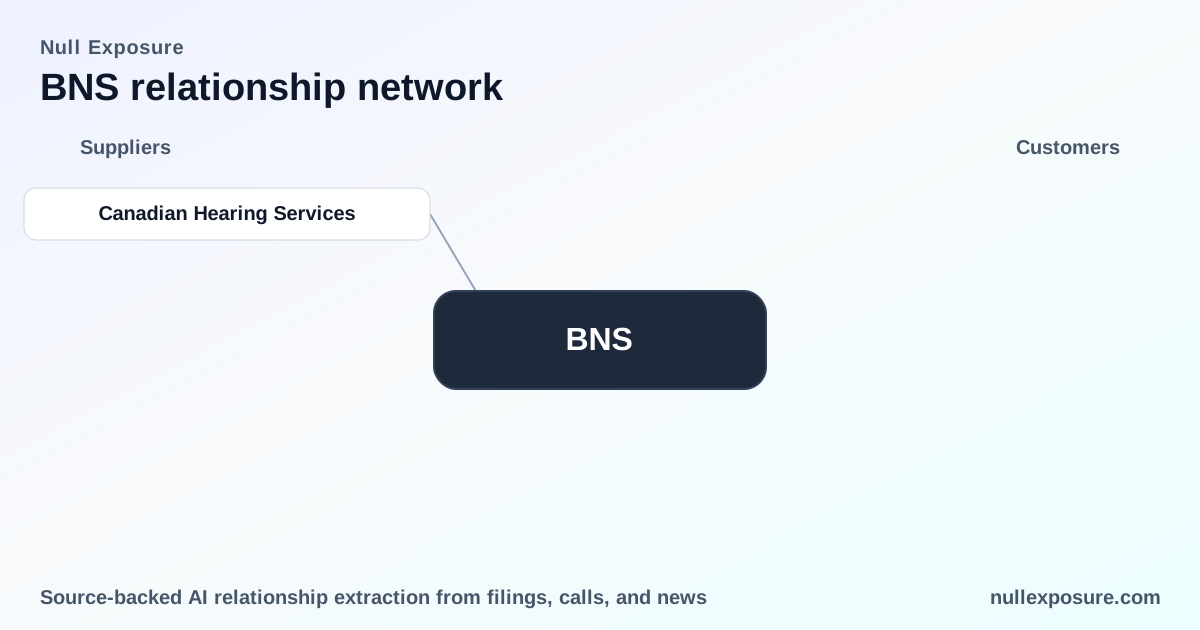
The supplier relationship you need to know: Canadian Hearing Services
Canadian Hearing Services partnered with Scotiabank to implement virtual sign-language interpretation across Canadian branches as part of a customer-accessibility initiative; the engagement was noted alongside retail product activity in FY2026 reporting. According to a TradersUnion news report published March 9, 2026, the rollout of virtual interpretation services was deployed across Canadian branches in partnership with Canadian Hearing Services, cited in the context of other firm-level actions for FY2026 (TradersUnion, 2026).
- This is a customer-facing, compliance-adjacent service that impacts branch accessibility and public reputation.
- The TradersUnion article also referenced a structured-product issuance (a USD 3.788 million autocallable note linked to Netflix, maturing March 2027) and insider selling amid broader market pressure; those items provide context for business activity but are distinct from the supplier engagement (TradersUnion, March 2026).
Why this relationship matters to investors and operators
The Canadian Hearing Services engagement exemplifies how Scotiabank sources specialized capabilities:
- Criticality: Accessibility services are material to branch-level compliance and customer retention; failure or poor performance would have outsized reputational and regulatory implications relative to the contract size.
- Concentration: This single reported supplier relationship is narrow and specialized; across a global bank of Scotiabank’s scale, supplier concentration risk is low on a portfolio basis but high at the service-level if a single vendor is the exclusive provider for an essential capability.
- Contracting posture: The bank’s preference for partner rollouts indicates a contracting posture favoring external vendors for specialized, non-core services—an efficiency strategy consistent with peers in the sector.
- Maturity: Rolling out virtual interpretation at scale is a mid-stage operational program: the technology exists, but the bank is still in the deployment phase across branches, which raises short-term execution risk and medium-term normalization of costs.
These operating-model characteristics—outsourcing of specialist services, limited supplier concentration across the enterprise but potential single-vendor criticality for specific functions, and a deployment-stage maturity profile—should be treated as company-level signals about how Scotiabank manages non-core capabilities (company fiscal signals drawn from FY2026 disclosures and market commentary).
Operational and financial risk considerations
Investors and operators should track a few precise vectors when evaluating the impact of supplier relationships on Scotiabank’s risk profile:
- Service availability and SLAs: customer-facing services directly affect branch throughput and accessibility compliance, which regulators scrutinize.
- Contract terms and termination rights: outsourcing reduces capex but increases exposure to vendor pricing power in renewals.
- Integration and cyber risk: third-party interfaces introduce operational dependencies that compound across digital and physical channels.
- Reputation and regulatory fines: accessibility failures result in outsized reputational damage relative to contract cost.
Operational watchers should prioritize vendor continuity planning for any single-provider, high-visibility service. For investors, the financial impact is modest in absolute dollars but significant in risk-adjusted terms because of reputational and regulatory multipliers.
How this fits into Scotiabank’s broader commercial profile
Scotiabank’s macro metrics underline the context in which it signs such supplier agreements: price-to-book 1.54, forward P/E 11.96, ROE ~10.3%, and a dividend yield above 6%. These figures indicate a mature banking franchise that monetizes scale while outsourcing specialized front-line capabilities to focus balance-sheet and technology investment where it delivers the highest return. The bank’s mixed geography—Canada, Latin America, and the Caribbean—drives a pragmatic vendor strategy that balances local providers for regional compliance with centralized vendor oversight.
Practical takeaways for portfolio and operations teams
- For portfolio managers: treat small, high-visibility supplier contracts as non-linear risk drivers—they are low in cost but high in potential regulatory and reputational impact. Maintain a watchlist of vendor concentration at the service level rather than aggregate supplier count.
- For operators and vendor managers: enforce robust SLAs, monitor service KPIs continuously, and require contingency plans for single-vendor critical services.
- For risk and compliance teams: prioritize audit trails and accessibility performance metrics in vendor scorecards.
Mid-report action: if your investment or vendor-monitoring workflow needs richer supplier context and continuous tracking, start a focused review at https://nullexposure.com/ to integrate vendor-level signals into your operational risk framework.
Closing: what investors should do next
Bank of Nova Scotia’s partnership with Canadian Hearing Services is a tactical example of a broader strategic posture: outsource specialized, customer-facing services to accelerate capability deployment while retaining core banking functions internally. That posture optimizes operating leverage but concentrates operational risk at the service level; investors and operators should treat these as asymmetrical risks worthy of active monitoring.
For a deep-dive into supplier exposure and to set up automated monitoring of critical vendor signals, visit https://nullexposure.com/ and subscribe to targeted alerts.