BioNTech (BNTX) — what supplier relationships tell investors about scale, control, and risk
BioNTech develops and commercializes mRNA-based immunotherapies for cancer and infectious diseases and monetizes through product sales, licensing fees, and strategic partnerships. The company’s revenue mix combines commercial vaccine income with recurring license and collaboration receipts, and its recent acquisition activity is accelerating consolidation of mRNA IP and supplier relationships. For investors and operators, the supplier footprint is therefore both a revenue lever and an integration risk to manage. Learn more about supplier intelligence and counterparty exposure at https://nullexposure.com/.
Why supplier and counterparty signals matter for valuation
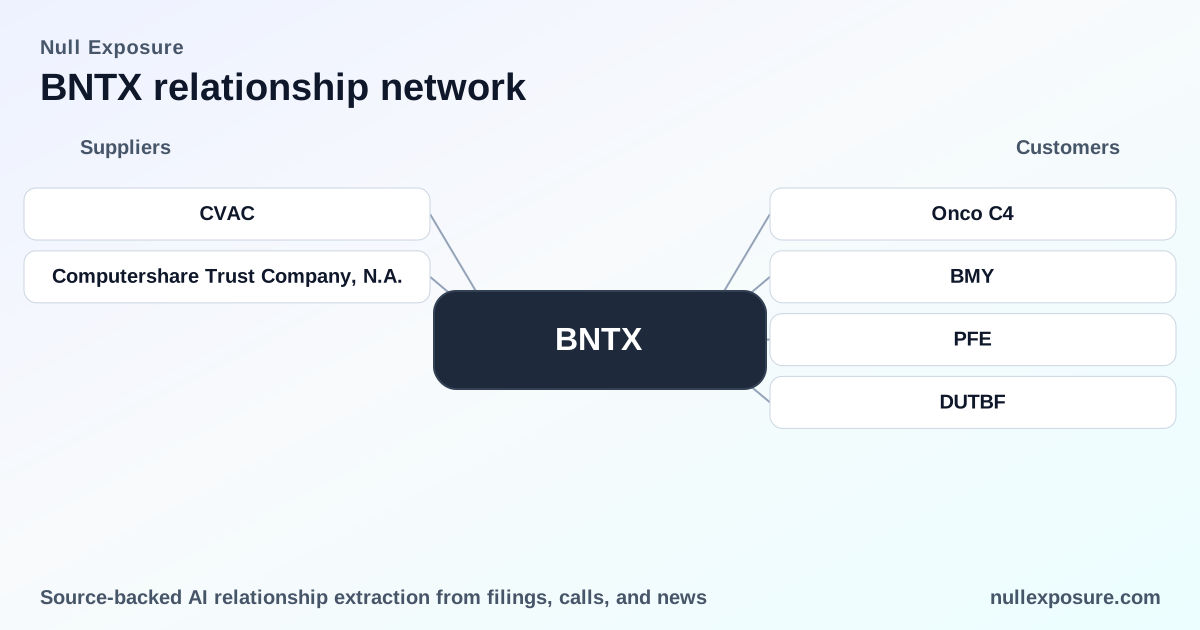
Supplier and counterparty relationships are not administrative details for a therapeutic platform company; they are a vector of revenue, IP access, and operational continuity. Strong licensing partners contribute predictable non-product revenue, while exchange agents and transfer agents are critical to completing M&A and equity actions. The recent items that surfaced in public reporting indicate two discrete supplier/counterparty roles tied to BioNTech’s consolidation strategy: a licensor/partner (CureVac) with direct revenue flows and an exchange agent (Computershare) facilitating shareholder tender mechanics. Both affect near-term cash flows and integration timelines.
What the reporting shows — CureVac
CureVac contributed headlineable license income in 2025: CureVac reported €11.1 million in license fees from BioNTech during the first nine months of 2025, alongside other partnership revenue lines. This is recorded as part of CureVac’s FY2025 revenue composition, demonstrating an active commercial/contractual cash flow from BioNTech into CureVac before the acquisition closed. According to an ad-hoc-news report on March 9, 2026, those license receipts were explicitly disclosed in CureVac’s nine-month financial summary for 2025. This entry both signals that BioNTech already had contractual economic interactions with CureVac and that those interactions produced measurable revenue for the counterparty prior to consolidation.
What the reporting shows — Computershare Trust Company, N.A.
Computershare served as the exchange agent for BioNTech’s offer into CureVac and reported tender participation levels: 195,341,219 CureVac shares — about 86.75% of issued and outstanding shares — were validly tendered by the close of the subsequent offering period, according to a news report published March 9, 2026. Stocktitan relayed that BioNTech was informed of this outcome by Computershare Trust Company, N.A., reflecting a near-complete tender acceptance that is material to control and integration. This relationship is not commercial in the therapeutic sense, but it is operationally critical to completing the acquisition and transferring ownership.
What these relationships imply about BioNTech’s operating model
The supplied relationships reveal a company operating with an aggressive consolidation and partnership posture. BioNTech is not only a product seller; it executes licensing, acquisition, and structured offers that require both contractual counterparties and financial-administrative agents.
Key company-level signals for investors and operators:
- Contracting posture — strategic and acquisitive. BioNTech deploys licensing and acquisition to secure IP and market positions, shown by the license payments to CureVac and the subsequent tender process. This is a proactive, control-oriented posture rather than a passive sourcing model.
- Concentration and revenue composition. The firm’s revenue in recent filings shows a mix of product sales and significant licensing/collaboration receipts; such income can be lumpy but provides diversification away from single-product dependence. BioNTech’s reported trailing revenue of about $2.87 billion and significant gross profit indicate meaningful commercial scale while operating margins remain under pressure.
- Criticality of counterparties. Partnership counterparties (licensing partners) and service providers (exchange agents, transfer agents) are critical nodes — they directly affect cash receipts, share transfers, and the speed of consolidation. The Computershare engagement demonstrates how nonclinical suppliers can be operationally central.
- Maturity and transition. BioNTech is transitioning from R&D/launch phases toward a hybrid commercial-and-consolidation model: product commercialization coexists with M&A-driven IP consolidation, and that broadens both opportunity and integration risk.
Because no supplier constraints were reported in the provided materials, there are no explicit contractual constraints flagged at the supplier-level in this review. That absence itself is a signal: the publicly surfaced supplier relationships here focus on revenue and transaction mechanics rather than on restrictive covenants, termination notice risks, or supplier concentration limits. Treat this as a company-level observation rather than evidence of specific relationship conditions.
Operational and investor risks to monitor
Investors and operators should focus on three executable risk areas:
- Integration execution risk. Consolidation of licensing counterparties and acquired IP necessitates rapid integration of R&D programs and supply arrangements; missteps erode synergies and delay revenue realization.
- Counterparty operational dependency. Administrative suppliers like Computershare are single points that can materially delay M&A outcomes if operational issues arise — governance and contingency planning matter.
- Revenue volatility from license timing. Licensing receipts are typically discrete events; while beneficial, they create lumpiness in near-term cash flow forecasting.
Practical takeaways for portfolio managers and operators
- Prioritize diligence on licensing terms and earn-out triggers for counterparties similar to CureVac; those terms govern cash flow recognition and upside capture.
- Validate administrative counterparties’ SLAs and historical execution before major equity actions; Computershare’s role underscores the importance of the exchange agent in consummating offers.
- Model consolidation impact conservatively: account for integration timing, potential re-pricing of pipelines, and the one-time nature of many licensing receipts.
If you are mapping supplier exposures for biotech targets or incumbents, start with counterparty revenue flow and administrative role analysis; develop contingency plans for key administrative suppliers and timeline scenarios for licensing cash flows. For additional supplier mapping and counterparty intelligence, visit https://nullexposure.com/ to see how we surface and contextualize these relationships.
Closing recommendation
BioNTech’s visible supplier relationships in the recent reporting show a company intentionally converting counterparty access into owned capability through licensing and acquisition. That strategy expands IP control and revenue optionality but elevates integration execution as a primary near-term risk. Active monitoring of license cash flows and administrative counterparties will determine whether consolidation drives sustained margin improvement or creates transitional volatility.
Explore deeper supplier and counterparty profiles to position your investment or operational strategy: https://nullexposure.com/.