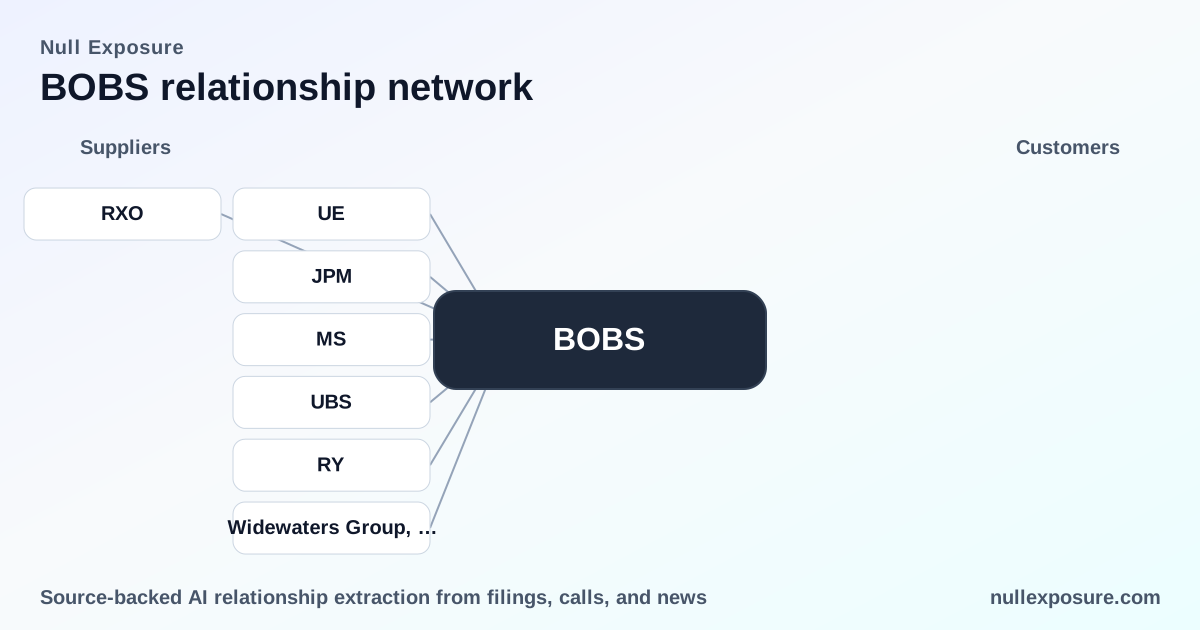
BOBS supplier relationships: capital, real estate and logistics that shape near‑term execution
Bob’s Discount Furniture (BOBS) operates a national retail fleet that monetizes through merchandise sales, ancillary delivery and installation services, and continued store rollouts driven by third‑party real estate arrangements. The company funds growth through capital markets activity and underwrites store expansion via landlord and broker relationships while outsourcing last‑mile logistics to specialist carriers; these relationships collectively determine operating leverage, working capital cadence, and customer fulfilment risk.
Explore deeper supplier mapping and sourcing signals at https://nullexposure.com/.
Why these relationships matter to investors: a short read
BOBS is a retail operator whose margin profile and growth trajectory hinge less on product sourcing and more on three external relationships: landlords and developers that supply retail footprint, investment banks that provide access to public capital, and logistics contractors that execute deliveries. Real estate deals accelerate same‑store network effects, underwriting drives liquidity and valuation, and last‑mile partners create a direct line to customer satisfaction and potential litigation exposure. The documents and reports collected in early March 2026 show active use of each of these relationship channels.
Operational posture and business model characteristics investors should note
BOBS executes a growth‑centric, asset‑light expansion strategy that emphasizes third‑party partners:
- Contracting posture: The company routinely contracts out functions that are operationally intensive—real estate procurement and delivery logistics—indicating a preference for variable cost structures over heavy capital investment in distribution.
- Concentration and access to capital: Leadership used a syndicate of global banks for an offering in FY2026, signaling reliance on institutional underwriting for major financing events and potential concentration risk around a small number of lead banks.
- Criticality of suppliers: Logistics partners are operationally critical; disruptions, litigation, or contract exits by these vendors directly affect last‑mile performance and consumer experience.
- Maturity and sophistication: Use of established investment banks and traditional retail leasing intermediaries suggests a mature capital market posture and standard commercial leasing practices rather than bespoke financing or unusual contracting terms.
For a full supplier analysis and monitoring tools, visit https://nullexposure.com/.
Detailed relationship map (each relationship from the record)
Urban Edge Properties (UE)
CityBiz reported that Urban Edge Properties will add Bob’s Discount Furniture at Amherst Commons, where Bob’s is taking approximately 31,242 square feet of retail space in a former TJ Maxx unit, showing continued expansion via third‑party landlords (CityBiz, March 2026).
Widewaters Group, Inc.
CityBiz noted that Jim Lavelle of Widewaters Group represented both Bob’s and Urban Edge in the Amherst Commons transaction, indicating use of outside brokerage and development advisors to negotiate lease and occupancy terms (CityBiz, March 2026).
JPMorgan Chase & Co. (JPM)
Transport Topics’ coverage of Bob’s financing activity identifies JPMorgan Chase as one of the lead underwriters on the company’s offering in FY2026, a signal that Bob’s tapped top‑tier capital markets distribution for liquidity (TTNews/Transport Topics, March 2026).
Morgan Stanley (MS)
The same Transport Topics item lists Morgan Stanley among the banks that led Bob’s FY2026 offering, reflecting a syndicate approach to public capital raising and institutional placement capacity (TTNews/Transport Topics, March 2026).
UBS Group AG (UBS)
Transport Topics includes UBS Group AG as a bookrunner on the FY2026 offering, implying Bob’s engaged multiple global wealth and capital platforms to broaden investor distribution (TTNews/Transport Topics, March 2026).
Royal Bank of Canada (RY)
Transport Topics also names Royal Bank of Canada as part of the underwriting group for the FY2026 offering, underscoring cross‑border institutional involvement in Bob’s capital event (TTNews/Transport Topics, March 2026).
RXO Last Mile Inc. (RXO)
Bloomberg Law’s Daily Labor Report documents that Bob’s formerly contracted with RXO (previously XPO Last Mile) to handle deliveries and that Bob’s exited a delivery‑driver wage lawsuit against RXO in FY2025; that history highlights legal and operational risks tied to outsourced logistics (Bloomberg Law, FY2025).
What the relationship map implies for revenue, operations and risk
- Growth and footprint execution: The Urban Edge/Widewaters transaction underscores a strategy of accelerating store openings through landlord deals and brokered site repurposing—this increases unit growth without equivalent capital expenditure but increases fixed occupancy and lease negotiation exposure.
- Capital dependence and distribution strategy: The multi‑bank syndicate for the FY2026 offering—JPMorgan, Morgan Stanley, UBS and RBC—demonstrates access to deep capital markets, but also concentration of funding relationships that can influence deal pricing and timing.
- Operational risk tied to logistics: The RXO litigation and contract history is a direct operational reminder: outsourced last‑mile partners are a single point of failure for customer experience and a source of legal exposure that can generate margin volatility and reputational cost.
Practical checklist for a supplier‑risk due diligence
- Confirm lease terms and escalation mechanics on recently announced store deals to assess cash flow impact and breakpoint risk.
- Review underwriting and placement detail from the FY2026 offering to understand covenant structures, use of proceeds and potential dilution.
- Audit current last‑mile contracts and litigation history; quantify the share of deliveries managed by third parties and contingency plans for in‑house fallback.
Key takeaway: BOBS’ P&L sensitivity is dominated by landlord commitments, capital structure from a concentrated bank syndicate, and third‑party delivery relationships.
Mid‑report action: if you evaluate counterparties for retail or logistics exposure, start with a tailored supplier screen at https://nullexposure.com/.
What investors should do next
- For active investors: model scenarios that stress lease and delivery cost inflation and simulate refinancing outcomes given the FY2026 syndicate structure.
- For portfolio managers: treat delivery provider litigation history as a governance flag; seek contractual covenants that limit pass‑through liabilities.
- For operating partners: prioritize diversification of last‑mile carriers and contractual performance SLAs to protect same‑day customer fulfilment.
For research teams building a watchlist or monitoring alerts around these counterparties, the homepage is the fastest starting point: https://nullexposure.com/.
Final read: concise action points
BOBS leverages external capital and real estate relationships to scale while outsourcing critical operational execution to third parties. Investors should weight expansion upside against concentrated financing relationships and the demonstrable legal and operational risks embedded in last‑mile logistics. For ongoing monitoring and supplier relationship intelligence, visit https://nullexposure.com/ and subscribe for updates.