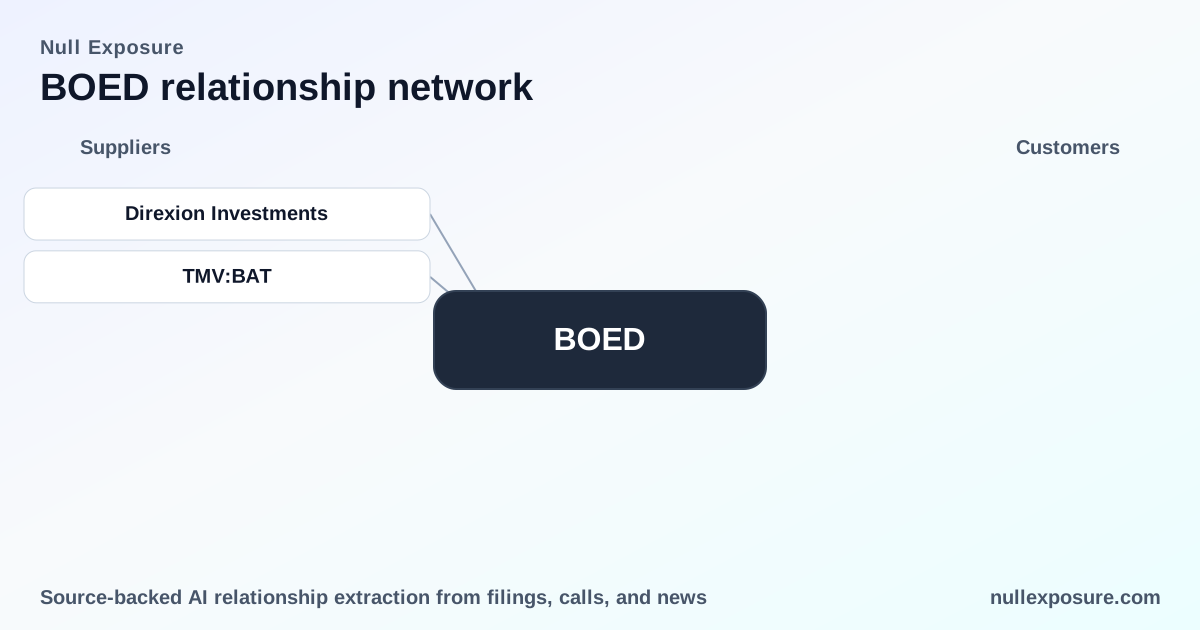
BOED (Direxion Daily BA Bear 1X): Supplier relationships and what investors need to know
Thesis: BOED is an exchange-traded fund product that operates as an inverse single-stock instrument providing short exposure to Boeing (BA) on a daily basis; the product is sponsored and managed by Direxion, which monetizes the position through ETF management fees and related operating charges while relying on market counterparties for intraday execution and portfolio manufacturing. For investors and operators evaluating BOED as a supplier relationship, the critical fact is that risk and service continuity flow through a single sponsor model — Direxion — rather than a multi-vendor network. Learn more about supplier mapping and exposure at https://nullexposure.com/.
How BOED operates and how it makes money
- BOED is structured to deliver -100% of Boeing’s daily stock performance, rebalancing each trading day to maintain that inverse exposure; the fund’s economic model is driven by management and operating fees, liquidity provisioning, and, where applicable, securities financing and trading spreads.
- The sponsor (Direxion) handles product design, brand and distribution, regulatory filings, and the operational plumbing that allows brokerage and market-makers to transact the ETF; third-party custodians, authorized participants, and derivatives counterparties execute the underlying trades that deliver daily inverse performance.
- From a procurement and vendor-risk perspective, BOED exhibits high sponsor concentration (single principal supplier), operational criticality (product performance and NAV depend on execution and rebalancing), and mature market mechanics (leveraged and inverse ETFs are established product lines with known rebalancing behavior). If you need detailed supplier maps or counterparty exposure for operational due diligence, start here: https://nullexposure.com/.
Supplier relationship inventory — every mention in the reviewed records The available records reference a single supplier entity across multiple news and technical mentions: Direxion (Direxion Investments). Below are each of the sourced references in the review set, with a concise, plain-English summary and the source.
Direxion Investments — ETF sponsor and promoter (ETF Trends overview, March 2026)
Direxion positions BOED as a vehicle for investors to capitalize on bearish moves in Boeing stock, marketing the fund as a one-times inverse alternative for directional short exposure. According to ETF Trends’ coverage of Direxion’s Boeing products (March 2026), BOED is explicitly framed as the inverse counterpart to Direxion’s bullish Boeing ETF. (Source: ETF Trends, March 2026 — https://www.etftrends.com/leveraged-inverse-content-hub/boeing-stock-continues-take-flight-after-april-sell-off/)
Direxion — technical sentiment and indicator snapshot (Intellectia.ai technical, March 2026)
A technical-data summary flagged a negative momentum signal for BOED on moving-average indicators, representing short-term sell pressure from a charting perspective; this is a market-technical observation rather than a structural supplier change. (Source: Intellectia ETF technical summary, March 2026 — https://intellectia.ai/etf/BOED/technical)
Direxion — product design statement (ETF Trends product announcement, March 2026)
Direxion’s product literature and launch commentary describe BOED’s objective to generate -100% of Boeing’s daily performance, underscoring that the fund is engineered for daily inversion and thus unsuitable for buy-and-hold long-term exposure without active management. (Source: ETF Trends product announcement, March 2026 — https://www.etftrends.com/leveraged-inverse-content-hub/new-direxion-etfs-target-daily-boeing-exxon-mobil-performance/)
Direxion — market context and trader demand (Inkl coverage, March 2026)
Journalistic reporting placed Direxion’s BOED and its bullish counterpart BOEU in the context of traders seeking tactical exposure while Boeing works to rebuild credibility, highlighting market demand for both hedging and leveraged directional tools around BA. (Source: inkl, March 2026 — https://www.inkl.com/news/boeing-s-protracted-effort-to-regain-credibility-pushes-traders-toward-direxion-s-boeu-boed-etfs)
What these relationships imply for investors and counterparties
- Single-sponsor exposure: All referenced materials point to Direxion as the supplier and operator; that creates a concentration point for vendor risk — product governance, compliance, and operational resilience are all functions centralized at Direxion.
- Operational criticality: BOED’s daily rebalancing requirement makes counterparty execution and liquidity provisioning operationally critical; market-makers, authorized participants, and derivatives counterparties (not listed in the reviewed records) are functionally necessary downstream service providers.
- Product maturity and behavior: Inverse one-times single-stock ETFs are established instruments with predictable intraday dynamics, so counterparty operational playbooks and market-underwriting behavior are standardized compared with bespoke OTC short positions.
Company-level constraints and procurement signals
- The record set contained no explicit contractual constraints or vendor-specific limitations extracted for BOED; treat this as a company-level signal that the public linkage data provided no flagged contractual redlines.
- As a company-level operating signal, the absence of extracted constraints emphasizes the need for direct contractual review when onboarding BOED as a supplier for trading, custody, or white-label distribution: do not substitute public commentary for formal agreements and operational attachments.
Risk checklist for operators and investors
- Concentration risk: Sponsor-centric model requires vendor due diligence on Direxion’s operational controls and continuity plans.
- Execution risk: Daily inverse funds require reliable market-making and AP channels to avoid NAV dislocations.
- Misuse risk for long-term holders: BOED is engineered for daily exposure; long-term holders will experience performance drift versus the underlying.
- Reputational risk: Media attention and trader flows (as noted in coverage) are material to liquidity and short-term volatility.
Actionable next steps
- Request Direxion’s operational SLAs, custody and execution counterparties, and fee schedule during commercial diligence.
- If your firm will use BOED for client strategies, map authorized participant relationships and build trade-monitoring for daily rebalancing effects.
- For comprehensive supplier exposure mapping and counterparty analysis, visit https://nullexposure.com/ for tools and reports tailored to ETF sponsor relationships.
Conclusion and investor takeaway BOED is a single-sponsor inverse ETF whose economic viability for users hinges on Direxion’s stewardship and the supporting market infrastructure. For institutional investors and platform operators, the core evaluation is not whether BOED can deliver its objective — it is whether Direxion and its ecosystem of market-makers and counterparties meet your operational and compliance thresholds. Conduct contractual diligence, confirm counterparty arrangements, and monitor liquidity signals before integrating BOED into production exposures. To begin a structured supplier due-diligence or to request a bespoke exposure report, go to https://nullexposure.com/.