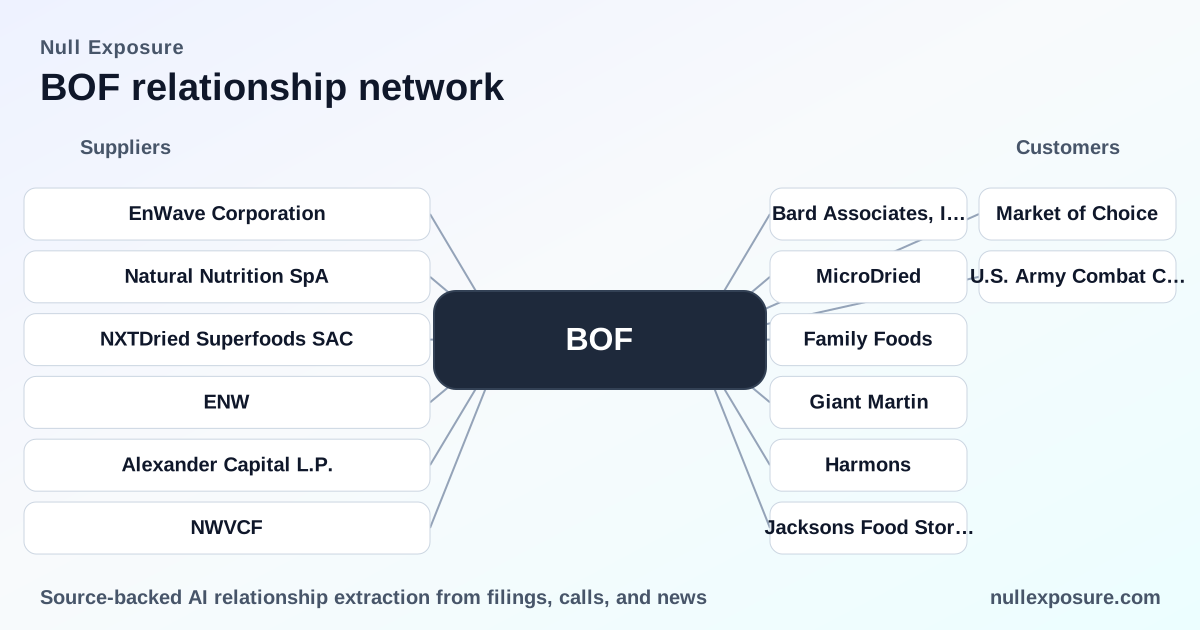
BOF supplier map: what investors need to know about manufacturing, licensing and capital partners
BranchOut Food Inc. (BOF) operates as a branded dehydrated-food manufacturer that monetizes via product sales and licensed production capacity; the company contracts manufacturing, licenses dehydration technology, and raises capital through public offerings where investment banks act as bookrunners. BOF’s economics depend on outsourced manufacturing capacity in Latin America, a close relationship with a technology licensor/manufacturer, and recurring capital markets access to fund capacity expansion. For an at-a-glance supplier and capital-partner view, see the relationship breakdown below — and if you want continuous monitoring of supplier and contract signals, visit the Null Exposure homepage: https://nullexposure.com/.
How BOF makes money and why suppliers matter
BOF sells dehydrated fruit and vegetable products produced under proprietary dehydration methodologies that the company licenses and implements through a mix of owned equipment and third‑party contract manufacturers. Revenue growth is driven by production throughput and the company’s ability to deploy licensed REV machines at scale; supply-side constraints therefore translate directly into revenue volatility. The corporate model is capital-intensive and operationally reliant on a small set of external manufacturers and licensors, which elevates counterparty and concentration risk for investors.
The supplier and capital partner list — one-paragraph summaries with sources
EnWave Corporation
BOF purchased REV vacuum‑microwave dehydration equipment from EnWave and has repeatedly committed to additional REV machines to expand capacity; a FY2024 10‑K discloses an equipment purchase agreement dated May 22, 2023 for a used 100kW REV unit, and multiple press releases across 2024–2025 report commitments to buy larger REV 120kW machines to support 2026 production increases. According to BOF’s FY2024 10‑K and several press reports (GlobeNewswire, StockTitan and QuiverQuant coverage in 2024–2025), EnWave is both equipment vendor and a critical technology provider.
Natural Nutrition SpA (Nanuva)
BOF entered a Manufacturing and Distributorship Agreement with Natural Nutrition SpA (Chile) on February 4, 2021 and provided a $500,000 advance to finance two industrial fruit‑drying machines that Nanuva purchased to service BOF’s manufacturing needs. This loan-to-supplier structure is documented in BOF’s FY2024 10‑K and positions Nanuva as a financed contract manufacturer supporting BOF’s regional capacity.
NXTDried Superfoods SAC
BOF has a contract manufacturing agreement with NXTDried Superfoods SAC dated January 19, 2022, under which NXTDried produces products for BOF distribution. The FY2024 10‑K lists this contract explicitly, establishing NXTDried as an ongoing third‑party manufacturer in BOF’s supply chain.
Alexander Capital L.P.
Alexander Capital L.P. has acted as sole bookrunner on multiple BOF offerings in 2024 and 2025, underwriting follow‑on capital raises that funded operational expansion and reduced short‑term liabilities. Press filings and investor releases (GlobeNewswire and Yahoo Finance in 2024–2025) identify Alexander Capital as the capital markets facilitator for BOF’s equity or convertible offerings.
What the relationship map implies for BOF’s operating profile
BOF shows a clear contracting posture: outsourced manufacturing plus licensed technology. The combination creates four practical characteristics investors should track:
- Concentration: A small number of manufacturers and a single licensed dehydration technology concentrate operational risk. Equipment delivery schedules and contract performance from these partners materially affect revenue timing.
- Criticality: Suppliers are mission‑critical; EnWave supplies the physical REV machines and the dehydration technology BOF uses, while Nanuva and NXTDried supply finished throughput. Disruption at any one node reduces production.
- Maturity and capital intensity: The business model requires heavy upfront equipment costs and working capital — evidenced by BOF’s machine purchases and a supplier loan — which increases reliance on capital markets and bookrunners such as Alexander Capital.
- Geography: Manufacturing and capacity are materially Latin America‑centric, which concentrates operational and regulatory exposure regionally.
These are company‑level signals drawn from BOF’s disclosures and the constraint set; they are not an attribution of any single constraint to a single supplier unless BOF’s filings explicitly named that connection.
If you need a supplier‑risk scorecard for BOF that quantifies these exposures, check Null Exposure for tailored analytics: https://nullexposure.com/.
Operational risk and escalation vectors investors should monitor
Two risk vectors dominate: equipment and financing. First, timely delivery and uptime of REV machines are the production throttle; press reports confirm BOF’s aggressive machine purchases to meet demand, so schedule slip or underperformance will compress margins. Second, external financing matters — Alexander Capital’s role in recent offerings demonstrates BOF’s dependence on public capital to refinance payables and fund capacity. Both vectors are correlated: capital enables equipment installs, and equipment performance affects future fundraising capability.
Practical takeaways for portfolio decisions
- Underwriting signal: If you value downside protection, treat BOF as a capacity‑driven growth story where supplier continuity is central; stress test valuations for a protracted supplier disruption scenario.
- Catalyst watchlist: Equipment delivery dates, EnWave contractual amendments, and subsequent bookrunner activity are high‑information events that will move the stock.
- Counterparty diligence: Focus on contractual terms and remedies with EnWave, Nanuva, and NXTDried — especially lead times, payment schedules, exclusivity clauses, and any cross‑default mechanics tied to BOF financing.
For ongoing alerts about supplier developments that affect valuation and operational risk, start monitoring BOF supplier relationships via Null Exposure: https://nullexposure.com/.
Closing view
BOF’s path to scaled profitability is straightforward: increase throughput by deploying more REV capacity and keep manufacturing partners aligned — but the route is narrow. The company operates with concentrated manufacturing relationships, licensed technology dependencies, and a funding model that relies on public capital raises; each is a lever for upside and a potential source of asymmetric downside. Investors should therefore weigh growth upside against supplier concentration and financing dependence, and monitor the named counterparties and announced machine purchases as near‑term catalysts.