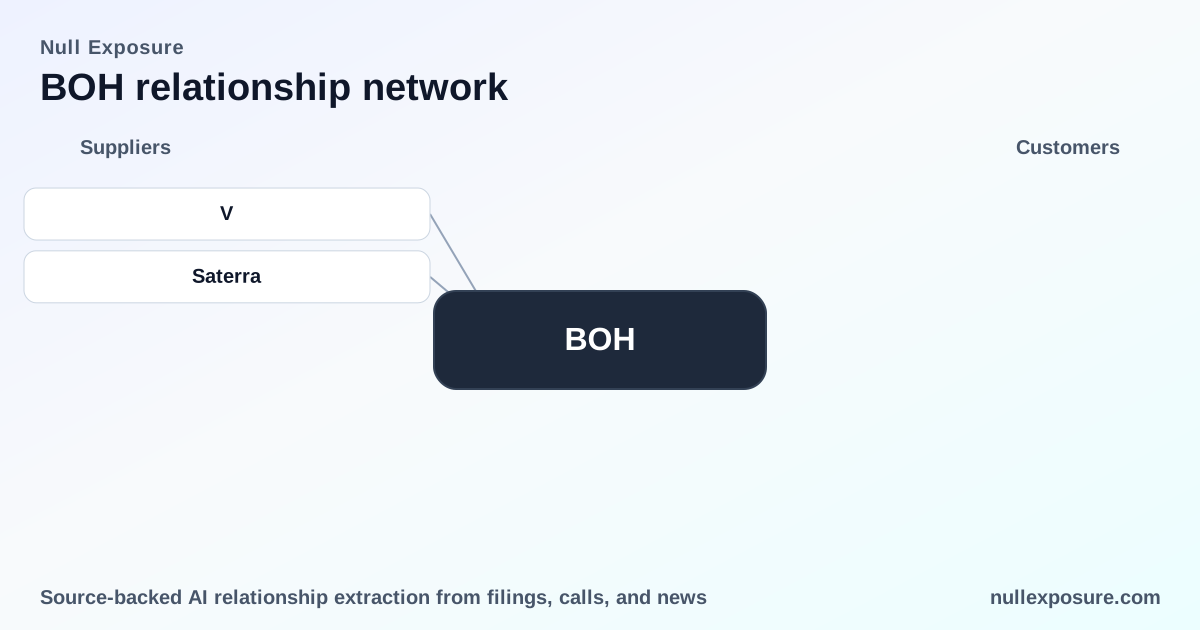
Bank of Hawaii (BOH) — supplier relationships that shape earnings and operational resilience
Bank of Hawaii operates as a regional commercial bank that monetizes customer balances and credit flows through net interest margin on loans and deposits, supplemented by non‑interest revenue from payments, brokerage and servicing arrangements. Supplier relationships with payment networks and fintech vendors influence fee income volatility and platform modernization costs; governance relationships such as the external auditor shape control and disclosure quality. For investors, the question is whether these supplier ties are high‑value, concentrated, or replaceable — and how they influence earnings stability and operational risk.
Explore more on partner risk and supplier mapping at https://nullexposure.com/.
How these supplier links actually move the P&L
Bank of Hawaii shows a classic regional bank operating posture: core earning power comes from lending and deposit spreads while third‑party partners drive non‑interest fee lines and platform upgrades. The relationships captured in public filings and call transcripts point to two distinct drivers:
- Payment network interactions (Visa) translate into discrete accounting impacts — conversion adjustments and one‑time charges can materialize as modest line‑item swings in non‑interest income.
- Platform modernization partners (Saterra) feed strategic initiatives to reach higher‑margin mass‑affluent customers, implying capital and implementation spend over multiple quarters.
Company‑level constraints provide further context: Bank of Hawaii maintains secured borrowing facilities with federal entities and has a stable external audit relationship, signaling access to liquidity and mature governance controls (see constraints discussion below). If you are modeling BOH, assume non‑interest income events are lumpy but controlled, and treat payments‑related accounting items as recurring but small swings rather than core earnings drivers. For a deeper look at counterparties and supplier impact, visit https://nullexposure.com/.
Relationship snapshots investors need to know
Visa — FY2026 (earnings call disclosure)
Bank of Hawaii recorded a $770,000 charge tied to a Visa B conversion ratio change in the FY2026 quarter, a discrete accounting impact that reduced non‑interest income for the period. This is a modest but explicit example of how payment‑network contractual adjustments flow to the income statement. (Source: FY2026 earnings call transcript published March 9, 2026 — https://news.alphastreet.com/bank-of-hawaii-corporation-boh-q4-2025-earnings-call-transcript/)
Visa — FY2025 (earnings call disclosure)
In FY2025 the bank similarly disclosed a $780,000 charge related to a Visa B conversion ratio change, alongside a roughly $800,000 one‑time BOLI recovery gain; again, Visa contractual mechanics produced a small, visible swing in non‑interest income. These recurring, low‑single‑digit‑million effects indicate the payments relationship influences reported non‑interest items but is not a material earnings driver by size. (Source: FY2025 earnings call transcript — https://www.insidermonkey.com/blog/bank-of-hawaii-corporation-nyseboh-q3-2025-earnings-call-transcript-1635242/)
Saterra — FY2025 (platform modernization)
Bank of Hawaii disclosed a partnership with Saterra to modernize its broker‑dealer platform for the mass‑affluent segment, signaling an active investment in digital wealth/ brokerage capabilities to access higher‑margin customer segments. This is a strategic vendor relationship tied to customer‑facing platform upgrades rather than an immediate revenue stream. (Source: FY2025 earnings call transcript — https://www.insidermonkey.com/blog/bank-of-hawaii-corporation-nyseboh-q3-2025-earnings-call-transcript-1635242/)
Operational constraints and governance signals that matter
Two constraint signals in filings provide clarity on BOH’s operating posture:
- Government counterparties — company‑level liquidity and collateral posture. As of December 31, 2024, Bank of Hawaii had pledged loans and securities to the Federal Reserve Discount Window and maintained borrowing capacity with the Federal Home Loan Bank (FHLB), with remaining capacities of $7.4 billion and $1.7 billion respectively. This is a strong liquidity backstop signal and supports a conservative balance‑sheet posture when modeling stress scenarios. (Evidence from public filing excerpts covering 2024 disclosures.)
- Service provider — external audit continuity. The proxy filing explicitly calls out the re‑appointment of Ernst & Young LLP as the company’s independent registered public accounting firm for the 2025 fiscal year, reflecting continuity in external assurance and established governance controls over financial reporting. This reduces accounting‑related execution risk for investors reviewing supplier governance. (Evidence: Proxy Statement disclosure incorporated by reference.)
Together, these constraints imply low supplier concentration for core control functions and institutional maturity: liquidity relationships with policy counterparties reduce systemic funding risk, and a stable auditor relationship supports reliable disclosures.
For a mapped, investor‑ready view of these relationships and their financial implications, see https://nullexposure.com/.
Investment implications — where to focus in due diligence
- Revenue sensitivity: Payment‑network contractual adjustments produce small but noticeable swings in non‑interest income; model them as recurring low‑magnitude items rather than core drivers.
- Strategic spend: Platform modernization with vendors like Saterra suggests capex and operating expense pressure in the near term with potential for longer‑term fee and client growth in wealth segments.
- Liquidity resilience: Pledged collateral and access to the Fed and FHLB provide a buffer against funding shocks, enabling management to operate from a position of funding optionality.
- Governance stability: Continued engagement with a Big Four auditor is a positive signal for disclosure quality and control maturity.
Key risks to monitor: contracting terms with payments networks for conversion events (timing and accounting treatment), execution risk on Saterra‑led platform initiatives, and the trend in non‑interest income margins as fee mixes evolve.
Bottom line and next steps
Bank of Hawaii’s supplier footprint is functional and strategic: payment networks produce small accounting items that affect quarterly non‑interest income while platform vendors support strategic client acquisition and product modernization. Liquidity relationships with government backstops and steady external audit coverage reduce macro operational risk and support predictable disclosure quality. For investors evaluating BOH, the core questions are around execution of platform modernization and continued diversification of fee income.
If you want a concise supplier exposure brief or a partner impact scenario modeled for BOH, start here: https://nullexposure.com/. For customized exposure mapping and counterparty risk scoring for your portfolio, request a detailed review at https://nullexposure.com/.