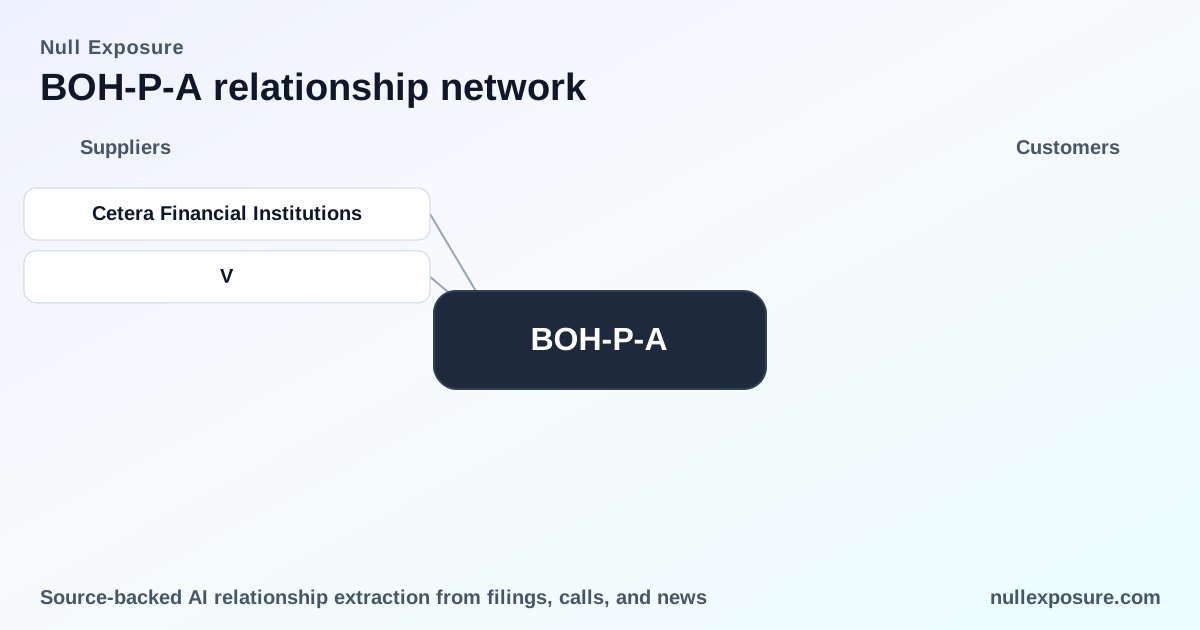
BOH-P-A supplier intelligence: what Cetera and Visa tell investors about distribution and payments exposure
Bank of Hawaii monetizes through traditional deposit and lending spreads, card and payments fees, and a growing wealth‑management channel operated through Bankoh Investment Services, Inc. (BISI); supplier relationships with broker‑dealer networks and card networks are therefore direct drivers of fee income, customer distribution, and operational cost. The two supplier links documented here — a national broker‑dealer networking agreement and a discrete Visa accounting adjustment — illuminate how distribution partnerships and payments economics feed into BOH’s revenue mix and short‑term earnings variability. Explore more supplier intelligence at https://nullexposure.com/.
Why these supplier links matter for investors
Bank of Hawaii’s supplier relationships are not peripheral. Distribution partners such as broker‑dealers convert retail deposits and advisory clients into fee income, while card networks determine interchange economics and require ongoing operational compliance. The Cetera agreement strengthens a channel for advisory and insurance distribution through BISI, increasing noninterest income potential and client retention. The Visa note is an accounting reflection of payment‑network mechanics that can compress quarterly earnings unexpectedly.
Company‑level signals from disclosures shape the operating model profile:
- No supplier constraints are explicitly disclosed in the public relationship payload, which is itself a company‑level signal that there are no known material supplier lockups or disclosed exclusivity terms affecting BOH’s negotiating posture.
- That absence of constraints implies a standard contracting posture: commercially negotiated, service‑level driven, and subject to periodic renewal rather than permanent vendor entrenchment.
- For investors this points to moderate supplier concentration risk (partners are large industry platforms) but not a fragile single‑vendor dependency based on current public records.
Cetera Financial Institutions — expanding wealth distribution for BISI
Bank of Hawaii entered a networking agreement with Cetera Financial Institutions to provide broker‑dealer services for Bankoh Investment Services, Inc. This arrangement places Cetera as the broker‑dealer of record for BISI, enabling BOH to offer advisory and insurance products to local customers through an established national platform. According to a PR Newswire release in FY2025, the agreement is explicitly framed to “elevate investment services” and formalize the supplier role Cetera will play in custody, brokerage, and compliance support.
Commercial takeaways:
- Distribution lift: Outsourcing broker‑dealer functions to Cetera accelerates product availability and compliance scale for BISI without BOH building those capabilities in house.
- Revenue levers: Income will come from advisory and transactional fees routed through the network and from insurance placement margins, improving noninterest income diversification.
- Source: PR Newswire news release, March 2026 (Cetera and Bank of Hawaii networking agreement).
Visa — a discrete conversion‑ratio charge and what it signals about payments economics
An earnings call transcript for FY2026 records a $770,000 charge related to a Visa conversion‑ratio change; the company noted a similar Visa charge in the prior linked quarter. The disclosure, published in a Q4 2025/early‑2026 transcript, is an accounting item tied directly to card‑network mechanics rather than a core credit or fraud loss.
Why this matters:
- Earnings sensitivity: Even modest card‑network adjustments can create visible quarterly volatility in reported noninterest income or operating expenses.
- Payments dependence: BOH’s card portfolio and associated interchange dynamics are material enough that network policy shifts produce discrete line‑item effects on earnings.
- Source: Q4 2025 / FY2026 earnings call transcript reported by InsiderMonkey, March 2026.
What investors should watch next (a practical checklist)
- Monitor further filings and press releases for expansion or revision of the Cetera agreement: extensions, fee splits, or added product shelf will directly influence BISI growth projections.
- Track quarterly card revenue and other payments disclosures for repeated Visa‑related adjustments; recurring charges could indicate structural changes in interchange or conversion methodologies.
- Evaluate the bank’s noninterest income cadence: growth driven by BISI distribution should show higher fee income and lower reliance on one‑time items.
- Review regulatory filings for any post‑deal compliance or supervision notes tied to third‑party broker‑dealer arrangements.
- Assess integration risk and client retention metrics from wealth channels to quantify revenue realization speed.
Commercial constraints and operating model characteristics
The public supplier disclosures include no explicit contractual constraints. Presenting that absence as a company‑level signal yields these operating model characteristics:
- Contracting posture: BOH uses third‑party platforms (like Cetera) to extend capabilities rather than vertically integrate services, indicating a partnership‑and‑outsourcing posture that conserves capital and speeds market access.
- Concentration and criticality: Partners are large industry incumbents; while not exclusive bottlenecks disclosed publicly, they are critical service providers whose policy changes (e.g., network conversion rules from Visa) materially affect revenues.
- Maturity: The use of established suppliers suggests a mature approach to third‑party relationships — proven platforms rather than experimental vendors — which supports predictable scaling of advisory and payments functions.
How to use this intelligence in investment decisions
- Recalibrate revenue models to assign measurable growth to BISI fee lines if Cetera’s networking agreement expands assets under administration or advisory flows.
- Treat Visa adjustments as a recurring volatility factor until a trend is established; build scenario analyses that stress card income around network policy changes.
- Include qualitative due diligence on execution risk: integration of broker‑dealer services, adviser retention, and cross‑sell conversion rates will determine how supplier relationships convert into durable earnings.
- For deeper supplier monitoring and to track future relationship updates, visit https://nullexposure.com/.
Bottom line: supplier links are strategic, not incidental
The Cetera agreement strengthens Bank of Hawaii’s distribution channel and elevates the strategic value of BISI as a fee engine. The Visa conversion charge is a reminder that payments‑network mechanics can cause earnings noise even when underlying consumer behavior is stable. Together, these supplier items demonstrate that BOH’s path to diversified revenue depends on the successful orchestration of external platforms and effective management of card economics.
For continuous monitoring of supplier exposures and to integrate these signals into investment models, go to https://nullexposure.com/. For tailored supplier risk reports and alerts on BOH-P-A relationships, visit https://nullexposure.com/ and subscribe for updates.